Address: 5/7 Dvinskaya St., St. Petersburg, 198035, Russia
Navigation, Marine Engineering, Port Logistics
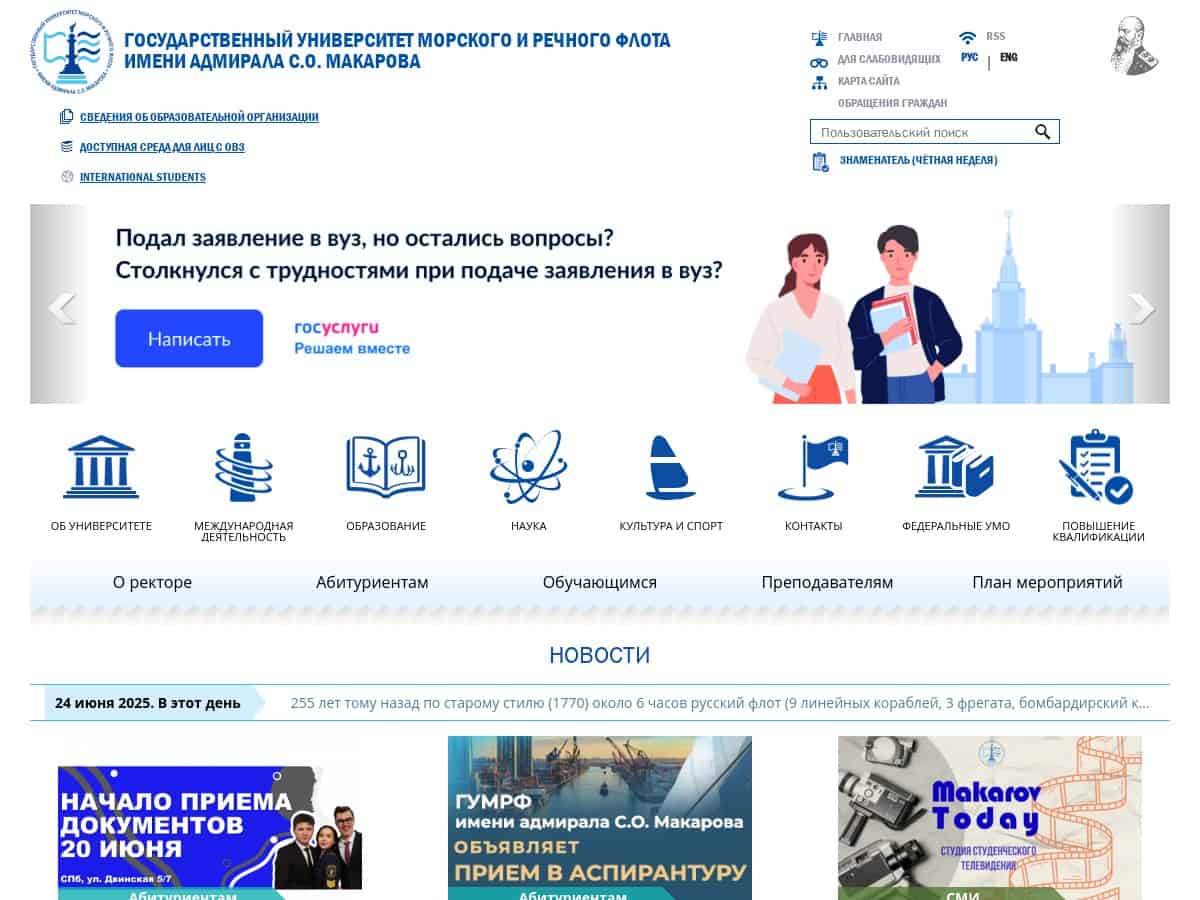
Admiral Makarov State University of Maritime and Inland Shipping in St. Petersburg is a federal state-funded university whose name covers both sea and river transport. It traces its roots to 1809, when Tsar Alexander I created an institution for water and land communications, and in its present form it dates from a merger approved by an order of the Russian Ministry of Transport on 11 September 2012. That order joined the Admiral Makarov State Maritime Academy with the Saint Petersburg State University of Water Communications.
The maritime strand carries the name of Admiral Stepan Makarov, which the sea-going school received in 1949. The merged university kept that name and added inland shipping to its title.
The main campus is on Dvinskaya Street in St. Petersburg. The university also runs branches outside the city, among them Voronezh, Kotlas, Murmansk and Veliky Ustyug. Foreign applicants should consult the English pages of the university for the current admission procedure.
Emperor Alexander I St. Petersburg State Transport University in St. Petersburg teaches railway engineering, transport construction and bridge engineering in the same city.
Saint Petersburg Mining University in St. Petersburg is a technical school of mining, geology and oil and gas engineering.
Far Eastern Federal University in Primorsky Krai pairs oceanology with engineering and oriental studies, giving a sea-facing profile.
Russian University of Transport in Moscow focuses on railway engineering, transport construction and logistics.
Universität Rostock in Germany offers maritime systems and ocean technology.
École Centrale de Nantes in France combines marine engineering and hydrodynamics with mechanical engineering.
Memorial University of Newfoundland in Canada works on marine and ocean technology and earth sciences.
Nagasaki University in Japan covers fisheries science and marine engineering.
*our own picks (our criteria: a mix between domains, diploma delivered, reputation and size), but obviously too many criteria for an apple-to-apple ranking.
FAQ
How was the Makarov university created?
It was formed on 11 September 2012 by an order of the Russian Ministry of Transport that joined the Admiral Makarov State Maritime Academy with the Saint Petersburg State University of Water Communications. The new body took the name that it holds today.
Whose name does the university carry?
It is named after Admiral Stepan Makarov. The name was given to the maritime school in 1949 and passed to the merged university.
Where are the campuses of this maritime university?
The main campus is on Dvinskaya Street in St. Petersburg. Branches operate in other Russian regions, including Voronezh, Kotlas, Murmansk and Veliky Ustyug.
How far back does its history go?
The university traces its roots to 1809 and a manifesto of Alexander I that reorganised the administration of water and land communications. The present university was formed in 2012.
What does the university teach?
Its fields of study include marine engineering, nautical science, naval architecture, hydraulic engineering, transport economics and management.
Can foreign citizens apply?
The university maintains English pages for foreign applicants, and the current admission conditions should be checked there.
Environmental Engineering, Environmental Impact, Logistics, Marine Ecosystems, Marine Life Impact, Research and Development, Safety, Transportation
*: without any judgment of the quality, readers are strongly encouraged to check the official status of the exact diploma envisioned as many universities have a mix of recognized diplomas, not recognized, “co-delivered,” “equivalent to”, “some pathways” (…), can change over time, and can be named differently from one country to another.
**: international reputation: is based on some criteria that do not mean much in some domains or specialties (number of researchers, of scientific publications, on budget ….). Our approximate 1-4 scale:
known locally
known locally and internationally
is listed in some of the world university’s classifications
is listed among the 20 firsts in some of world university’s classifications
***: estimated numbers, based on online sources and/or feedbacks. The numbers can vary greatly depending on school organisation (ex.: school is part of a group, it employs internal staff or external consultants or has public staff without employing them …). Refer to all the links provided to have accurate and updated numbers.
Innovation.world is not affiliated with this school/university. We recommend to contact them directly on their website for any special request.
To complete or correct any information here or share your opinion, please comment below or > send us a direct message <.