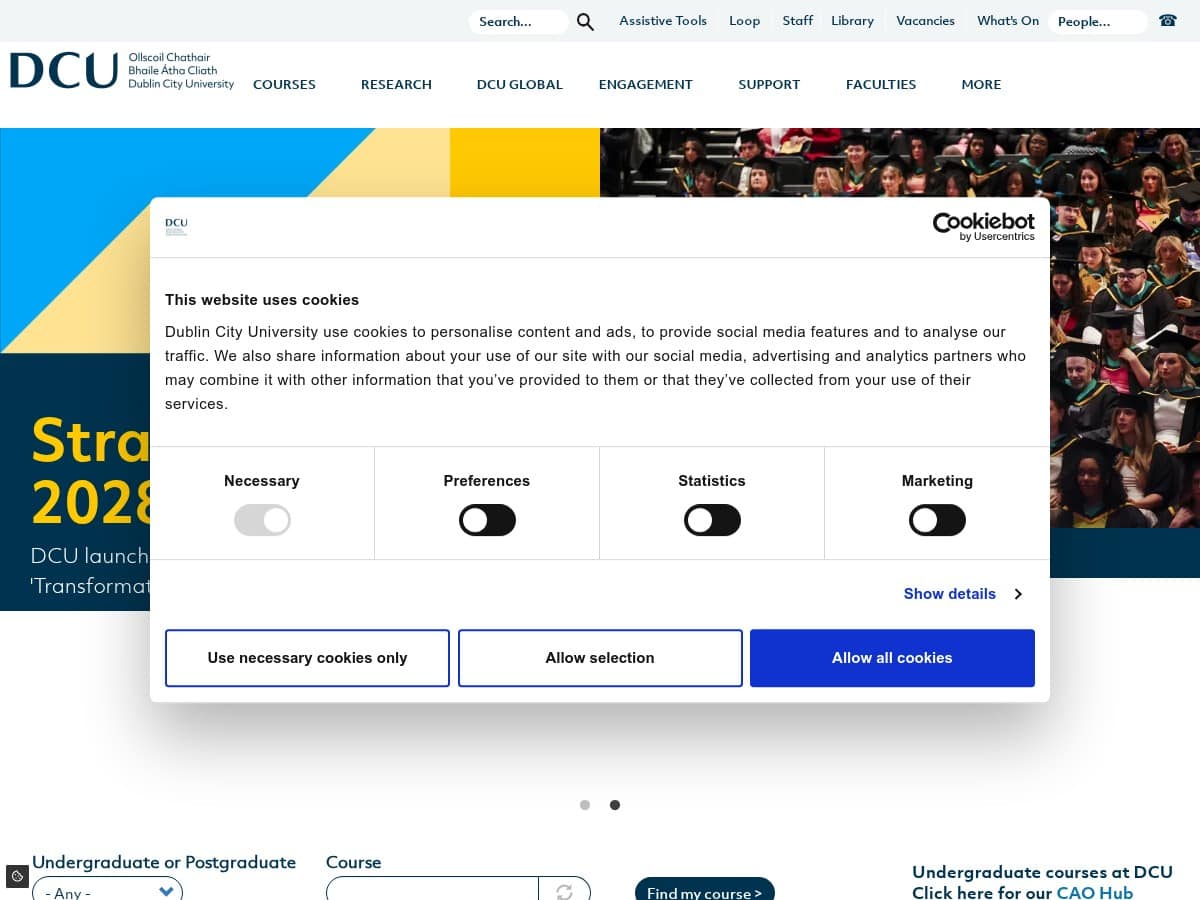
Established in 1980, DCU is a young, dynamic university known for its focus on innovation, enterprise, and close links with industry. It has a reputation for being Ireland’s ‘University of Enterprise’.
Dublin City University, DCU, is a university in the north of Dublin, founded in 1980 as the National Institute for Higher Education and granted university status in 1989. It has about 17,500 students and 1,500 staff, and roughly 20 percent of the students come from abroad. The main campus lies at Glasnevin, about five kilometres from the city centre, and in 2016 it merged with St Patrick’s College Drumcondra, the Mater Dei Institute and the Church of Ireland College of Education.
DCU describes itself as the university of enterprise and innovation, and it has built close links with industry from its early years. It was one of the first universities in Ireland to offer degrees in computing, journalism, communications and biotechnology as core subjects. Business students take part in a placement scheme called INTRA that places them in companies for several months, and the Ryan Academy helps new businesses to start.
The university is organised in five faculties, covering science and health, engineering and computing, humanities and social sciences, the business school and the institute of education, which is now the largest centre for teacher training in the country. Research focuses on computing and artificial intelligence, with the Insight Centre for Data Analytics, on water science, biomedical diagnostics and on media and communications.
Irish and other EU undergraduates generally pay no tuition under the Free Fees Initiative but pay a yearly student contribution, while students from outside the EU pay tuition that varies by programme. Check the current tariffs. Irish applicants use the CAO system, and international students and postgraduates have their own application routes.
Teaching is in English, and DCU offers some programmes through Irish. The campuses at Glasnevin and Drumcondra are served by city buses, and the airport is only a short drive away. Rents in Dublin are high, so students often look for on-campus residences early.
Domains taught:
AI and Machine Learning, Bioengineering, Chemistry, Data Analytics, Engineering, Software Engineering, Telecommunications
Diplomas*:
Bachelor, Doctor, Master
Status:
Public
Partnerships:
DCU has very strong ties with industry, with an integrated work placement (INTRA) programme that is a mandatory part of many degree courses. It has partnerships with major tech and financial companies.
Research:
DCU has a strong research focus in areas such as information technology, biotechnology, and plasma physics. It is home to several national research centres.
Famous Alumnis:
Laura Whitmore, John Connolly
International recognition**:
Number of staff***:
1500
Current students***:
17500
Foreign students***:
20%
Cumulative former students***:
80000
Pros
Strong focus on employability with excellent industry links and a mandatory internship program. A modern, innovative university with a strong entrepreneurial spirit.
Cons
The campus is located in a suburb of Dublin, not in the city centre. As a younger university, it lacks the history and prestige of older institutions.
Best For
Students who are career-focused and want an innovative education with practical work experience and strong ties to industry.
Think of Trinity College Dublin when chemistry, software engineering and engineering is the priority: it also offers mba programmes and covers nanotechnologies and physics as well.
Anyone who wants a second school in the same country with a similar spread of data analytics, software engineering and engineering can consider Technological University Dublin, and it is larger, enrolling about 29,700 students against roughly 17,500 here, and is also a public institution.
Think of University College Dublin when bioengineering, data analytics and engineering is the priority: it is larger, enrolling about 38,000 students against roughly 17,500 here, and is also a public institution.
For students who like the bioengineering, data analytics and software engineering focus of this institution but want another option nearby, University of Galway fits well: it is also a public institution, and teaches at the same levels, namely bachelor's, master's and doctoral.
University of Limerick follows much the same lines as this university, with software engineering as common ground, and it is also a public institution, and runs the same bachelor's, master's and doctoral programmes.
Most Similar Schools Abroad
Technion - Israel Institute of Technology brings a Israel setting to the same core fields, chemistry, data analytics and engineering, and it teaches at the same levels, namely bachelor's, master's and doctoral, and covers aerospace and physics as well.
Chinese University of Hong Kong, in Hong Kong, takes a similar route through chemistry, data analytics and engineering; it is also a public institution and also offers mba programmes.
Abroad, King Khalid University (Saudi Arabia) covers chemistry, data analytics and software engineering in a comparable way, and it is far larger, with about 61,708 students against roughly 17,500 here, and is also a public institution.
If this university is on your list for chemistry, data analytics and software engineering, Guangzhou University in China deserves a comparison, because it is larger, enrolling about 34,000 students against roughly 17,500 here, and is also a public institution.
For chemistry, data analytics and AI and machine learning outside the home country, Hong Kong University of Science and Technology in Hong Kong is a natural reference; it is slightly larger, at about 20,475 students against roughly 17,500 here, and is also a public institution.
*our own picks (our criteria: a mix between domains, diploma delivered, reputation and size), but obviously too many criteria for an apple-to-apple ranking.
FAQ
Where is DCU?
At Glasnevin in north Dublin, Ireland, about five kilometres from the city centre.
When was it founded?
In 1980 as the National Institute for Higher Education, and it received university status in 1989.
How large is it?
About 17,500 students and 1,500 staff.
What changed in 2016?
DCU merged with St Patrick's College Drumcondra, the Mater Dei Institute and the Church of Ireland College of Education.
What is DCU best known for?
Computing, communications, journalism, business, teacher education and biotechnology.
What is INTRA?
A placement scheme that places students in companies for several months.
What is the Ryan Academy?
A DCU initiative that helps new businesses to start.
Does DCU charge tuition?
Irish and other EU undergraduates generally pay no tuition under the Free Fees Initiative but pay a student contribution. Students from outside the EU pay tuition that varies by programme. Check the current tariff.
How do you apply?
Irish undergraduates apply through the CAO system. International students and postgraduates have separate routes.
What is the language of teaching?
English, with some programmes through Irish.
Engineering, Information Technology (IT), Innovation, Research and Development
*: without any judgment of the quality, readers are strongly encouraged to check the official status of the exact diploma envisioned as many universities have a mix of recognized diplomas, not recognized, “co-delivered,” “equivalent to”, “some pathways” (…), can change over time, and can be named differently from one country to another.
**: international reputation: is based on some criteria that do not mean much in some domains or specialties (number of researchers, of scientific publications, on budget ….). Our approximate 1-4 scale:
known locally
known locally and internationally
is listed in some of the world university’s classifications
is listed among the 20 firsts in some of world university’s classifications
***: estimated numbers, based on online sources and/or feedbacks. The numbers can vary greatly depending on school organisation (ex.: school is part of a group, it employs internal staff or external consultants or has public staff without employing them …). Refer to all the links provided to have accurate and updated numbers.
Innovation.world is not affiliated with this school/university. We recommend to contact them directly on their website for any special request.
To complete or correct any information here or share your opinion, please comment below or > send us a direct message <.