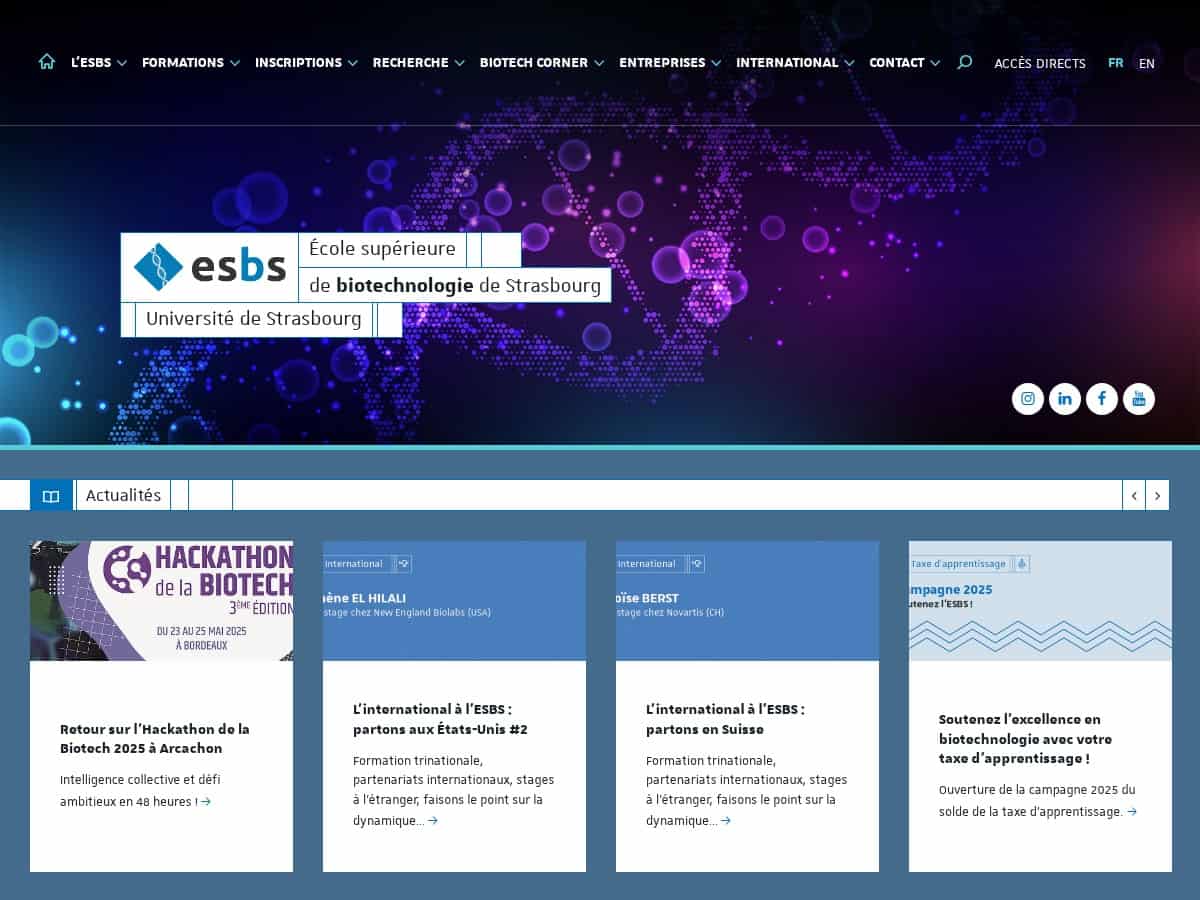
Biotechnology engineers are trained in the Strasbourg area at the École supérieure de biotechnologie de Strasbourg, a school of the Université de Strasbourg. Its website names Pierre Chambon among the co-founders. The engineering diploma is a three-year course at master’s level taught in an international setting, with teaching shared between Strasbourg, Basel and Freiburg.
The partners are the University of Freiburg in Germany and the University of Basel in Switzerland. The curriculum is multilingual: French, German and English are all used, and first-year students follow intensive English and German courses. Graduates receive the French Diplôme d’ingénieur en biotechnologies and can combine it with a master’s degree in biology with a biotechnology specialisation.
The same three universities run a trinational Master of Science in Biotechnology. Most of its teaching takes place at the school, instruction is generally in English, and laboratory courses are held in blocks in Freiburg and Basel. Biotechnology applies biological systems and processes to fields such as health, food and industry, which is why programmes of this kind combine biology, chemistry and engineering.
Domains taught:
AI and Machine Learning, Bioengineering, Bioinformatics, Chemistry, Data Analytics, Ecology and Sustainability, Engineering, Fluid Dynamics, Food Science, Life Sciences, Manufacturing, Materials, Mathematics, Mechanical Engineering, Microbiology and Genetics, Nanotechnologies, Optics, Physics, Process Control, Project Management, Quality, Robotics, Signal Processing, Software Engineering, Statistics, Structural Engineering, Thermodynamics
Diplomas*:
Doctor, Master
Status:
Public
Partnerships:
Part of Université de Strasbourg. Trinational program with universities of Basel (CH), Freiburg (DE), and Offenburg (DE). Partnerships with biotech and pharma companies.
Research:
Molecular and cellular biology, Genetic engineering and synthetic biology, Bioprocess engineering and fermentation, Pharmaceutical development and drug discovery, Bioinformatics.
Famous Alumnis:
N/A
International recognition**:
Number of staff***:
80
Current students***:
300
Foreign students***:
60%
Cumulative former students***:
Pros
Unique trinational curriculum leading to multiple degrees, strong focus on biotechnology and pharmaceutical applications, international student body.
Cons
Specialized in biotechnology.
Best For
International engineering school specializing in biotechnology with a trinational curriculum.
Oniris in Nantes combines bioengineering and process engineering with food science and food safety.
Chimie ParisTech - PSL in Paris offers chemical engineering and molecular chemistry, a chemistry-centred route to biotechnology jobs.
École Supérieure de Chimie Physique Électronique de Lyon in Villeurbanne trains chemists and electronics specialists, which complements a broader biology education.
Université Claude Bernard Lyon 1 in Villeurbanne gathers life and health sciences with chemistry and materials science in one university.
VetAgro Sup in Marcy-l'Étoile teaches agronomic engineering and food science, a neighbouring application area.
Most Similar Schools Abroad
In Germany, Albert-Ludwigs-Universität Freiburg, a partner of the engineering programme, lists life sciences and bioengineering among its specialties in Freiburg im Breisgau.
*our own picks (our criteria: a mix between domains, diploma delivered, reputation and size), but obviously too many criteria for an apple-to-apple ranking.
FAQ
Which university does the school belong to?
It is part of the Université de Strasbourg, as shown on its website, and teaching is concentrated in Strasbourg.
How long is the engineering course?
The engineering diploma takes three years and leads to a master's-level degree, the Diplôme d'ingénieur en biotechnologies.
Which languages are used in class?
The programme is multilingual, with French, German and English all in use.
Which foreign universities cooperate with the school?
The University of Freiburg in Germany and the University of Basel in Switzerland are the partners of the engineering programme, and part of the teaching is shared with them.
Where is the school located?
It stands in Illkirch, in the Strasbourg metropolitan area.
Who founded the school?
Pierre Chambon is named as a co-founder on the school's website.
Bioengineering, Bioinformatics, Environmental Impact, Research and Development, Sustainable Development
*: without any judgment of the quality, readers are strongly encouraged to check the official status of the exact diploma envisioned as many universities have a mix of recognized diplomas, not recognized, “co-delivered,” “equivalent to”, “some pathways” (…), can change over time, and can be named differently from one country to another.
**: international reputation: is based on some criteria that do not mean much in some domains or specialties (number of researchers, of scientific publications, on budget ….). Our approximate 1-4 scale:
known locally
known locally and internationally
is listed in some of the world university’s classifications
is listed among the 20 firsts in some of world university’s classifications
***: estimated numbers, based on online sources and/or feedbacks. The numbers can vary greatly depending on school organisation (ex.: school is part of a group, it employs internal staff or external consultants or has public staff without employing them …). Refer to all the links provided to have accurate and updated numbers.
Innovation.world is not affiliated with this school/university. We recommend to contact them directly on their website for any special request.
To complete or correct any information here or share your opinion, please comment below or > send us a direct message <.