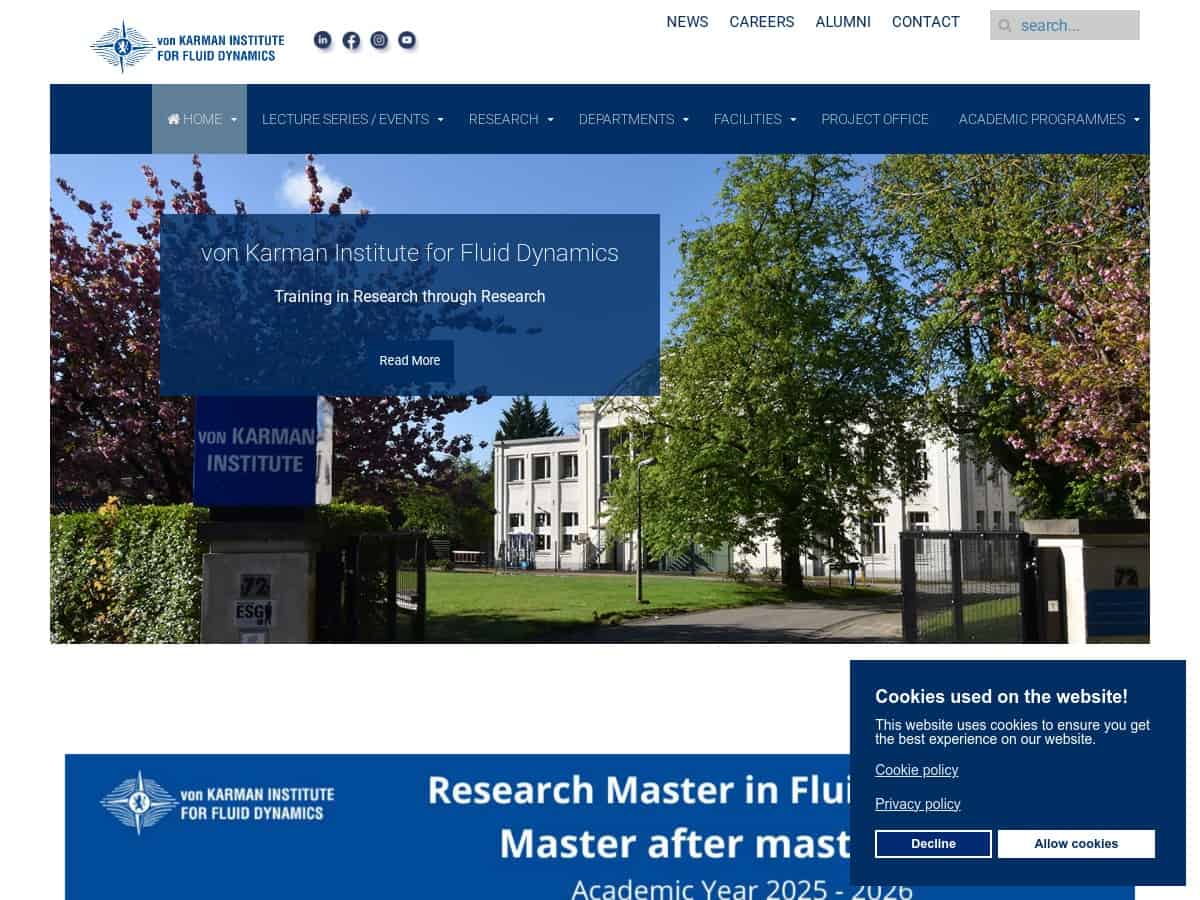
VKI is a non-profit international educational and scientific organization, hosting advanced research and postgraduate programs in fluid dynamics. It was founded in 1956.
The Von Karman Institute for Fluid Dynamics, VKI, is a small international school and research centre in Sint-Genesius-Rode, south of Brussels. About 80 students share a staff of roughly 100, and around 70 percent of the students come from outside Belgium. It is a non-profit organisation, not a university in the usual sense, and it teaches almost entirely at postgraduate level.
The institute was created in 1956 on the initiative of the Hungarian-American aerodynamicist Theodore von Kármán, with NATO as a founding partner, to train engineers from allied countries in aerodynamics and propulsion. Courses today include a one-year diploma course, a research master in fluid dynamics and doctoral training, all taught in English. Around 2,500 people have attended its programmes, many of whom now lead teams at aerospace companies and research laboratories.
The research programme covers aerodynamics, turbomachinery, aerospace propulsion, and environmental and industrial fluid dynamics. Its experimental facilities include supersonic and hypersonic wind tunnels and the Plasmatron, a plasma wind tunnel used to test thermal protection materials for atmospheric re-entry. Work is carried out with the European Space Agency, the aerospace industry and universities worldwide, and the institute is known for its lecture series, which bring in experts from across the field.
Applicants usually hold an engineering or physics degree and are selected on academic record and motivation. Funding is partly through scholarships from member countries and industry, and tuition fees apply to many programmes, so candidates should contact the institute directly about current terms. Because places are few, the cohort is small and students work directly with researchers on live experiments.
The campus is a green site in Rhode-Saint-Genèse, a few kilometres from Waterloo and about 20 kilometres from central Brussels. Housing is arranged in the surrounding area, and the international mix gives the school the feel of a small research laboratory with students from five continents.
Think of Katholieke Universiteit Leuven when aerospace, fluid dynamics and thermodynamics is the priority: it is far larger, with about 62,000 students against roughly 80 here, and also offers bachelor's and graduate diploma programmes.
Université catholique de Louvain follows much the same lines as this school, with fluid dynamics, thermodynamics and physics as common ground, and it also offers bachelor's programmes and covers food science and bioinformatics as well.
Among national alternatives, Hogere Zeevaartschool Antwerpen stands out for its focus on fluid dynamics, thermodynamics and mechanical engineering, and it covers marine science and telecommunications as well, and is far larger, with about 400 students against roughly 80 here.
Université de Liège sits close to this institution on aerospace, fluid dynamics and thermodynamics; it covers food science and bioinformatics as well, and is far larger, with about 26,000 students against roughly 80 here.
Université libre de Bruxelles takes a similar route through fluid dynamics, thermodynamics and physics, and it is far larger, with about 34,000 students against roughly 80 here, and also offers bachelor's programmes.
Most Similar Schools Abroad
Balseiro Institute in Argentina shares the physics, mechanical engineering and engineering orientation of this institution, and it is larger, enrolling about 150 students against roughly 80 here, and also offers bachelor's programmes.
IHE Delft Institute for Water Education in the Netherlands pursues a similar profile in fluid dynamics and engineering, and it is larger, enrolling about 200 students against roughly 80 here, and also offers certificate programmes.
National Technical University Kharkiv Polytechnic Institute in Ukraine is the nearest foreign match on thermodynamics, mechanical engineering and engineering; it also offers bachelor's programmes and covers chemical engineering and electrical and electronics as well.
Seen from abroad, Moscow Aviation Institute (Russia) is a close relative on subject matter, since aerospace, mechanical engineering and engineering are central to both, and it covers robotics and automation as well, and is far larger, with about 20,000 students against roughly 80 here.
Observatoire de la Côte d'Azur, based in France, is built around aerospace, fluid dynamics and thermodynamics much like this school, and it is slightly larger, at about 100 students against roughly 80 here, and does not run the graduate certificate programmes found here.
*our own picks (our criteria: a mix between domains, diploma delivered, reputation and size), but obviously too many criteria for an apple-to-apple ranking.
FAQ
Where is the Von Karman Institute?
It is in Sint-Genesius-Rode, a municipality south of Brussels, at Waterloosesteenweg 72.
What is VKI?
It is a non-profit international educational and research organisation for fluid dynamics, founded in 1956 on the initiative of Theodore von Kármán.
Is VKI a university?
Not in the usual sense. It is a postgraduate school and research centre that awards diplomas and runs doctoral training with partner universities.
What programmes does it offer?
A one-year diploma course, a research master in fluid dynamics, doctoral training and specialised lecture series.
What language is used for teaching?
English.
How many students attend?
About 80 students are enrolled, and roughly 70 percent come from outside Belgium.
What is the Plasmatron?
It is a plasma wind tunnel at VKI used to test thermal protection materials for atmospheric re-entry of spacecraft.
Who are VKI's main partners?
NATO as founding partner, the European Space Agency, the aerospace industry and universities around the world.
Which research areas does VKI cover?
Aerodynamics, turbomachinery, aerospace propulsion and environmental and industrial fluid dynamics.
How do you apply?
Applicants normally hold an engineering or physics degree and apply directly to the institute, which publishes deadlines and funding options each year.
*: without any judgment of the quality, readers are strongly encouraged to check the official status of the exact diploma envisioned as many universities have a mix of recognized diplomas, not recognized, “co-delivered,” “equivalent to”, “some pathways” (…), can change over time, and can be named differently from one country to another.
**: international reputation: is based on some criteria that do not mean much in some domains or specialties (number of researchers, of scientific publications, on budget ….). Our approximate 1-4 scale:
known locally
known locally and internationally
is listed in some of the world university’s classifications
is listed among the 20 firsts in some of world university’s classifications
***: estimated numbers, based on online sources and/or feedbacks. The numbers can vary greatly depending on school organisation (ex.: school is part of a group, it employs internal staff or external consultants or has public staff without employing them …). Refer to all the links provided to have accurate and updated numbers.
Innovation.world is not affiliated with this school/university. We recommend to contact them directly on their website for any special request.
To complete or correct any information here or share your opinion, please comment below or > send us a direct message <.