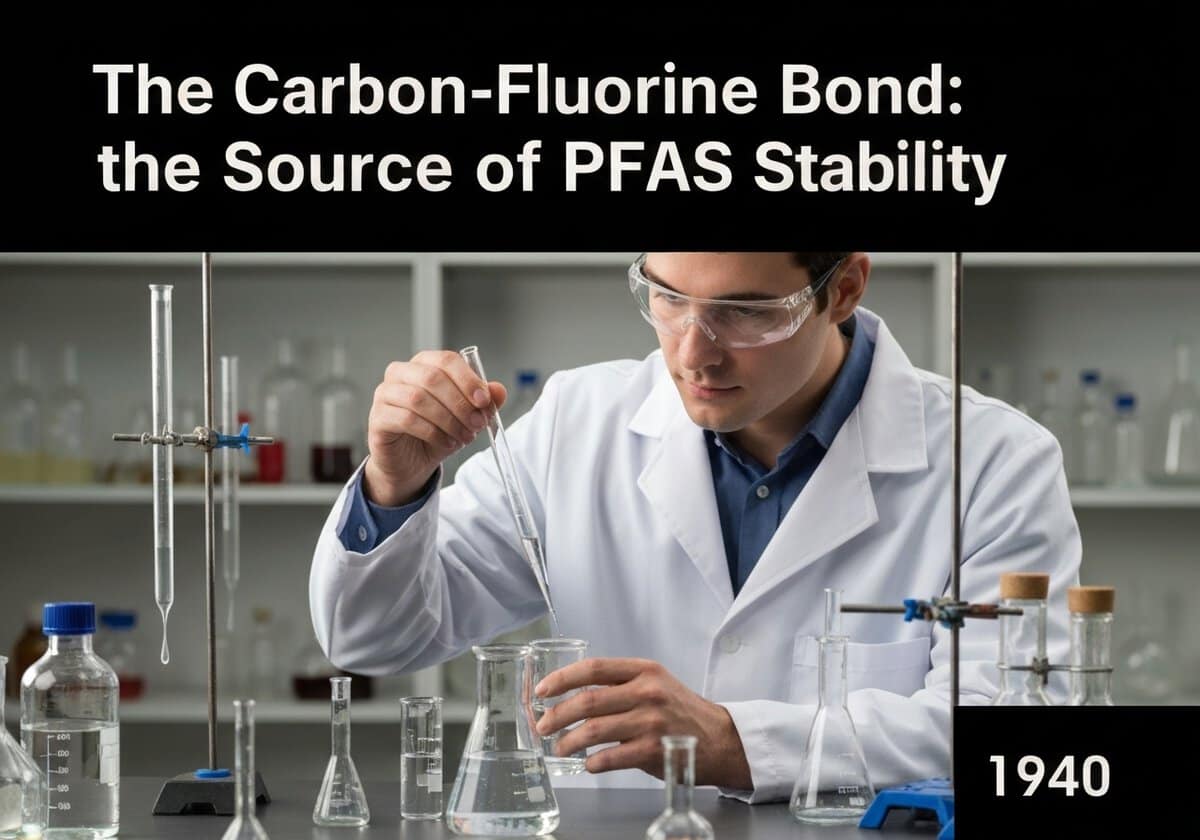
과불화알킬 물질 및 폴리플루오로알킬 물질PFASPFAS(과불소화합물)는 탄소 원자들이 불소 원자와 결합된 사슬 구조를 특징으로 합니다. 탄소-불소(CF) 결합은 유기화학에서 가장 강한 단일 결합 중 하나로, 결합 해리 에너지는 약 485 kJ/mol에 달합니다. 이러한 극도의 강도로 인해 PFAS는 화학적, 열적, 생물학적 분해에 매우 강하여 환경에 오랫동안 잔류합니다.

(설명을 위한 생성된 이미지입니다)
과불화알킬 물질 및 폴리플루오로알킬 물질PFASPFAS(과불소화합물)는 탄소 원자들이 불소 원자와 결합된 사슬 구조를 특징으로 합니다. 탄소-불소(CF) 결합은 유기화학에서 가장 강한 단일 결합 중 하나로, 결합 해리 에너지는 약 485 kJ/mol에 달합니다. 이러한 극도의 강도로 인해 PFAS는 화학적, 열적, 생물학적 분해에 매우 강하여 환경에 오랫동안 잔류합니다.
The exceptional stability of per- and polyfluoroalkyl substances (PFAS) is fundamentally rooted in the properties of the carbon-fluorine (C-F) bond. Fluorine is the most electronegative element, creating a highly polarized bond with carbon. This results in a short bond length (around 1.35 Å) and a very high bond dissociation energy, making it extremely difficult to break. In perfluoroalkyl substances, where all non-terminal carbons are fully saturated with fluorine atoms, this effect is amplified. The fluorine atoms create a helical sheath around the carbon backbone, sterically protecting it from chemical attack. This ‘fluorine shield’ also repels both water (hydrophobicity) and oils (oleophobicity), a rare combination that makes PFAS effective surfactants. The cumulative inductive effect of multiple fluorine atoms also strengthens adjacent C-C bonds within the chain, further contributing to the molecule’s overall inertness. This chemical robustness is why PFAS are dubbed “forever chemicals”; they do not readily break down under natural environmental conditions, leading to their widespread accumulation.
탄소-불소 결합: PFAS 안정성의 원천
(날짜를 알 수 없거나 관련이 없는 경우, 예를 들어 "유체역학"의 경우, 주목할 만한 등장 시기를 대략적으로 추정하여 제공합니다.)

고화질 이미지 및 다운로드는 등록된 회원에게만 100% 무료로 제공됩니다.
> 로그인 <