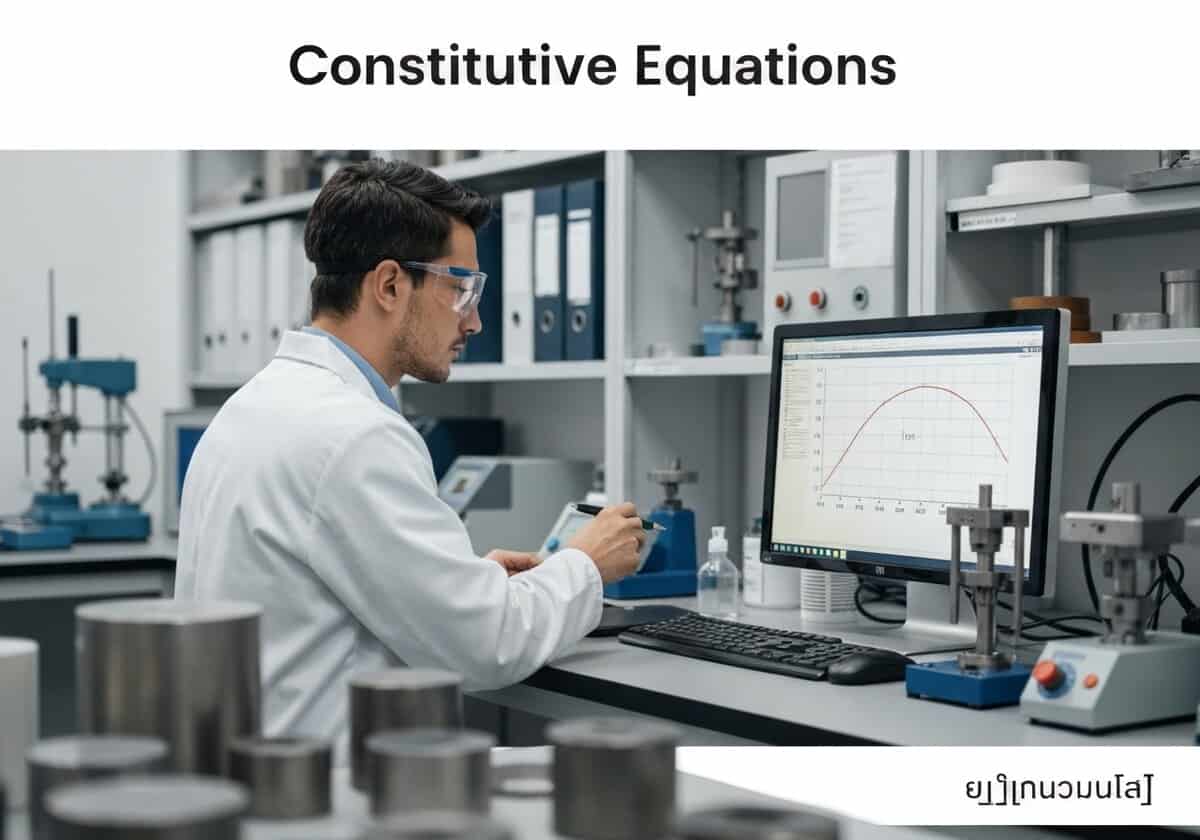
구성 방정식
A constitutive equation, or constitutive relation, is a mathematical relationship that describes how a specific material responds to external stimuli. In continuum mechanics, it connects kinematic quantities like strain to kinetic quantities like stress. For example, Hooke’s Law, [latex]\boldsymbol{\sigma} = \mathbf{C} : \boldsymbol{\varepsilon}[/latex], is a constitutive equation for linear elastic solids, relating the stress tensor [latex]\boldsymbol{\sigma}[/latex] to the strain tensor [latex]\boldsymbol{\varepsilon}[/latex].
연속체 역학의 기본 법칙 때문에 구성 방정식은 필수적입니다.질량 보존탄성, 운동량, 에너지와 같은 물리 법칙은 보편적이며 모든 물질에 적용됩니다. 그러나 동일한 하중 조건에서도 물질마다 거동은 다릅니다. 강철 빔, 수주, 고무 조각은 모두 가해지는 힘에 대해 고유한 반응을 보입니다. 구성 방정식은 지배 방정식 시스템을 완성하고 주어진 문제에 대한 고유한 해를 얻기 위해 필요한 물질별 정보를 제공합니다. 구성 방정식은 실험적으로 결정되며 물질의 거동에 대한 수학적 모델을 나타냅니다.
The complexity of constitutive equations varies greatly. The simplest models are for linear, isotropic materials. For a linear elastic solid, Hooke’s Law relates stress and strain linearly via a fourth-order stiffness tensor [latex]\mathbf{C}[/latex]. For a Newtonian fluid, the stress is linearly related to the rate of strain. However, many real-world materials exhibit much more complex behavior. Non-linear elasticity is needed for materials like rubber that undergo large deformations. Plasticity models describe permanent deformation after a yield stress is exceeded. Viscoelastic models, used for 고분자, exhibit both fluid-like and solid-like characteristics, with their response depending on the rate of loading. Developing accurate constitutive models for advanced materials like 복합재료, biological tissues, or granular materials is a major and ongoing area of research in mechanics.
UNESCO Nomenclature: 2210
역학
전구체
- 로버트 훅의 용수철 실험("ut tensio, sic vis")
- 아이작 뉴턴의 개념 점도 유체 속에서
- 응력과 변형률의 수학적 개념의 발전
- 재료 특성에 대한 실험적 테스트
응용 프로그램
- 응력-변형률 거동을 기반으로 한 엔지니어링 설계에서의 재료 선택
- 시뮬레이션 비뉴턴 유체 CFD에 케첩이나 혈액과 같은 액체가 들어 있습니다.
- 금속 성형 공정에서 소성 변형 및 영구 변형 모델링
- 지반공학은 하중을 받는 토양과 암석의 거동을 설명하는 학문입니다.
잠재적 혁신 아이디어
- ai systems that automatically derive constitutive models from experimental data or molecular simulations
- 4D 프린팅 materials with programmable, time-dependent constitutive laws
- ‘digital twin’ materials in software that perfectly replicate the constitutive behavior of their real-world counterparts for testing
- biomimetic materials with constitutive properties that mimic natural tissues for better implants
- self-healing materials whose constitutive laws change to strengthen damaged areas
- soft robotics actuators designed by optimizing their non-linear constitutive behavior
- virtual reality environments where objects have physically accurate and complex constitutive models for realistic interaction
- smart fluids whose constitutive relations can be altered in real-time by electric or magnetic fields
관련 개념: 구성 방정식, 재료 모델, 응력-변형률 관계, 훅의 법칙, 뉴턴 유체, 점탄성, 소성, 재료 특성.