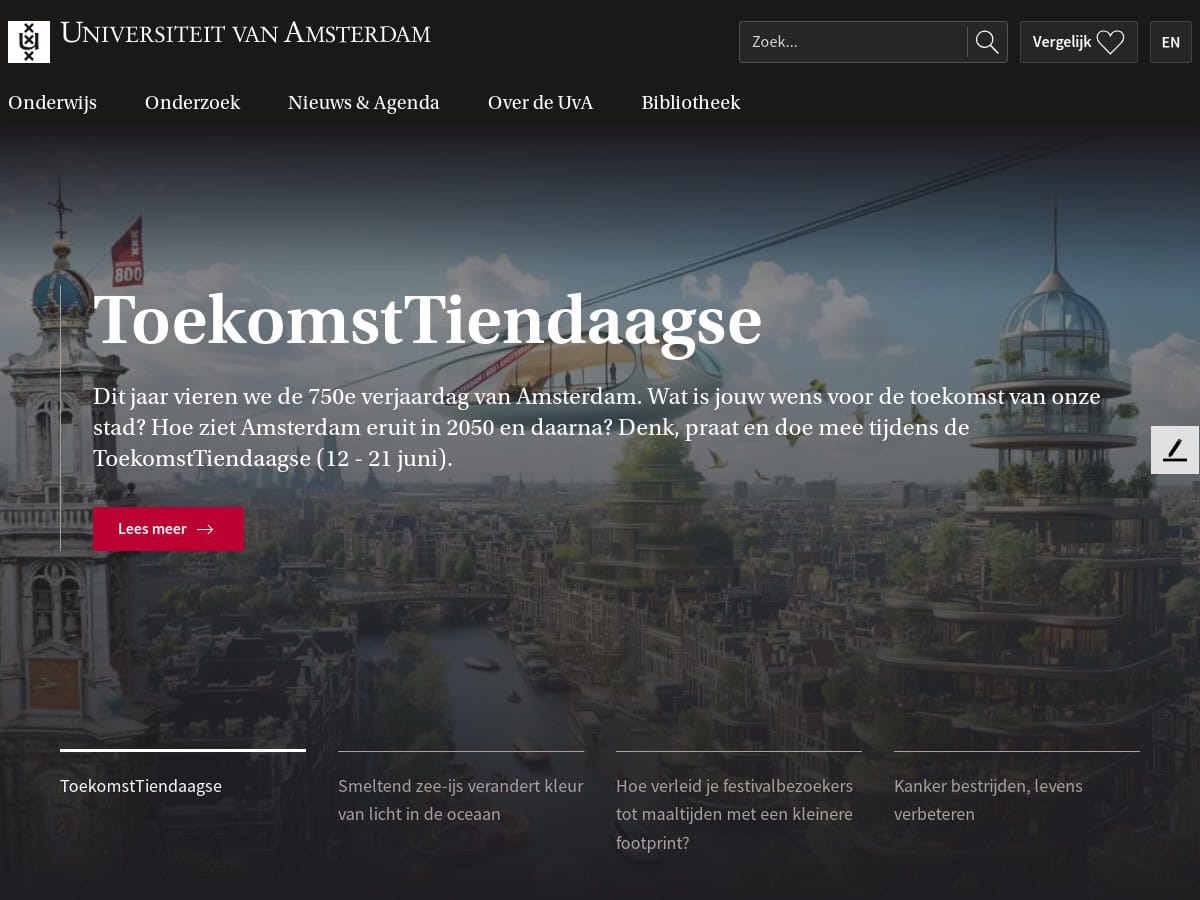
Established in 1632 (as Athenaeum Illustre), UvA is a large, comprehensive research university located in the heart of Amsterdam. It has strong science and informatics programs.
The University of Amsterdam, UvA, traces its history to 1632, when the Athenaeum Illustre was founded to teach the sons of the city’s merchants. It became a full university in 1877. It now has about 42,000 students and 6,000 staff, and around one student in five comes from abroad. The historic core lies in the old centre, around the Spui and the Oudemanhuispoort, with newer campuses at Roeterseiland, Science Park and the medical centre at the Amsterdam UMC.
It is one of the largest Dutch research universities, with a wide range of programmes. The faculties cover humanities, social and behavioural sciences, economics and business, law, sciences, dentistry and medicine. The Amsterdam School of Economics, the law faculty and communication science are well known. The university also has strong departments in physics, informatics, chemistry and astronomy at Science Park, where it shares labs with national institutes such as Nikhef and CWI.
Jacobus van ‘t Hoff, the first winner of the Nobel Prize in Chemistry in 1901, worked as a professor in Amsterdam, and Pieter Zeeman received the 1902 Nobel Prize in Physics for the Zeeman effect while teaching at the university. The Amsterdam libraries, including the special collections in the Allard Pierson Museum, hold major manuscripts, maps and archaeological objects. Spinoza and other thinkers of the Dutch Golden Age belong to the city’s intellectual tradition.
EU students pay the statutory Dutch tuition fee, which is around two and a half thousand euros a year, while students from outside the EU pay a higher institutional fee set by each programme. Check the current tariff. Applications go through Studielink, and popular programmes use selection or a limited number of places. Many bachelor’s programmes are taught in English, and most master’s degrees are in English.
Amsterdam is the most expensive Dutch city for students, and housing is scarce, so students are advised to apply for rooms early. The canals, museums and cycling culture are part of daily life.
Domains taught:
AI and Machine Learning, Astroscience, Bioengineering, Bioinformatics, Chemistry, Computer Vision, Data Analytics, Ecology and Sustainability, Electrical and Electronics, Engineering, Mathematics, Microbiology and Genetics, Nanotechnologies, Physics, Software Engineering, Statistics, Telecommunications
Diplomas*:
Bachelor, Doctor, Master
Status:
Public
Partnerships:
LERU, UNICA, U21. Extensive global partnerships.
Research:
Artificial intelligence, Quantum physics, Brain and cognition, Global health, Sustainable prosperity.
Radboud Universiteit is the closest domestic counterpart for bioinformatics, nanotechnologies and microbiology and genetics; it runs the same bachelor's, master's and doctoral programmes, and is smaller, enrolling about 25,000 students against roughly 42,000 here.
Also strong in bioinformatics, nanotechnologies and microbiology and genetics, Vrije Universiteit Amsterdam makes a sensible second look at home; it is slightly smaller, at about 32,000 students against roughly 42,000 here, and is also a public institution.
Another national school that puts astroscience, bioinformatics and nanotechnologies at the centre is Universiteit Leiden, and it is slightly smaller, at about 34,000 students against roughly 42,000 here, and is also a public institution.
Another national school that puts astroscience, bioinformatics and nanotechnologies at the centre is Universiteit Utrecht, and it covers marine science and geotechnics as well, and has almost the same size, at about 37,000 students.
On content, Technische Universiteit Delft and this university are close, as both teach bioinformatics, nanotechnologies and bioengineering; it covers marine science and aerospace as well, and is smaller, enrolling about 27,500 students against roughly 42,000 here.
Most Similar Schools Abroad
A foreign alternative with a similar emphasis on astroscience, bioinformatics and nanotechnologies is Fudan in China, and it covers optics and materials as well, and is slightly smaller, at about 35,000 students against roughly 42,000 here.
A foreign alternative with a similar emphasis on astroscience, bioinformatics and nanotechnologies is Peking University in China, and it has almost the same size, at about 45,000 students, and is also a public institution.
Abroad, University of Warsaw (Poland) covers astroscience, bioinformatics and nanotechnologies in a comparable way, and it has almost the same size, at about 40,000 students, and is also a public institution.
Universiteit Antwerpen in Belgium is the nearest foreign match on bioinformatics, nanotechnologies and microbiology and genetics; it is also a public institution, and runs the same bachelor's, master's and doctoral programmes.
Abroad, Ludwig-Maximilians-Universität München (Germany) covers astroscience, bioinformatics and nanotechnologies in a comparable way, and it runs the same bachelor's, master's and doctoral programmes, and covers marine science and geotechnics as well.
*our own picks (our criteria: a mix between domains, diploma delivered, reputation and size), but obviously too many criteria for an apple-to-apple ranking.
FAQ
Where is the University of Amsterdam?
The historic centre is at Spui 21 in Amsterdam, Netherlands. Further campuses are at Roeterseiland and Science Park.
When was it founded?
In 1632, as the Athenaeum Illustre. It became a full university in 1877.
How large is it?
About 42,000 students and 6,000 staff.
What does it teach?
Humanities, social sciences, economics and business, law, sciences, dentistry and medicine.
Which Nobel laureates worked at the university?
Jacobus van 't Hoff, first winner of the Nobel Prize in Chemistry, and Pieter Zeeman, who received the 1902 Nobel Prize in Physics.
What is the Allard Pierson Museum?
The university museum, which holds archaeological objects, manuscripts and maps.
What does it cost?
EU students pay the statutory Dutch tuition fee, around two and a half thousand euros a year. Students from outside the EU pay a higher institutional fee. Check the current tariff.
How do you apply?
Through Studielink, and popular programmes use selection or a limited number of places.
In which language are courses taught?
Many bachelor's programmes in English, and most master's degrees in English.
Is Amsterdam expensive?
Yes. It is the most expensive Dutch city for students, and housing is scarce.
*: without any judgment of the quality, readers are strongly encouraged to check the official status of the exact diploma envisioned as many universities have a mix of recognized diplomas, not recognized, “co-delivered,” “equivalent to”, “some pathways” (…), can change over time, and can be named differently from one country to another.
**: international reputation: is based on some criteria that do not mean much in some domains or specialties (number of researchers, of scientific publications, on budget ….). Our approximate 1-4 scale:
known locally
known locally and internationally
is listed in some of the world university’s classifications
is listed among the 20 firsts in some of world university’s classifications
***: estimated numbers, based on online sources and/or feedbacks. The numbers can vary greatly depending on school organisation (ex.: school is part of a group, it employs internal staff or external consultants or has public staff without employing them …). Refer to all the links provided to have accurate and updated numbers.
Innovation.world is not affiliated with this school/university. We recommend to contact them directly on their website for any special request.
To complete or correct any information here or share your opinion, please comment below or > send us a direct message <.