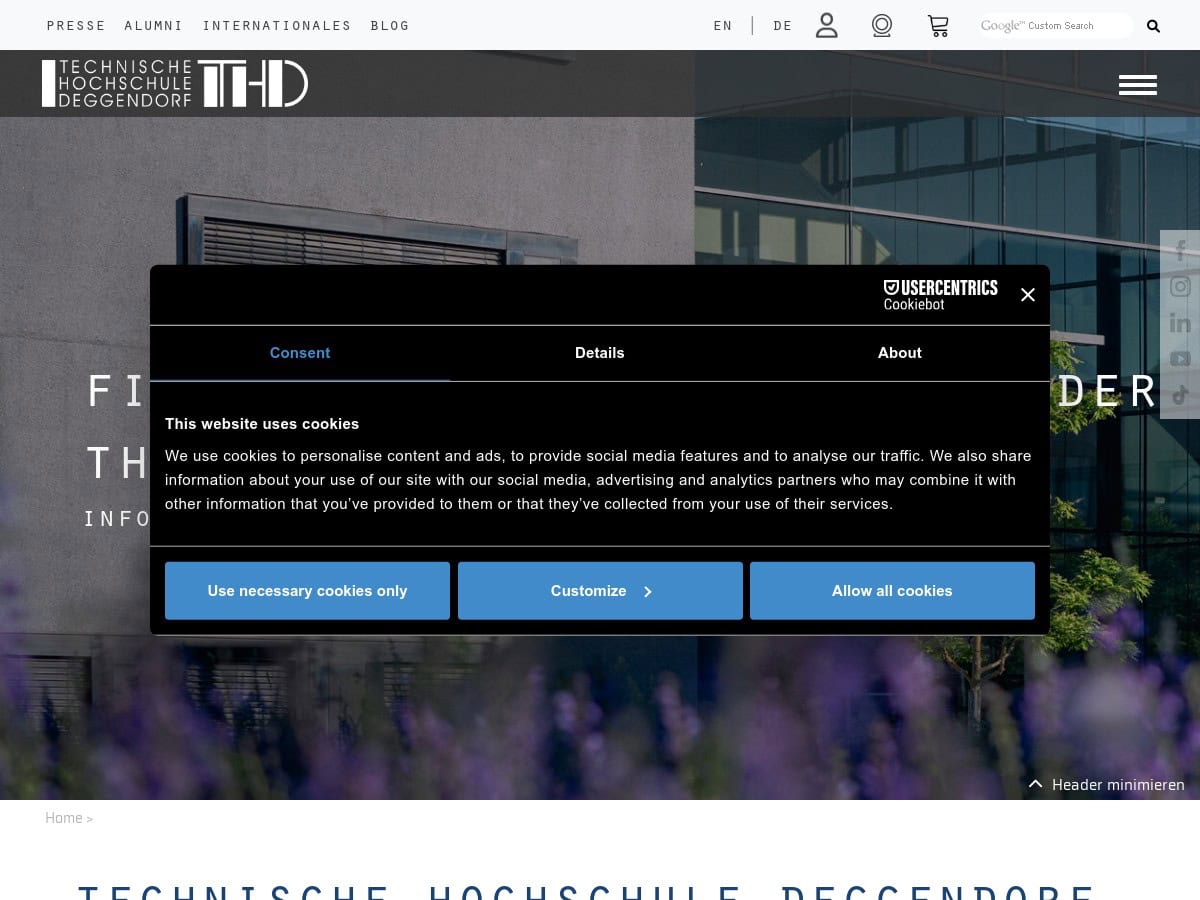
Technische Hochschule Deggendorf, known in English as Deggendorf Institute of Technology, is a university of applied sciences in Lower Bavaria on the Danube. The Bavarian cabinet decided in 1991 to create it, and it started in 1994 as Fachhochschule Deggendorf – Hochschule für Technik und Wirtschaft.
Besides the site in Deggendorf, teaching takes place at the European Campus Rottal-Inn in Pfarrkirchen, at Cham, and at technology campuses such as Teisnach and Freyung. Study fields include mechanical engineering and mechatronics, electrical engineering and media technology, applied healthcare sciences and computer science.
Enrolment grew from about 1,100 students in 1999 to more than 8,000 in 2021/22. Dual study programmes, the doctoral centres NITRO and DigiTech, and partnerships with universities worldwide round out the profile.
Domains taught:
AI and Machine Learning, Automation, Bioengineering, Chemistry, Civil Engineering, Computer Vision, Data Analytics, Ecology and Sustainability, Electrical and Electronics, Engineering, Ergonomics and UX, Fluid Dynamics, Geotechnics, Industrial Design, Life Sciences, Manufacturing, Materials, Mathematics, Mechanical Engineering, Optics, Physics, Process Control, Project Management, Robotics, Signal Processing, Software Engineering, Statistics, Structural Engineering, Telecommunications, Thermodynamics, Transportations
Diplomas*:
Bachelor, Master, MBA
Status:
Public
Partnerships:
Strong focus on applied research, innovation, and internationalization. Multiple international campuses/partnerships.
Research:
AI and robotics, Medical technology and digital health, Sustainable energy and resource management, International business and technology management.
Famous Alumnis:
N/A
International recognition**:
Number of staff***:
400
Current students***:
8000
Foreign students***:
20%
Cumulative former students***:
N/A
Pros
Innovative and entrepreneurial university of applied sciences, strong international programs, good research in specific applied areas.
Cons
Located in Deggendorf (smaller town), focus on applied sciences.
Best For
Innovative university of applied sciences strong in mechatronics, IT, and health/environmental engineering.
Technische Hochschule Ingolstadt, also in Bavaria, lists automotive engineering and mobility systems, mechanical engineering and production technology, and computer science and AI.
Technische Hochschule Nürnberg Georg Simon Ohm is listed with mechanical engineering and mechatronics, electrical engineering and information technology, and computer science and applied mathematics.
Ostbayerische Technische Hochschule Regensburg shares the electrical engineering and information technology focus and adds mechanical engineering and automotive as well as computer science and mathematics.
Ostbayerische Technische Hochschule Amberg-Weiden spans mechanical and environmental engineering, electrical engineering and information technology, and computer science and media informatics.
Technische Hochschule Rosenheim lists manufacturing together with mechanical and electrical engineering.
Most Similar Schools Abroad
Avans Hogeschool in the Netherlands is listed with engineering, ICT and environmental science.
Denmark's Aalborg University covers problem-based learning and engineering.
VIA University College, also in Denmark, lists engineering, construction and design.
In Switzerland, Fachhochschule Nordwestschweiz brings together engineering, life sciences, and architecture and civil engineering.
Thomas More Hogeschool in Belgium is listed with applied informatics, engineering and life sciences.
*our own picks (our criteria: a mix between domains, diploma delivered, reputation and size), but obviously too many criteria for an apple-to-apple ranking.
FAQ
When was Technische Hochschule Deggendorf founded?
The Bavarian cabinet took the decision in 1991, and teaching began in 1994 under the name Fachhochschule Deggendorf – Hochschule für Technik und Wirtschaft.
Where are the campuses of the university?
The university is based in Deggendorf, with further locations including the European Campus Rottal-Inn in Pfarrkirchen, Cham, Teisnach and Freyung.
How large has the student body become?
About 1,100 students were enrolled in 1999, and the figure passed 8,000 in 2021/22.
Which subject areas does the university cover?
They include mechanical engineering and mechatronics, electrical engineering and media technology, applied healthcare sciences and computer science, and its listed specialties include mechatronics and cyber-physical systems, electrical engineering and information technology, and civil and environmental engineering.
What are NITRO and DigiTech?
They are doctoral centres connected with the university's research and promotion of doctoral candidates.
Can studies be combined with practical work?
Dual study programmes are available, allowing study to be paired with employment-based training.
How international is Technische Hochschule Deggendorf?
It runs the English-language European Campus Rottal-Inn in Pfarrkirchen and maintains partner universities around the world.
Artificial Intelligence (AI), Cyber-Physical Systems (CPS), Engineering, Innovation, Medical Devices, Robotics, Sustainable Development
*: without any judgment of the quality, readers are strongly encouraged to check the official status of the exact diploma envisioned as many universities have a mix of recognized diplomas, not recognized, “co-delivered,” “equivalent to”, “some pathways” (…), can change over time, and can be named differently from one country to another.
**: international reputation: is based on some criteria that do not mean much in some domains or specialties (number of researchers, of scientific publications, on budget ….). Our approximate 1-4 scale:
known locally
known locally and internationally
is listed in some of the world university’s classifications
is listed among the 20 firsts in some of world university’s classifications
***: estimated numbers, based on online sources and/or feedbacks. The numbers can vary greatly depending on school organisation (ex.: school is part of a group, it employs internal staff or external consultants or has public staff without employing them …). Refer to all the links provided to have accurate and updated numbers.
Innovation.world is not affiliated with this school/university. We recommend to contact them directly on their website for any special request.
To complete or correct any information here or share your opinion, please comment below or > send us a direct message <.