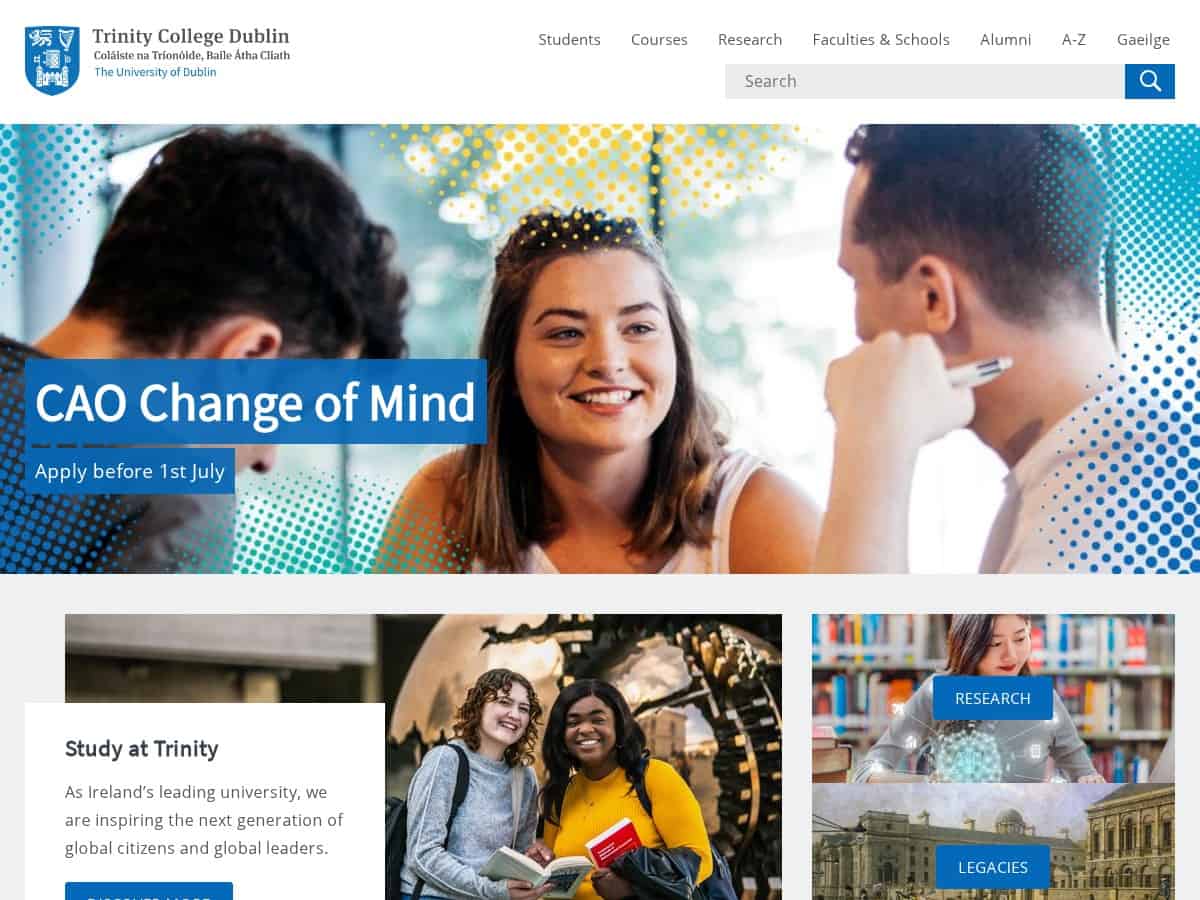
Founded in 1592, Trinity is Ireland’s oldest and highest-ranked university. As one of the seven ancient universities of Britain and Ireland, it has a long tradition of academic excellence and research, located on a historic campus in the heart of Dublin.
Trinity College Dublin, formally the University of Dublin, is the oldest university in Ireland. Queen Elizabeth I granted its charter in 1592, and the college has stood on College Green in the centre of Dublin ever since. It has about 19,750 students and 3,500 staff, and roughly 30 percent of the students come from abroad. The main campus of around 47 acres lies between Grafton Street and the Liffey, with cobbled squares, a cricket pitch and the Campanile in the middle.
The Old Library houses the Book of Kells, an illuminated gospel manuscript of about the year 800, and the Long Room, a barrel-vaulted hall holding some 200,000 of the library’s oldest books. As a legal deposit library, Trinity is entitled to a copy of every book published in Ireland and the United Kingdom, which makes its collection one of the largest in the country. Visitors queue to see the manuscript, but students use the reading rooms throughout the year.
The list of alumni is long and literary. Jonathan Swift, Oscar Wilde, Bram Stoker and Samuel Beckett studied here, and Ernest Walton shared the 1951 Nobel Prize in Physics for splitting the atom with John Cockcroft. Today Trinity is organised in three faculties, covering arts, humanities and social sciences, engineering, mathematics and science, and health sciences. It hosts the nanoscience institute CRANN, the Trinity Biomedical Sciences Institute and the Science Gallery.
Irish and other EU undergraduates generally pay no tuition under the national Free Fees Initiative but pay a yearly student contribution, while students from outside the EU pay tuition that varies by programme and can be considerable. Check the current tariffs. Undergraduate applications from Ireland go through the CAO system, with separate routes for international students and for postgraduates.
Teaching is in English. Dublin is expensive, and accommodation is scarce, so students should apply for college residences as early as possible.
Domains taught:
Chemistry, Engineering, Life Sciences, Mathematics, Nanotechnologies, Physics, Software Engineering
Diplomas*:
Bachelor, Doctor, Master, MBA
Status:
Public
Partnerships:
Trinity is a member of the League of European Research Universities (LERU) and the Coimbra Group. It has global partnerships with leading universities and research institutes, and strong collaborations with industry through its research centres like ADAPT and CRANN.
Research:
Trinity is a world-leading research institution with research strengths in immunology, neurosciences, cancer, telecommunications, and nanoscience. It hosts several large, internationally recognized research centres.
Famous Alumnis:
Oscar Wilde, Samuel Beckett, Ernest Walton, Mary Robinson, William Rowan Hamilton
International recognition**:
Number of staff***:
3500
Current students***:
19750
Foreign students***:
30%
Cumulative former students***:
130000
Pros
Highly prestigious with a global reputation, beautiful historic campus in the city centre, and a strong research focus with excellent facilities.
Cons
The cost of living in Dublin is high, admission is extremely competitive, and the large size can sometimes feel impersonal.
Best For
Students seeking a world-class, research-intensive education at a historic university with a vibrant city life.
Dublin City University offers a comparable education in chemistry, software engineering and engineering: it covers bioengineering and telecommunications as well, and has almost the same size, at about 17,500 students.
University College Cork follows much the same lines as this institution, with chemistry, life sciences and engineering as common ground, and it does not run the mba programmes found here and covers food science and microbiology and genetics as well.
University College Dublin shares the core fields of this institution, namely life sciences and engineering; it covers agriculture and food science as well, and is larger, enrolling about 38,000 students against roughly 19,750 here.
Where this institution leans on life sciences, software engineering and engineering, University of Galway does the same, and it does not run the mba programmes found here and covers marine science and civil engineering as well.
Another national school that puts software engineering and engineering at the centre is Technological University Dublin, and it covers food science and civil engineering as well, and is larger, enrolling about 29,700 students against roughly 19,750 here.
Most Similar Schools Abroad
For a study option in the United Kingdom with a comparable spread of chemistry, physics and mathematics, University of Glasgow is the reference point: it is also a public institution, and teaches at the same levels, namely bachelor's, master's, doctoral and mba.
If this school is on your list for chemistry, physics and mathematics, Henan University in China deserves a comparison, because it is larger, enrolling about 50,000 students against roughly 19,750 here, and is also a public institution.
Soochow University offers an international parallel to this school, with nanotechnologies, chemistry and physics as common ground; it is larger, enrolling about 39,000 students against roughly 19,750 here, and is also a public institution.
Chinese University of Hong Kong in Hong Kong is the nearest foreign match on chemistry, physics and mathematics; it teaches at the same levels, namely bachelor's, master's, doctoral and mba, and covers finance and statistics as well.
Looking internationally, University of Helsinki in Finland is where chemistry, physics and life sciences get a comparable treatment; it is also a public institution and does not run the mba programmes found here.
*our own picks (our criteria: a mix between domains, diploma delivered, reputation and size), but obviously too many criteria for an apple-to-apple ranking.
FAQ
Where is Trinity College Dublin?
On College Green in the centre of Dublin, Ireland.
When was it founded?
In 1592, under a charter granted by Queen Elizabeth I.
How large is it?
About 19,750 students and 3,500 staff, with around 30 percent of students from abroad.
What is the Book of Kells?
An illuminated gospel manuscript of about the year 800, kept in the Old Library.
What is the Long Room?
A barrel-vaulted hall in the Old Library that holds around 200,000 of the library's oldest books.
Who are famous alumni?
Jonathan Swift, Oscar Wilde, Bram Stoker, Samuel Beckett and Ernest Walton.
Which Nobel prize is linked to Trinity?
Ernest Walton shared the 1951 Nobel Prize in Physics for splitting the atom with John Cockcroft.
Does Trinity charge tuition?
Irish and other EU undergraduates generally pay no tuition under the Free Fees Initiative but pay a student contribution. Students from outside the EU pay tuition that varies by programme. Check the current tariff.
How do you apply?
Irish undergraduates apply through the CAO system. International students and postgraduates have separate application routes.
What is the language of teaching?
English.
Artificial Intelligence (AI), Biomedical Sensors, Computer Aided Design (CAD), Engineering, Environmental Impact, Nanotechnologies, Neuroscience Technology, Research and Development
*: without any judgment of the quality, readers are strongly encouraged to check the official status of the exact diploma envisioned as many universities have a mix of recognized diplomas, not recognized, “co-delivered,” “equivalent to”, “some pathways” (…), can change over time, and can be named differently from one country to another.
**: international reputation: is based on some criteria that do not mean much in some domains or specialties (number of researchers, of scientific publications, on budget ….). Our approximate 1-4 scale:
known locally
known locally and internationally
is listed in some of the world university’s classifications
is listed among the 20 firsts in some of world university’s classifications
***: estimated numbers, based on online sources and/or feedbacks. The numbers can vary greatly depending on school organisation (ex.: school is part of a group, it employs internal staff or external consultants or has public staff without employing them …). Refer to all the links provided to have accurate and updated numbers.
Innovation.world is not affiliated with this school/university. We recommend to contact them directly on their website for any special request.
To complete or correct any information here or share your opinion, please comment below or > send us a direct message <.