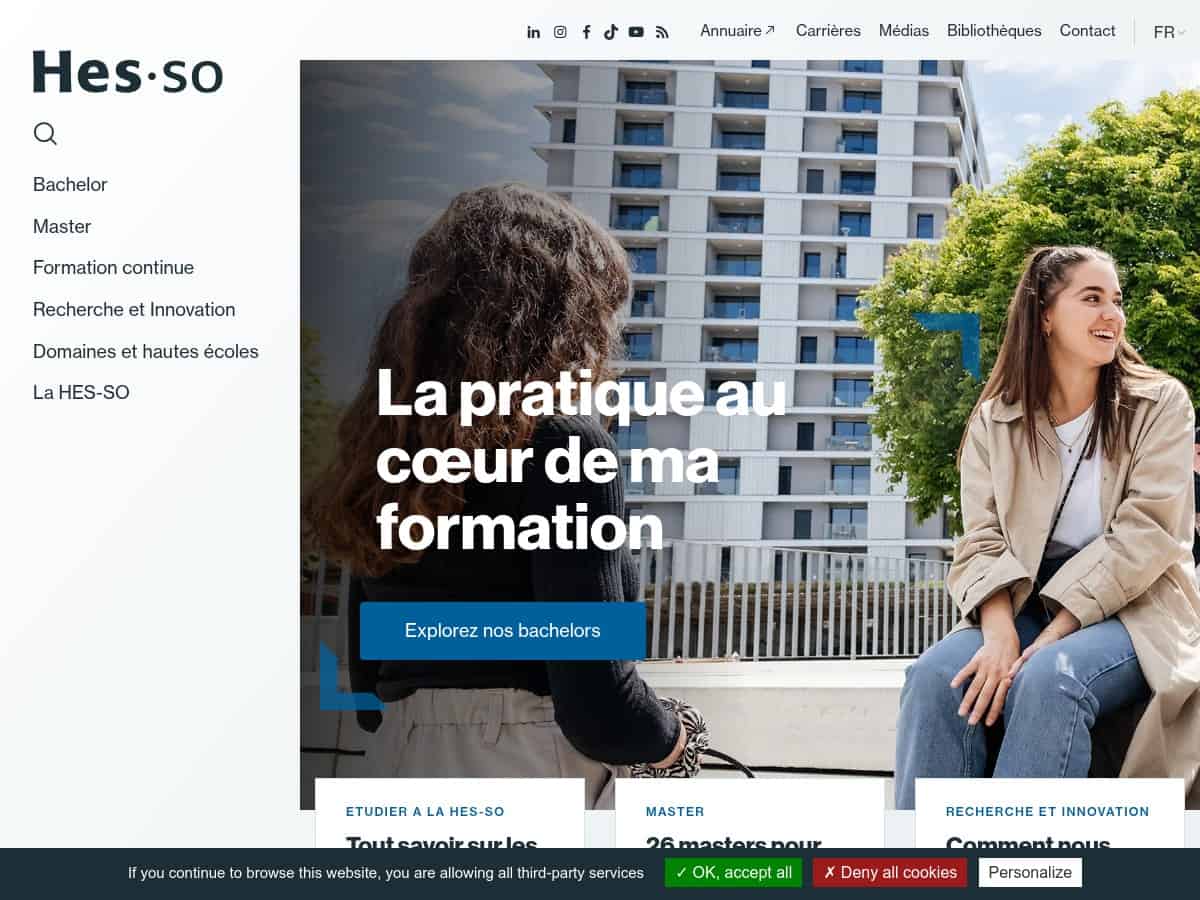
Address: Avenue de Provence 6, 1007 Lausanne, Vaud, Switzerland
Engineering and Architecture
HES-SO, the University of Applied Sciences and Arts Western Switzerland, is a network of schools located in the French-speaking part of the country and in nearby bilingual areas. Its schools are spread over seven cantons: Bern, Fribourg, Geneva, Jura, Neuchâtel, Valais and Vaud. Unlike a single-campus university, it works as a federation in which each member school keeps its own location and subject identity.
The network brings together 28 institutions of higher education and organises their offer in six domains: design and fine arts, business, management and services, engineering and architecture, music and performing arts, health, and social work. Examples of member schools include the engineering and management school of canton Vaud, known as HEIG-VD, and the schools for design, music and health that sit in Geneva, Fribourg, Valais and the Arc region.
Member schools award bachelor’s and master’s degrees and MBA programmes, with a practical orientation. Applicants should consult the official website for the schools, programmes, admission routes and fees that apply to the field they choose.
Domains taught:
Agriculture, AI and Machine Learning, Automation, Bioengineering, Chemistry, Civil Engineering, Computer Vision, Data Analytics, Ecology and Sustainability, Electrical and Electronics, Engineering, Ergonomics, Fluid Dynamics, Food Science, Geotechnics, Industrial Design, Manufacturing, Materials, Mathematics, Mechanical Engineering, Metrology, Nanotechnologies, Optics, Physics, Process Control, Project Management, Quality, Robotics, Signal Processing, Statistics, Structural Engineering, Telecommunications, Thermodynamics
Diplomas*:
Bachelor, Diploma, Master
Status:
Public
Partnerships:
A network of schools with strong regional and international partnerships. Extensive collaboration with industry, public institutions, and research centers for applied R&D and student projects.
Research:
Applied research across a wide spectrum of engineering and architectural disciplines, including sustainable development, industrial technologies, information and communication technologies, health technologies, and design.
Famous Alumnis:
N/A
International recognition**:
Number of staff***:
3000
Current students***:
21000
Foreign students***:
10%
Cumulative former students***:
100000
Pros
Offers a vast range of practice-oriented programs across Western Switzerland, with strong regional integration and a focus on innovation. Bilingual (French, some German/English).
Cons
Highly decentralized structure with many affiliated schools, which can vary in specific focus and offerings.
Best For
Students in French-speaking Switzerland seeking practice-oriented higher education in a wide range of engineering and technical fields.
Berner Fachhochschule is another applied sciences institution, with engineering, information technology and architecture, wood and civil engineering as directory specialties.
Fachhochschule Nordwestschweiz provides practice-oriented teaching in engineering, life sciences, architecture and civil engineering.
Germany's Hochschule für Angewandte Wissenschaften Hamburg teaches mechanical engineering, information and electrical engineering, and life sciences and biotechnology.
Technische Hochschule Köln, also in Germany, covers automotive engineering, computer science, media technology and renewable energy engineering.
In the Netherlands, Fontys Hogescholen is a multi-campus applied institution for engineering, ICT and applied natural sciences.
Belgium's Hogeschool UC Leuven-Limburg offers applied engineering, technology and health sciences.
Haute École Léonard de Vinci in Belgium combines industrial engineering, computer science and health sciences technology.
*our own picks (our criteria: a mix between domains, diploma delivered, reputation and size), but obviously too many criteria for an apple-to-apple ranking.
FAQ
What type of institution is HES-SO?
It is a university of applied sciences, formed by a group of regional schools in Western Switzerland. Teaching is practice-oriented and the network runs bachelor's, master's and MBA programmes.
Which cantons take part in the network?
Seven cantons are involved: Bern, Fribourg, Geneva, Jura, Neuchâtel, Valais and Vaud. Each canton hosts one or more member schools.
How many schools make up HES-SO?
Sources describe a network of 28 higher education institutions. They are grouped into six domains rather than into traditional faculties.
Which fields of study are offered?
The domains are design and fine arts, business, management and services, engineering and architecture, music and performing arts, health, and social work. The directory profile highlights engineering and architecture as a main area.
Where do students actually study?
Classes take place at the individual member schools in the cantons, not at one central campus. The directory gives a Lausanne address for the network as a whole.
How can applicants find admission requirements?
Requirements differ between schools and programmes, so the official HES-SO website and the pages of each member school are the reliable source. They list entry conditions, tuition fees and application deadlines.
*: without any judgment of the quality, readers are strongly encouraged to check the official status of the exact diploma envisioned as many universities have a mix of recognized diplomas, not recognized, “co-delivered,” “equivalent to”, “some pathways” (…), can change over time, and can be named differently from one country to another.
**: international reputation: is based on some criteria that do not mean much in some domains or specialties (number of researchers, of scientific publications, on budget ….). Our approximate 1-4 scale:
known locally
known locally and internationally
is listed in some of the world university’s classifications
is listed among the 20 firsts in some of world university’s classifications
***: estimated numbers, based on online sources and/or feedbacks. The numbers can vary greatly depending on school organisation (ex.: school is part of a group, it employs internal staff or external consultants or has public staff without employing them …). Refer to all the links provided to have accurate and updated numbers.
Innovation.world is not affiliated with this school/university. We recommend to contact them directly on their website for any special request.
To complete or correct any information here or share your opinion, please comment below or > send us a direct message <.