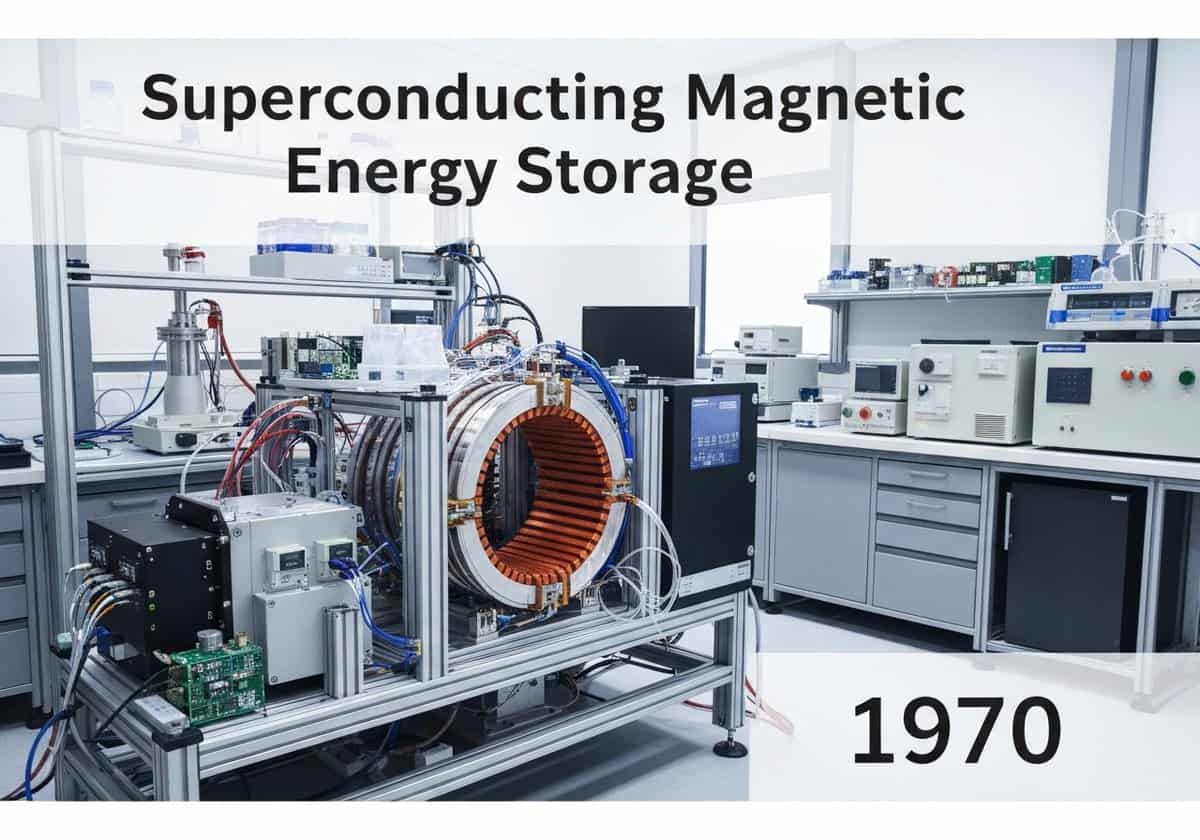
超伝導磁気エネルギー貯蔵(SMES)システムは、超伝導コイルに直流電流を流すことで発生する磁場にエネルギーを蓄積します。コイルが超伝導温度に保たれている限り、電気抵抗によるエネルギー損失がほとんどないため、エネルギーは無期限に蓄積できます。蓄積されるエネルギーは、[latex]E = frac{1}{2} LI^2[/latex]で与えられます。


(画像はイメージです)
超伝導磁気エネルギー貯蔵(SMES)システムは、超伝導コイルに直流電流を流すことで発生する磁場にエネルギーを蓄積します。コイルが超伝導温度に保たれている限り、電気抵抗によるエネルギー損失がほとんどないため、エネルギーは無期限に蓄積できます。蓄積されるエネルギーは、[latex]E = frac{1}{2} LI^2[/latex]で与えられます。

An SMES unit consists of three main parts: a superconducting coil, a power conditioning system (PCS), and a cryogenic refrigerator. The coil is made from a superconducting material (like Niobium-titanium) which, when cooled below its critical temperature, has near-zero electrical resistance. A direct current is charged into the coil, creating a strong magnetic field where energy is stored according to the formula [latex]E = frac{1}{2} L I^2[/latex], where L is the coil’s inductance and I is the current. Because the resistance is negligible, the current can circulate perpetually with minimal loss, making the storage highly efficient. The PCS, typically using solid-state inverters/rectifiers, manages the flow of power, converting AC power from the grid to DC for charging the coil, and converting the stored DC energy back to AC for discharge. The entire coil must be maintained at extremely low temperatures (around 4.2 K for low-temperature superconductors) by a cryocooler, which represents the main continuous energy cost. SMES systems are characterized by extremely high round-trip efficiency (>95%), instantaneous response time (milliseconds), and an unlimited cycle life. However, their energy density is relatively low and the capital costs, primarily for the superconducting wire and cryogenic system, are very high, limiting their use to high-value, short-duration power applications.
ボットによるトラフィック(現在1日あたり4万件以上)を排除するため、このコンテンツはコミュニティメンバー限定となっています。
> ログイン < または > 登録 < (100%無料)でこれにアクセスできます。他のすべての制限付きコンテンツとツールも同様です。
超伝導磁気エネルギー貯蔵(SMES)
(日付が不明または関連性がない場合、例えば「流体力学」などでは、その注目すべき出現時期の概算値が提示されます。)
フルサイズの画像とダウンロードは、登録会員のみが100%無料で利用できます。
> ログイン <