細胞呼吸は、グルコースなどの有機分子が酸化されてエネルギーを放出する一連の酸化還元反応です。グルコース([latex]C_6H_{12}O_6[/latex])は酸化されて[latex]CO_2[/latex]になり、酸素([latex]O_2[/latex])は還元されて水([latex]H_2O[/latex])になります。この過程で電子が電子伝達系を介して移動し、細胞の主要なエネルギー通貨であるATPの合成を促進するプロトン勾配が生成されます。
(画像はイメージです)
細胞呼吸は、グルコースなどの有機分子が酸化されてエネルギーを放出する一連の酸化還元反応です。グルコース([latex]C_6H_{12}O_6[/latex])は酸化されて[latex]CO_2[/latex]になり、酸素([latex]O_2[/latex])は還元されて水([latex]H_2O[/latex])になります。この過程で電子が電子伝達系を介して移動し、細胞の主要なエネルギー通貨であるATPの合成を促進するプロトン勾配が生成されます。
細胞呼吸は、グルコースの制御された多段階酸化反応です。熱として爆発的にエネルギーを放出する直接燃焼とは異なり、細胞は解糖系、クレブス回路(クエン酸回路)、および酸化的リン酸化によってグルコースを徐々に分解します。この一連の反応において、電子はグルコースとその中間体から奪われ、[latex]NAD^+[/latex]や[latex]FAD[/latex]などの電子キャリアに伝達され、[latex]NADH[/latex]や[latex]FADH_2[/latex]に還元されます。
These reduced coenzymes then donate their high-energy electrons to the electron transport chain (ETC), a series of protein complexes in the inner mitochondrial membrane. As electrons are passed down the chain, they move to successively lower energy levels. The final electron acceptor is molecular oxygen, which is highly electronegative and is reduced to form water. The energy released during this electron transfer is used to pump protons ([latex]H^+[/latex]) from the mitochondrial matrix into the intermembrane space, establishing an electrochemical gradient. This proton-motive force is a form of stored energy. The flow of protons back into the matrix through an enzyme called ATP synthase powers the synthesis of large amounts of ATP from ADP and inorganic phosphate, a process called chemiosmosis.
ボットによるトラフィック(現在1日あたり4万件以上)を排除するため、このコンテンツはコミュニティメンバー限定となっています。
> ログイン < または > 登録 < (100%無料)でこれにアクセスできます。他のすべての制限付きコンテンツとツールも同様です。
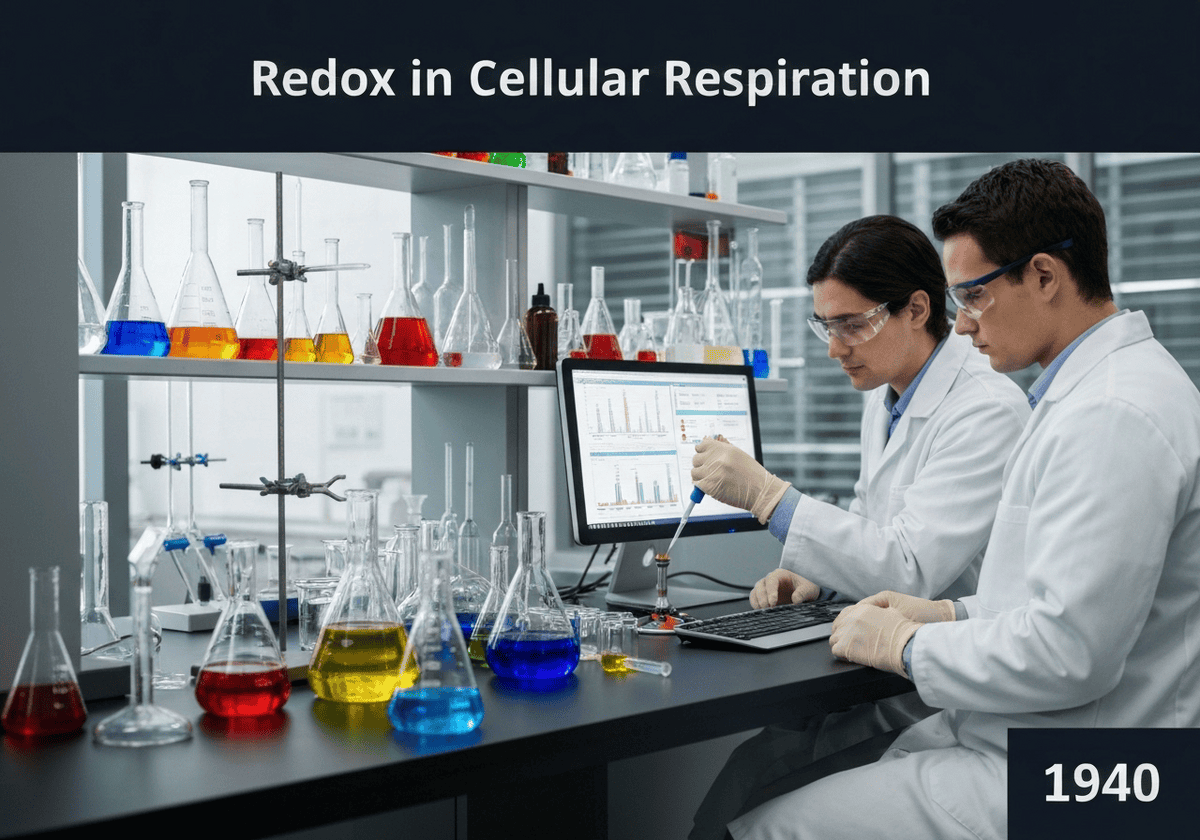
細胞呼吸における酸化還元反応
(日付が不明または関連性がない場合、例えば「流体力学」などでは、その注目すべき出現時期の概算値が提示されます。)
フルサイズの画像とダウンロードは、登録会員のみが100%無料で利用できます。
> ログイン <