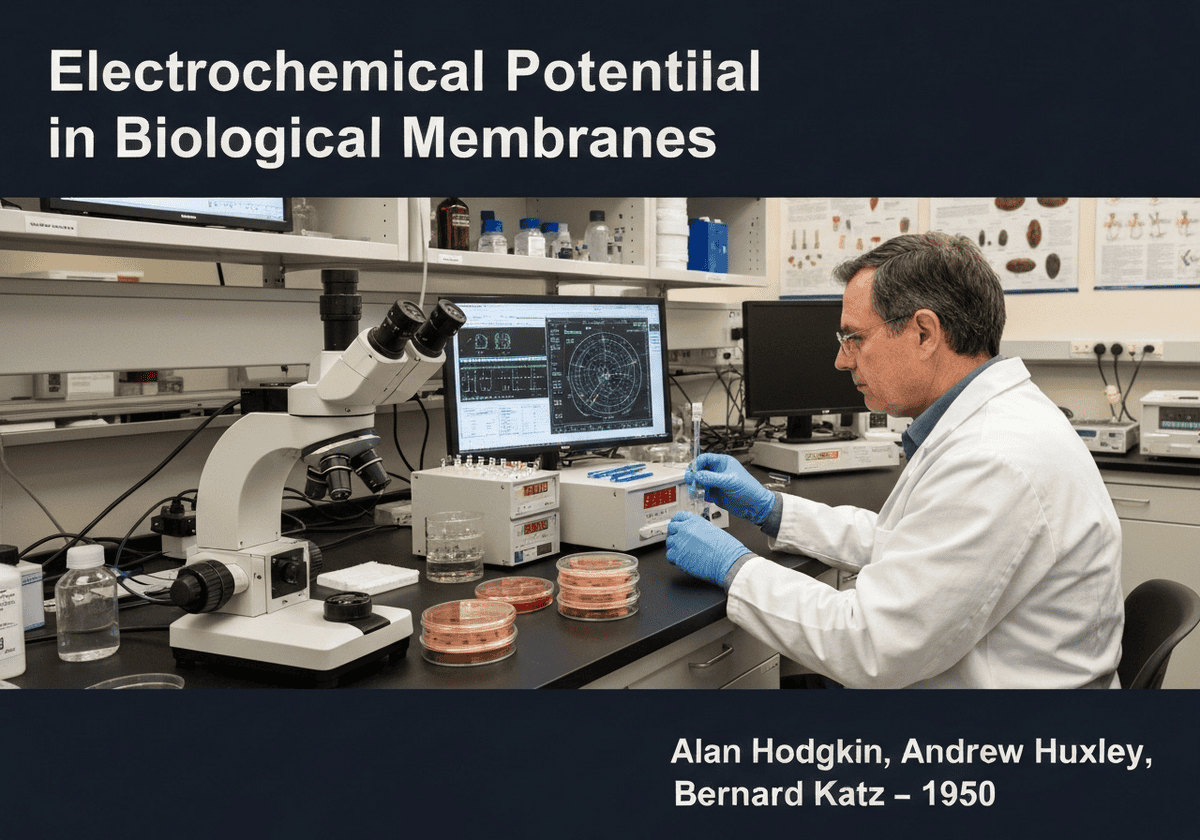
生体膜における電気化学ポテンシャル
1950
- Alan Hodgkin
- Andrew Huxley
- Bernard Katz
Electrochemical potential is fundamental to life, driving processes across cell membranes. Ion pumps actively create concentration gradients, while the selective permeability of ion channels establishes an electrical potential (membrane potential). The resulting electrochemical gradient dictates the passive flow of ions, which is crucial for nerve signaling (action potentials), muscle contraction, and cellular energy production (ATP synthesis) in mitochondria.
The existence of life depends on maintaining a state of disequilibrium across cell membranes, which is quantified by electrochemical potential gradients. The sodium-potassium pump ([latex]Na^+/K^+[/latex]-ATPase), for example, uses the energy from ATP hydrolysis to actively transport [latex]Na^+[/latex] ions out of the cell and [latex]K^+[/latex] ions in. This action establishes steep concentration gradients (a chemical potential difference) and contributes to an electrical potential difference, as more positive charge is pumped out than in.
The cell membrane is studded with ion channels, which are proteins that allow specific ions to pass through. The resting membrane potential is primarily established by ‘leak’ channels that are more permeable to [latex]K^+[/latex] than [latex]Na^+[/latex]. [latex]K^+[/latex] ions flow out of the cell down their concentration gradient, leaving behind a net negative charge inside and thus creating an electrical potential that opposes further outflow. The equilibrium, described by the Goldman-Hodgkin-Katz equation, is reached when the electrical force pulling [latex]K^+[/latex] in balances the chemical force pushing it out.
This stored energy in the electrochemical gradient is harnessed for vital functions. In neurons, a stimulus can open voltage-gated ion channels, allowing a rapid influx of [latex]Na^+[/latex] that depolarizes the membrane and creates an action potential. In mitochondria, the electron transport chain pumps protons across the inner membrane, creating a powerful electrochemical gradient that drives ATP synthase to produce the cell’s primary energy currency, ATP.
UNESCO Nomenclature: 2406
– Biophysics
前駆物質
- luigi galvani’s discovery of ‘animal electricity’
- julius bernstein’s membrane hypothesis for nerve potential
- walther nernst’s equation for equilibrium potential
- the discovery of the sodium-potassium pump by jens christian skou
アプリケーション
- pharmacology (drugs targeting ion channels)
- neuroscience (understanding nerve impulse propagation)
- cardiology (electrocardiogram, ecg, and understanding heart rhythms)
- bioenergetics (studying mitochondrial function and disease)
- development of anesthetics and neurotoxins
潜在的なイノベーションのアイデア
ボットによるトラフィック(現在1日あたり4万件以上)を排除するため、このコンテンツはコミュニティメンバー限定となっています。
> ログイン < または > 登録 < (100%無料)でこれにアクセスできます。他のすべての制限付きコンテンツとツールも同様です。
Related to: membrane potential, ion channel, action potential, atp synthesis, hodgkin-huxley model, bioenergetics, neuroscience, sodium-potassium pump.