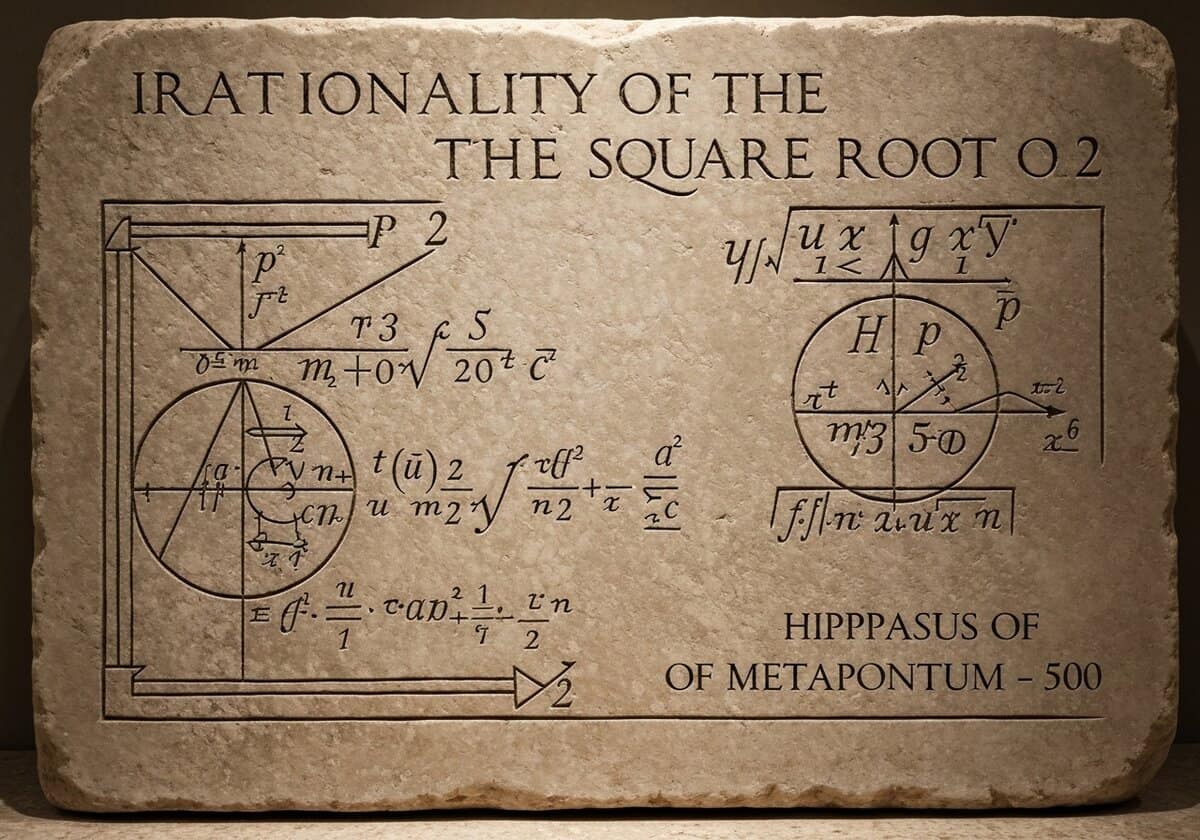
2の平方根は無理数であり、2つの整数の比[latex]p/q[/latex]として表すことはできません。ピタゴラス学派に帰せられることが多い古典的な証明は、背理法による証明です。この証明では、[latex]sqrt{2} = p/q[/latex]を既約分数で仮定すると、[latex]p[/latex]と[latex]q[/latex]の両方が偶数でなければならないという結論に至り、最初の仮定と矛盾します。
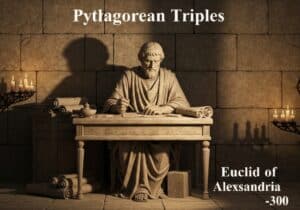
(画像はイメージです)
2の平方根は無理数であり、2つの整数の比[latex]p/q[/latex]として表すことはできません。ピタゴラス学派に帰せられることが多い古典的な証明は、背理法による証明です。この証明では、[latex]sqrt{2} = p/q[/latex]を既約分数で仮定すると、[latex]p[/latex]と[latex]q[/latex]の両方が偶数でなければならないという結論に至り、最初の仮定と矛盾します。
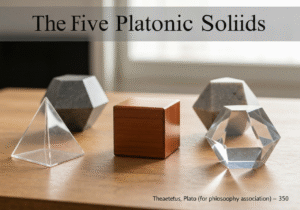
[latex]sqrt{2}[/latex]の無理性の証明は数論の基礎であり、古典的な例である。 背理法議論は次のように進みます。まず、[latex]sqrt{2}[/latex] が 有理数定義によれば、これは、1 以外の共通因数を持たない 2 つの整数 [latex]p[/latex] と [latex]q[/latex] が存在し、[latex]sqrt{2} = p/q[/latex] となることを意味します。両辺を二乗すると [latex]2 = p^2/q^2[/latex] となり、これを [latex]2q^2 = p^2[/latex] と変形できます。
この式は、[latex]p^2[/latex]が2の倍数であるため偶数であることを示しています。重要な補題は、整数の2乗が偶数であれば、その整数自体も偶数でなければならないということです。したがって、[latex]p[/latex]は偶数です。これは、[latex]p[/latex]が、ある整数[latex]k[/latex]に対して[latex]2k[/latex]と書けることを意味します。[latex]p=2k[/latex]を方程式[latex]2q^2 = p^2[/latex]に代入すると、[latex]2q^2 = (2k)^2 = 4k^2[/latex]が得られます。両辺を2で割ると、[latex]q^2 = 2k^2[/latex]が得られます。
This new equation shows that [latex]q^2[/latex] is also an even number, and by the same lemma, [latex]q[/latex] must also be even. The conclusion that both [latex]p[/latex] and [latex]q[/latex] are even contradicts the initial assumption that the fraction [latex]p/q[/latex] was in its simplest form (i.e., that [latex]p[/latex] and [latex]q[/latex] had no common factors). Since the initial assumption leads to a contradiction, the assumption must be false. Therefore, [latex]\sqrt{2}[/latex] cannot be a rational number and is 非合理的. This discovery was revolutionary for Greek mathematics, which had been built on the premise that all geometric magnitudes could be compared as ratios of integers.
2の平方根の無理性
(日付が不明または関連性がない場合、例えば「流体力学」などでは、その注目すべき出現時期の概算値が提示されます。)

フルサイズの画像とダウンロードは、登録会員のみが100%無料で利用できます。
> ログイン <