背理法(または背理法)は、間接証明の一形態です。これは、命題が偽であると仮定すると論理的な矛盾が生じることを示すことで、命題の真偽を確立します。命題[latex]p[/latex]を証明するには、その否定[latex]neg p[/latex]を仮定し、[latex]q land neg q[/latex]のような矛盾を導き出すことで、[latex]p[/latex]が真であると結論づけます。
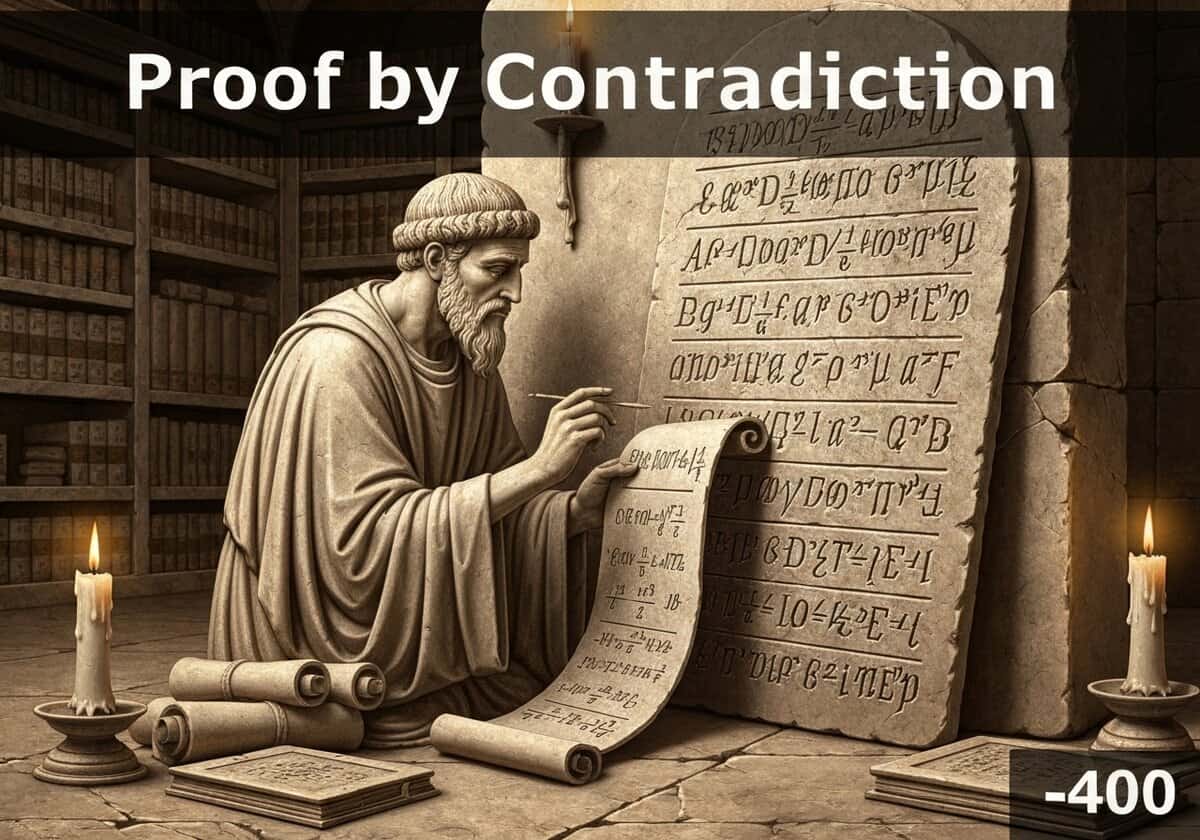
(画像はイメージです)
背理法(または背理法)は、間接証明の一形態です。これは、命題が偽であると仮定すると論理的な矛盾が生じることを示すことで、命題の真偽を確立します。命題[latex]p[/latex]を証明するには、その否定[latex]neg p[/latex]を仮定し、[latex]q land neg q[/latex]のような矛盾を導き出すことで、[latex]p[/latex]が真であると結論づけます。

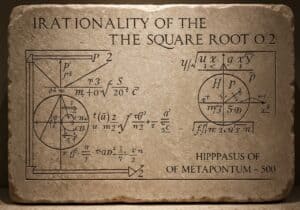
背理法の論理的基礎は、命題が真かつ偽であることはあり得ないという無矛盾律と、命題は真か偽のどちらかでなければならないという排中律である。この方法は、証明したいことの反対を仮定することから始まる。例えば、 2の平方根 は 非合理的, one starts by assuming it is rational. If [latex]\sqrt{2}[/latex] is rational, it can be expressed as a fraction [latex]a/b[/latex] in lowest terms, where a and b are integers. This leads to [latex]2 = a^2/b^2[/latex], or [latex]a^2 = 2b^2[/latex]. This implies [latex]a^2[/latex] is even, which means [latex]a[/latex] must also be even. So, [latex]a = 2k[/latex] for some integer k. Substituting this back gives [latex](2k)^2 = 2b^2[/latex], or [latex]4k^2 = 2b^2[/latex], which simplifies to [latex]2k^2 = b^2[/latex]. This means [latex]b^2[/latex] is even, and therefore [latex]b[/latex] is also even. If both a and b are even, the fraction [latex]a/b[/latex] was not in lowest terms, which contradicts the initial assumption. This contradiction forces the conclusion that the initial assumption—that [latex]\sqrt{2}[/latex] is rational—must be false. This method is powerful but can be non-constructive, as it proves a statement is true without providing a direct example or construction.
矛盾による証明 (不条理の還元)
(日付が不明または関連性がない場合、例えば「流体力学」などでは、その注目すべき出現時期の概算値が提示されます。)

フルサイズの画像とダウンロードは、登録会員のみが100%無料で利用できます。
> ログイン <