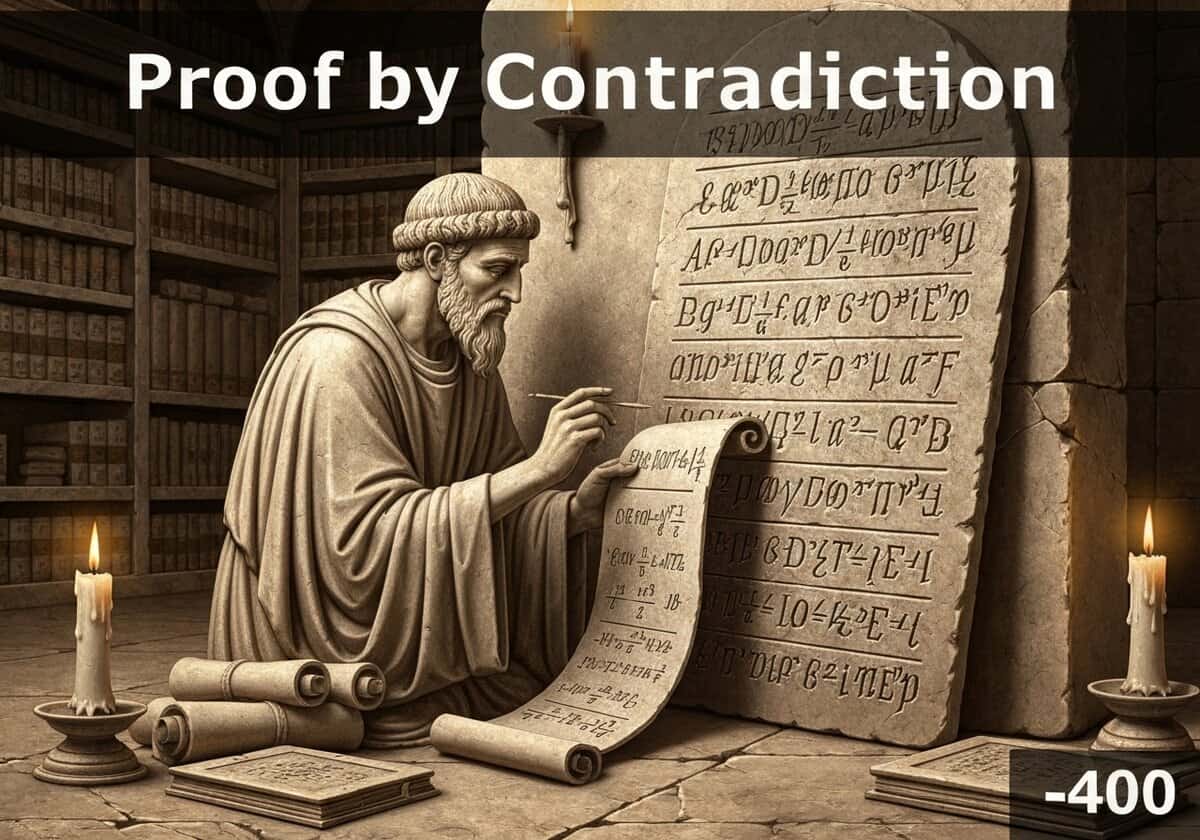
귀류법 또는 귀류법은 간접 증명의 한 형태입니다. 이는 어떤 명제가 거짓이라고 가정했을 때 논리적 모순이 발생함을 보여줌으로써 그 명제의 참을 증명하는 방법입니다. 명제 p를 증명하려면, 먼저 그 명제의 부정인 n=p를 가정하고, q=n=q와 같은 모순을 추론하여 p가 참임을 결론짓습니다.
(설명을 위한 생성된 이미지입니다)
귀류법 또는 귀류법은 간접 증명의 한 형태입니다. 이는 어떤 명제가 거짓이라고 가정했을 때 논리적 모순이 발생함을 보여줌으로써 그 명제의 참을 증명하는 방법입니다. 명제 p를 증명하려면, 먼저 그 명제의 부정인 n=p를 가정하고, q=n=q와 같은 모순을 추론하여 p가 참임을 결론짓습니다.

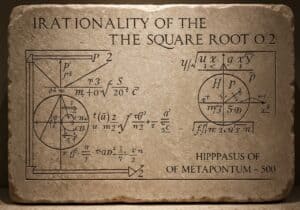
귀류법의 논리적 기초는 명제가 참이면서 동시에 거짓일 수 없다는 모순율과 명제가 반드시 참이거나 거짓이어야 한다는 배중률입니다. 이 방법은 증명하고자 하는 내용의 반대되는 가정을 세우는 것에서 시작합니다. 예를 들어, 다음 명제가 참이라는 것을 증명하려면, 2의 제곱근 ~이다 비합리적인, one starts by assuming it is rational. If [latex]\sqrt{2}[/latex] is rational, it can be expressed as a fraction [latex]a/b[/latex] in lowest terms, where a and b are integers. This leads to [latex]2 = a^2/b^2[/latex], or [latex]a^2 = 2b^2[/latex]. This implies [latex]a^2[/latex] is even, which means [latex]a[/latex] must also be even. So, [latex]a = 2k[/latex] for some integer k. Substituting this back gives [latex](2k)^2 = 2b^2[/latex], or [latex]4k^2 = 2b^2[/latex], which simplifies to [latex]2k^2 = b^2[/latex]. This means [latex]b^2[/latex] is even, and therefore [latex]b[/latex] is also even. If both a and b are even, the fraction [latex]a/b[/latex] was not in lowest terms, which contradicts the initial assumption. This contradiction forces the conclusion that the initial assumption—that [latex]\sqrt{2}[/latex] is rational—must be false. This method is powerful but can be non-constructive, as it proves a statement is true without providing a direct example or construction.
모순에 의한 증명(reductio ad absurdum)
(날짜를 알 수 없거나 관련이 없는 경우, 예를 들어 "유체역학"의 경우, 주목할 만한 등장 시기를 대략적으로 추정하여 제공합니다.)

고화질 이미지 및 다운로드는 등록된 회원에게만 100% 무료로 제공됩니다.
> 로그인 <