Product Design, Manufacturing & Innovation Resources
بيت » تحفيز الإنزيم (التحفيز الحيوي)

تحفيز الإنزيم (التحفيز الحيوي)

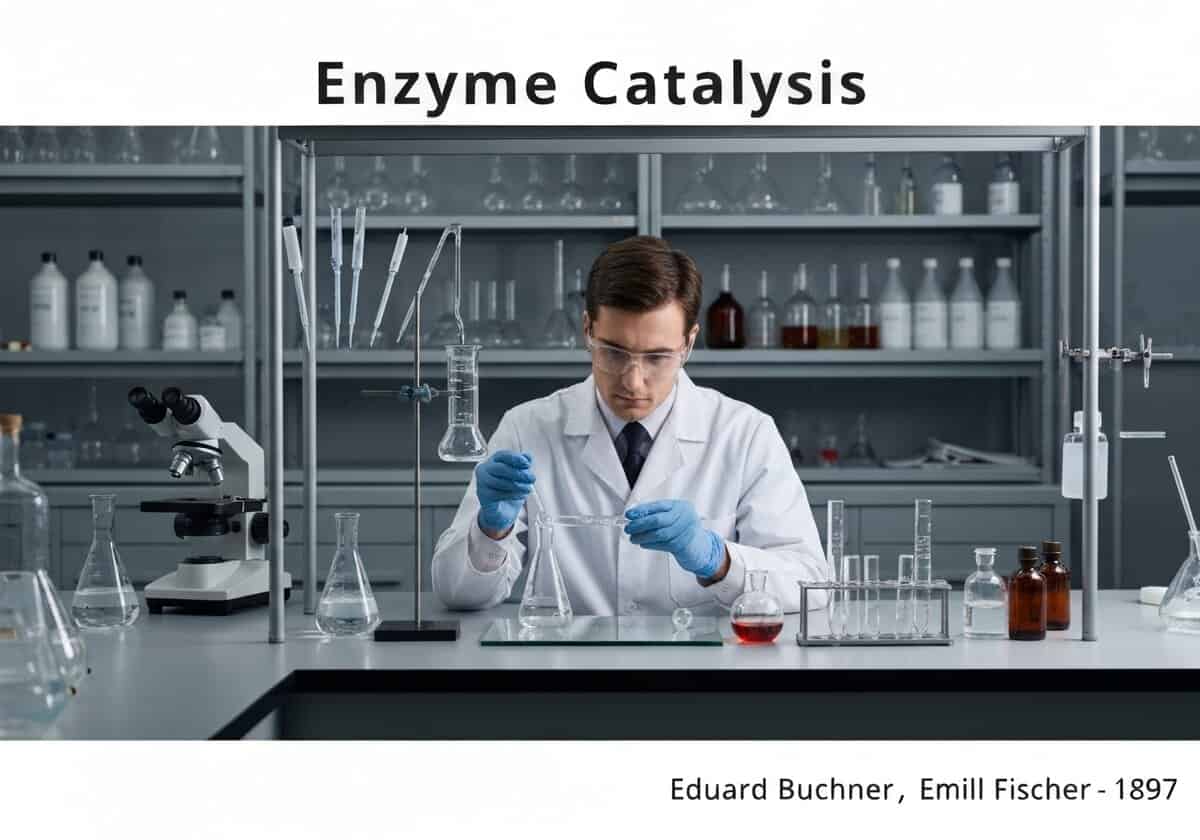
1897
  • Eduard Buchner
  • Emil Fischer
Biochemist conducting enzyme catalysis experiments in a laboratory.

(صورة توضيحية فقط)

Enzymes are proteins that act as biological المحفزات (biocatalysts). They exhibit remarkable specificity and efficiency, often accelerating reactions by factors of millions under mild physiological conditions (temperature, pH). The reaction occurs in a specific region of the enzyme called the active site, which binds the substrate through a lock-and-key or induced-fit mechanism.

Enzyme catalysis represents the pinnacle of catalytic efficiency and selectivity. These complex protein structures create a unique microenvironment within their active site that is perfectly tailored to stabilize the transition state of a specific reaction. This is achieved through a combination of factors: precise orientation of substrates, providing acidic or basic functional groups, straining substrate bonds, and providing an alternative covalent pathway. The kinetics of many enzyme-catalyzed reactions can be described by the Michaelis-Menten equation: [latex]v = \frac{V_{max}[S]}{K_M + [S]}[/latex], where [latex]v[/latex] is the reaction rate, [latex]V_{max}[/latex] is the maximum rate, [latex][S][/latex] is the substrate concentration, and [latex]K_M[/latex] (the Michaelis constant) is the substrate concentration at which the reaction rate is half of [latex]V_{max}[/latex].

Emil Fischer’s original ‘lock-and-key’ model proposed a rigid active site perfectly matching the substrate. This was later refined by Daniel Koshland’s ‘induced-fit’ model, which suggests that the active site is flexible and changes conformation upon substrate binding to achieve optimal catalytic orientation. This specificity is often stereospecific, meaning enzymes can distinguish between stereoisomers, a critical feature for producing enantiomerically pure drugs. While historically used in food production, modern biotechnology has expanded their use to industrial synthesis, diagnostics, and therapeutics through techniques like directed evolution, which allows scientists to engineer enzymes with novel properties.

UNESCO Nomenclature: 2302
– Biochemistry

يكتب

Biological Process

خلل

Revolutionary

الاستخدام

استخدام واسع النطاق

مقدمات

  • Louis Pasteur’s work linking fermentation to living organisms
  • اكتشاف وعزل الدياستاز (الأميليز) بواسطة أنسلم باين
  • Emil Fischer’s lock-and-key theory of enzyme specificity
  • Eduard Buchner’s discovery of cell-free fermentation

التطبيقات

  • إنتاج شراب الذرة عالي الفركتوز
  • استخدام البروتياز في المنظفات الغسيل
  • تخليق المستحضرات الصيدلانية الكيرالية
  • إنتاج الجبن والزبادي
  • bioremediation to break down pollutants

براءات الاختراع:

NA

أفكار ابتكارية محتملة

  • الإنزيمات الاصطناعية (الإنزيمات المتزامنة) التي يتم إنشاؤها من هياكل غير بيولوجية
  • إنزيمات مصممة لتحلل البلاستيك مثل الحيوانات الأليفة
  • الإنزيمات المثبتة في مفاعلات التدفق المستمر للتخليق الصناعي
  • أجهزة استشعار حيوية تعتمد على الإنزيم للتشخيص الطبي ومراقبة البيئة
  • تفاعلات متتالية باستخدام إنزيمات متعددة في وعاء واحد لبناء جزيئات معقدة
  • الإنزيمات التي تعمل في المذيبات غير المائية للتخليق العضوي
  • إنزيمات ثابتة الحرارة من الكائنات المحبة للظروف المتطرفة للعمليات الصناعية ذات درجات الحرارة العالية
  • الإنزيمات المنشطة بالضوء (الأنزيمات الضوئية) للتحكم الدقيق في التفاعلات من حيث التوقيت والمكان
  • إنزيمات مصممة لالتقاط ثاني أكسيد الكربون وتحويله
  • العلاجات الإنزيمية داخل الجسم لتصحيح الاضطرابات الأيضية
Related to: enzyme, biocatalysis, active site, Michaelis-Menten kinetics, specificity, induced fit, lock and key, substrate, protein, directed evolution.

السياق التاريخي

1880
1897
1970
1890
1955
1980

(إذا كان التاريخ غير معروف أو غير ذي صلة، على سبيل المثال "ميكانيكا الموائع"، يتم توفير تقدير تقريبي لظهوره الملحوظ)

أحدث الإضافات

أهم المنشورات والمقالات

أفضل الأدوات الأصلية

السنة العاشرة عيد

الصور والتنزيلات بالحجم الكامل متاحة فقط، ومجانية تمامًا، للأعضاء المسجلين.