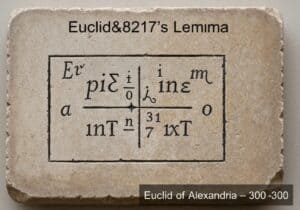
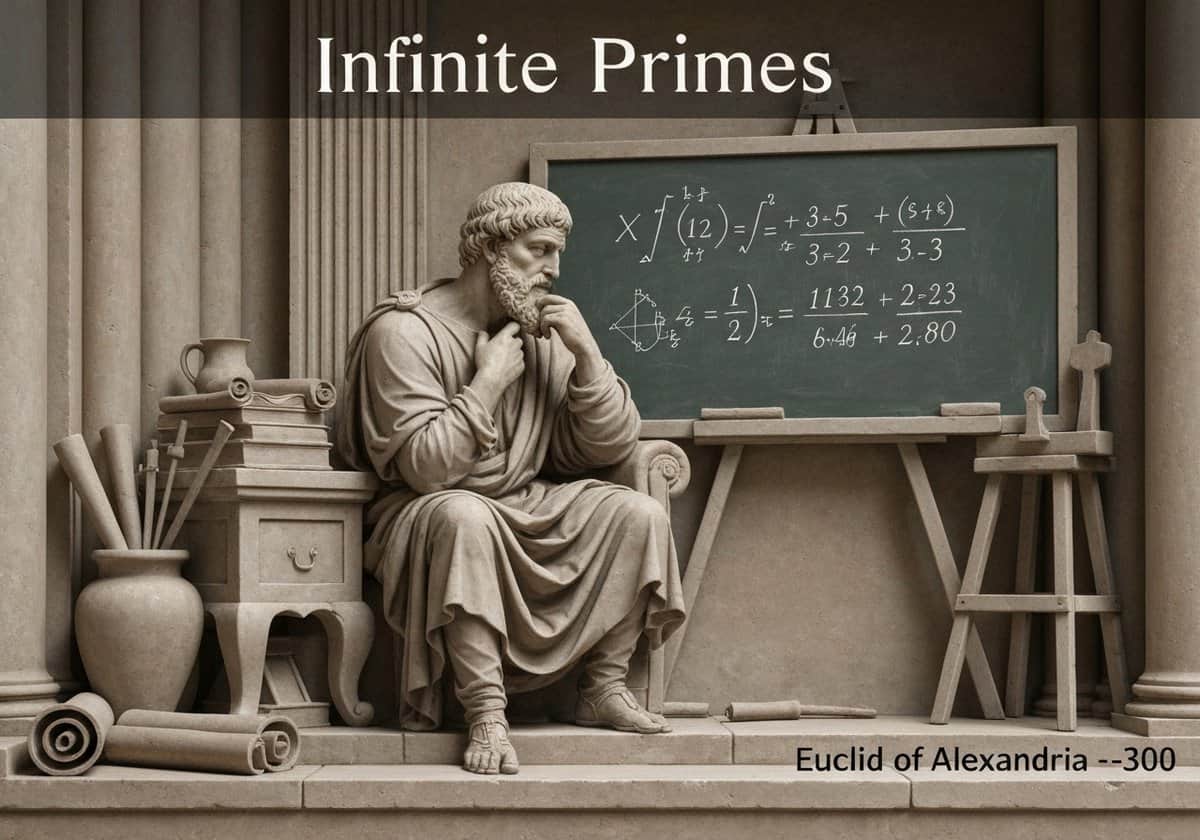
ユークリッドの定理は、素数は無限に存在すると述べています。古典的な証明は背理法です。すべての素数の有限リスト [latex]p_1, p_2, dots, p_n[/latex] を仮定します。次に、数 [latex]P = p_1 p_2 cdots p_n + 1[/latex] を考えます。この数 [latex]P[/latex] は素数であるかそうでないかのどちらかです。素数であれば、リストにない新しい素数になります。

(画像はイメージです)
ユークリッドの定理は、素数は無限に存在すると述べています。古典的な証明は背理法です。すべての素数の有限リスト [latex]p_1, p_2, dots, p_n[/latex] を仮定します。次に、数 [latex]P = p_1 p_2 cdots p_n + 1[/latex] を考えます。この数 [latex]P[/latex] は素数であるかそうでないかのどちらかです。素数であれば、リストにない新しい素数になります。
The proof continues: if [latex]P[/latex] is not prime, it must be divisible by some prime, say [latex]q[/latex]. This prime [latex]q[/latex] must be on our assumed complete list of primes. However, if we divide [latex]P[/latex] by any of the primes [latex]p_i[/latex] from our list, the remainder is always 1. Therefore, none of the primes on our list can be the factor [latex]q[/latex]. This means [latex]q[/latex] must be a prime number that was not on our original list. In either case—whether [latex]P[/latex] is prime or composite—there exists at least one more prime than is contained in any finite list. This contradicts the initial assumption that the set of all primes is finite. Therefore, the set of prime numbers must be infinite. This elegant argument is considered a masterpiece of mathematical reasoning and is often one of the first examples of proof by contradiction taught to students. It appears in Book IX, Proposition 20 of Euclid’s *Elements*.
無限個の素数(ユークリッドの証明)
(日付が不明または関連性がない場合、例えば「流体力学」などでは、その注目すべき出現時期の概算値が提示されます。)

フルサイズの画像とダウンロードは、登録会員のみが100%無料で利用できます。
> ログイン <