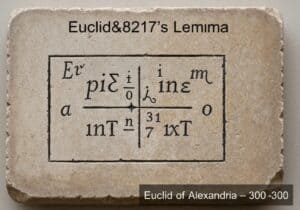
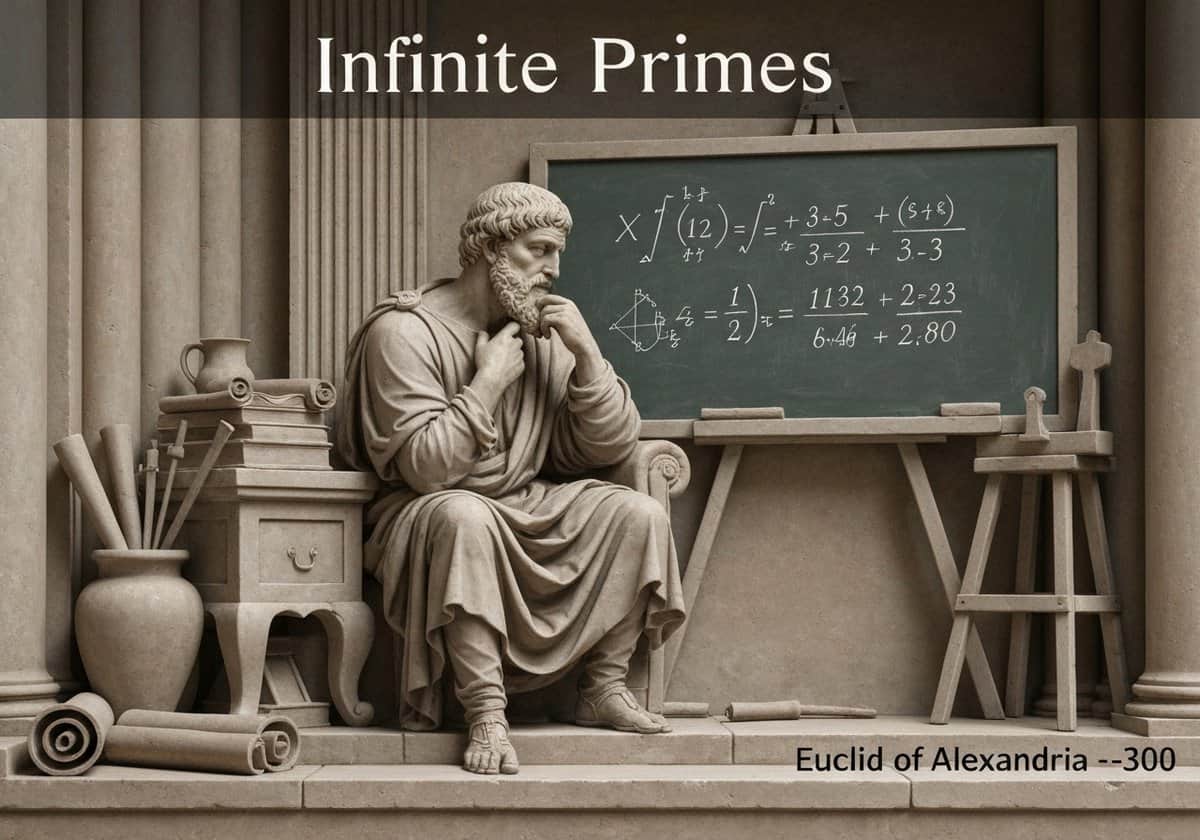
유클리드의 정리는 소수가 무한히 많다는 것을 말합니다. 고전적인 증명은 귀류법을 사용합니다. 모든 소수의 유한한 목록 [latex]p_1, p_2, dots, p_n[/latex]이 있다고 가정합니다. 그런 다음 [latex]P = p_1 p_2 cdots p_n + 1[/latex]이라는 수를 생각해 봅니다. 이 수 [latex]P[/latex]는 소수이거나 소수가 아닙니다. 만약 소수라면, 그것은 목록에 없는 새로운 소수입니다.
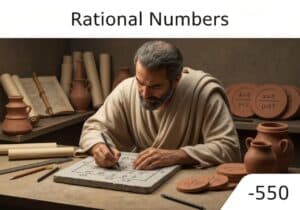
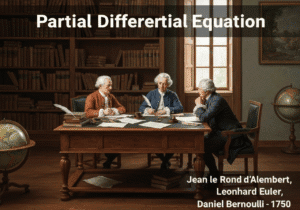
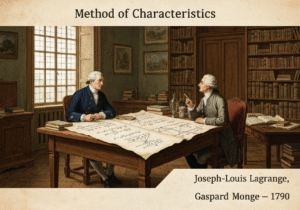
(설명을 위한 생성된 이미지입니다)
유클리드의 정리는 소수가 무한히 많다는 것을 말합니다. 고전적인 증명은 귀류법을 사용합니다. 모든 소수의 유한한 목록 [latex]p_1, p_2, dots, p_n[/latex]이 있다고 가정합니다. 그런 다음 [latex]P = p_1 p_2 cdots p_n + 1[/latex]이라는 수를 생각해 봅니다. 이 수 [latex]P[/latex]는 소수이거나 소수가 아닙니다. 만약 소수라면, 그것은 목록에 없는 새로운 소수입니다.
The proof continues: if [latex]P[/latex] is not prime, it must be divisible by some prime, say [latex]q[/latex]. This prime [latex]q[/latex] must be on our assumed complete list of primes. However, if we divide [latex]P[/latex] by any of the primes [latex]p_i[/latex] from our list, the remainder is always 1. Therefore, none of the primes on our list can be the factor [latex]q[/latex]. This means [latex]q[/latex] must be a prime number that was not on our original list. In either case—whether [latex]P[/latex] is prime or composite—there exists at least one more prime than is contained in any finite list. This contradicts the initial assumption that the set of all primes is finite. Therefore, the set of prime numbers must be infinite. This elegant argument is considered a masterpiece of mathematical reasoning and is often one of the first examples of proof by contradiction taught to students. It appears in Book IX, Proposition 20 of Euclid’s *Elements*.
무한 소수 (유클리드의 증명)
(날짜를 알 수 없거나 관련이 없는 경우, 예를 들어 "유체역학"의 경우, 주목할 만한 등장 시기를 대략적으로 추정하여 제공합니다.)

고화질 이미지 및 다운로드는 등록된 회원에게만 100% 무료로 제공됩니다.
> 로그인 <