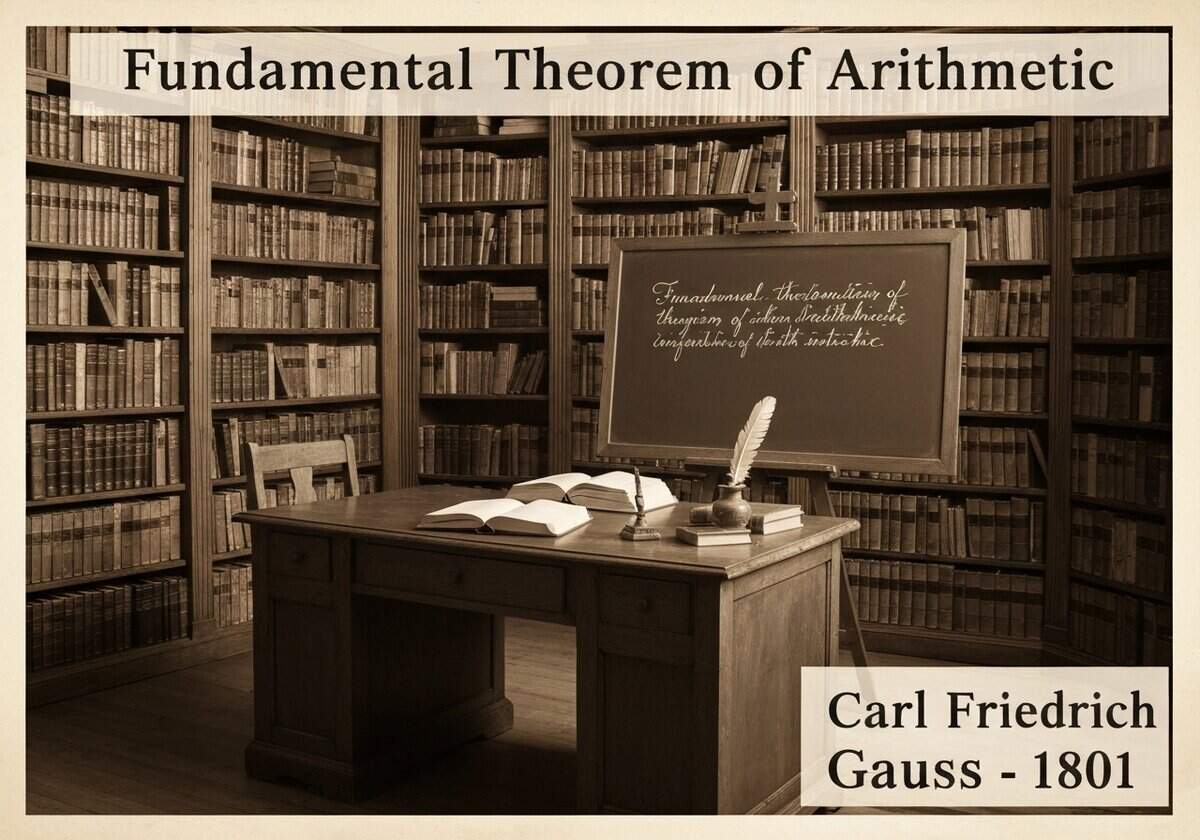
この定理は、1より大きいすべての整数は素数であるか、因数の順序に関係なく素数の積として一意に表すことができると述べています。たとえば、[latex]1200 = 2^4 times 3^1 times 5^2[/latex]です。 因数分解 は数論の基礎であり、整数に対する基本的な乗法構造を提供する。
The Fundamental Theorem of Arithmetic, also called the unique 因数分解 theorem, consists of two main assertions for any integer [latex]n > 1[/latex]: first, that [latex]n[/latex] can be written as a product of prime numbers (the existence part), and second, that this product is unique, apart from the order of the factors (the uniqueness part). The existence of a prime factorization is typically proven using strong induction. The base case is that 2 is prime. For the inductive step, assume every integer up to [latex]k[/latex] has a prime factorization. For [latex]k+1[/latex], it is either prime (and we are done) or composite. If it is composite, it can be written as a product of two smaller integers, [latex]a \times b[/latex]. By the induction hypothesis, both [latex]a[/latex] and [latex]b[/latex] have prime factorizations, and their product gives a prime factorization for [latex]k+1[/latex].