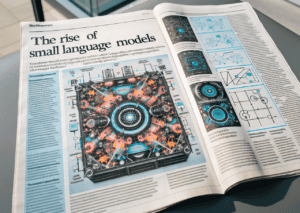
小規模言語モデルとは、約70億パラメータ未満で動作するトランスフォーマーベースの自然言語処理システムを指します。この閾値は、形式的な境界というよりも、クラウド推論インフラストラクチャを持たない消費者向けハードウェア、モバイルデバイス、組み込みシステムへの展開可能性という実際的な制約によって定義されます。
この分野は、最先端規模のモデルにおける計算コストと経済コストへの直接的な対応として出現しました。10億個以上のパラメータを持つアーキテクチャは幅広い汎用性を示す一方で、そのメモリ使用量、推論遅延、およびエネルギー消費量により、デバイス上での展開、プライバシーに配慮したアプリケーション、低帯域幅またはオフラインの運用環境とは構造的に互換性がありません。
中心となる研究プログラムは、知識蒸留(より大きな教師の出力分布に対してより小さな生徒モデルを訓練する)、構造化および非構造化剪定、INT4およびINT8表現への積極的な重み量子化、そして圧縮された基本モデルを最小限の追加計算コストでドメイン固有のタスクに適応させるLoRAやQLoRAなどのパラメータ効率の高い微調整手法を組み合わせることで、コンパクトモデルと最先端モデルの間の能力ギャップを埋めています。
以下に索引付けされた出版物および特許は、モデル圧縮技術、量子化アルゴリズム、蒸留プロトコル、効率的なトランスフォーマーアーキテクチャ、デバイス上での推論最適化、およびドメイン固有の微調整パイプラインを扱っています。
これは、多数の科学オンラインジャーナルの中から、小型言語モデル (SLM) に関する英語の世界中の出版物と特許の最新のセレクションです。小型言語モデル、SLM、オンデバイス言語モデル、エッジ言語モデル、コンパクトトランスフォーマー、7B 未満のパラメータモデル、言語モデル圧縮、知識蒸留 NLP、構造化剪定言語モデル、非構造化剪定言語モデル、重み量子化言語モデル、INT4 量子化 NLP、INT8 量子化 NLP、パラメータ効率の高い微調整、LoRA 微調整、QLoRA 微調整、アダプタチューニング言語モデル、オンデバイス推論、エッジ推論 NLP、投機的デコード、モデル蒸留トランスフォーマー、GGUF 量子化フォーマット、および専門家の混合コンパクトモデルに分類され、焦点を絞っています。
Teaching small language models petro-technical knowledge through language reasoning and fine-tuning
Patent published on the 2026-10-15 in US under Ref US20260319121 by SCHLUMBERGER TECH CORPORATION [US] (Paydayesh Mehdi [gb], Shamsa Amir [ca])
Abstract: A method for automatically generating an answer to a petro-technical query in an oil and gas domain includes receiving input data including question-answer pairs related to the oil and gas domain. The method also includes training a small language model (SLM) based upon the input data to produce a trained model. The method also includes fine-tuning the trained model to produce a fine-tuned model. The method also includes receiving the petro-technical query in the oil and gas domain. The method a[...]
Our summary: This method trains a small language model using question-answer pairs from the oil and gas domain. It fine-tunes the model to improve its ability to generate answers to petro-technical queries. The process enables automatic response generation for specific queries in the oil and gas sector.
small language models, petro-technical knowledge, fine-tuning, query generation
Patent
Method of laser-based additive manufacturing with pulse scan patterns for magnesium and its alloys
Patent published on the 2026-10-08 in US under Ref US20260307150 by OSSEOLABS CO LTD [TH] (Promoppatum Patcharapit [th], Sukpasert Montian [th], Ahuja Vikram [th], Harrysson Ola [us])
Abstract: This invention introduces an advanced pulse scanning technique for Selective Laser Melting (SLM) of magnesium, addressing critical manufacturing challenges. The method employs iterative optimization to regulate heat input through precise pulse patterns, preventing overheating and material defects. By alternating between powered and unpowered laser phases, the technique reduces material evaporation, minimizes internal stresses, and enhances microstructural uniformity. This approach enables more s[...]
Our summary: This invention presents a pulse scanning technique for Selective Laser Melting of magnesium. It optimizes heat input to prevent overheating and defects by alternating laser phases. This method improves fabrication stability and microstructural uniformity for magnesium components.
laser-based manufacturing, pulse scanning, magnesium alloys, Selective Laser Melting
Patent
Memory-efficient neural dialog artificial intelligence
Patent published on the 2026-10-08 in US under Ref US20260310927 by HSU JOSEPH BERNARD [US] (Hsu Joseph Bernard [us])
Abstract: [0000] A hybrid generative AI artificial intelligence system addresses cloud-centric AI inefficiencies through dynamic hierarchical memory indexing and selective cloud escalation. The system implements a three-object architecture comprising user profile management, thread index management, and dialog process control that enables client-side processing with precision-targeted cloud resource utilization. A small language model functions as a local decision engine, performing heuristic inference an[...]
Our summary: A hybrid generative AI system enhances cloud-centric AI efficiency through dynamic memory indexing. It features a three-object architecture for user profile, thread index, and dialog control. The system reduces response time by 84% and cloud dependency by 80% while ensuring cognitive coherence.
neural networks, cloud computing, memory indexing, dialog systems
Patent
Template guided speculative decoding
Patent published on the 2026-10-06 in US under Ref US12754958 by INTUIT INC [US] (Ben Shoham Ofir [il], Bar Eliyahu Natalie [il], Mendelson Shon [il], Antebi Sagiv [il], Ardazi Shai [il])
Abstract: Aspects of the present disclosure involve accelerated machine learning based sequence generation. Aspects include generating a first portion of a sequence based on an input query using a speculative decoding process involving a draft machine learning model and a target machine learning model with a larger number of parameters than the draft model. Aspects include determining, based on the input query and the first portion, that a next portion of the sequence is predicted to correspond to a templ[...]
Our summary: This disclosure involves a method for accelerated sequence generation using speculative decoding with two machine learning models. It includes generating a sequence portion based on an input query and determining if the next portion corresponds to a template. The next portion is generated through a template-based process and verified using a larger target model before appending to the sequence.
speculative decoding, sequence generation, machine learning models, template-based process
Patent
Secure explanation generation by large language models for sensitive search targets
Patent published on the 2026-10-06 in US under Ref US12755173 by INTUIT INC [US] (Eliyahu Natalie Bar [il], Mendelson Shon [il], Hazan Itay [il], Bechler Sigalit [il], Haas Noa [il], Bitton Ron [il])
Abstract: [0000] A method includes generating, by a large language model (LLM), a multitude of match explanations for a multitude of search targets. The multitude of match explanations is clustered to obtain a multitude of explanation clusters. An explanation template is generated for an explanation cluster. The explanation template includes a static portion and a dynamic portion. A multitude of explanation templates is obtained in this manner. A target match for a search target received from a user appli[...]
Our summary: The method generates match explanations for search targets using a large language model. These explanations are clustered to create templates with static and dynamic portions. A small language model populates match explanations based on user search targets and encoded templates.
explanation generation, large language model, sensitive search targets, clustering
Patent
Speculative decoding using expanded token matching
Patent published on the 2026-09-03 in US under Ref US20260260065 by MICROSOFT TECH LICENSING LLC [US] (Pathak Sayan Dev [us], Kesavamoorthy Harini [us], Basoglu Christopher Hakan [us], Vikram Ayush [us], Shah Amy Parag [us], Kelkar Rakesh [us])
Abstract: [0000] A speculative decoding technique generates tokens of a response using a verifying model and drafting model. In operation, the verifying model receives a set of draft tokens produced by the drafting model. The verifying model then verifies whether the draft tokens are correct by comparing probability information generated by the verifying model with probability information generated by the drafting model. The verifying model then determines whether any draft token that is rejected by the v[...]
Our summary: Speculative decoding generates response tokens using a verifying and drafting model. The verifying model checks draft tokens against probability information from both models. This iterative process expands accepted tokens, reducing resource use and latency.
speculative decoding, token matching, verifying model, drafting model
Patent
Automated synthesis of planar linkage mechanisms with diverse joint types via spring-connected link models and contrastive graph learning
Published on 2026-03-28 by @OXFORD
Abstract: AbstractThe automated synthesis of planar linkage mechanisms has long been a challenge in mechanism design, requiring both geometric feasibility and motion accuracy. Recent advances in data-driven and neural network–based methods have shown promise in automating linkage synthesis, improving efficiency and scalability compared to traditional analytical or optimization-based techniques. Nevertheless, existing data-driven approaches remain limited in handling diverse joint configurations and ofte[...]
Our summary: This study presents a framework for automating the synthesis of planar linkage mechanisms using deep learning and physics-based modeling. It employs a spring-connected link model for diverse joint configurations and utilizes contrastive graph learning for efficient linkage retrieval. The method demonstrates improved accuracy and optimization stability compared to traditional approaches.
mechanism synthesis, deep learning, contrastive graph learning, optimization stability
Enhancing Whisper Fine-Tuning with Discrete Wavelet Transform-Based LoRA Initialization
Published on 2026-01-29 by Liang Lan, Molin Fang, Yuxuan Chen, Daliang Wang, Wenyong Wang @MDPI
Abstract: In low-resource automatic speech recognition (ASR) scenarios, parameter-efficient fine-tuning (PEFT) has become a crucial approach for adapting large pre-trained speech models. Although low-rank adaptation (LoRA) offers clear advantages in efficiency, stability, and deployment friendliness, its performance remains constrained because random initialization fails to capture the time–frequency structural characteristics of speech signals. To address this limitation, this work proposes[...]
Our summary: This work introduces a structured initialization mechanism combining LoRA with discrete wavelet transform for fine-tuning in low-resource ASR. The proposed DWTLoRA method enhances convergence speed, stability, and accuracy by aligning with speech signal characteristics. Experimental results show DWTLoRA outperforms standard LoRA and other PEFT methods in character error rate and training efficiency.
Fine-Tuning, Discrete Wavelet Transform, Low-Rank Adaptation, Automatic Speech Recognition
Publication