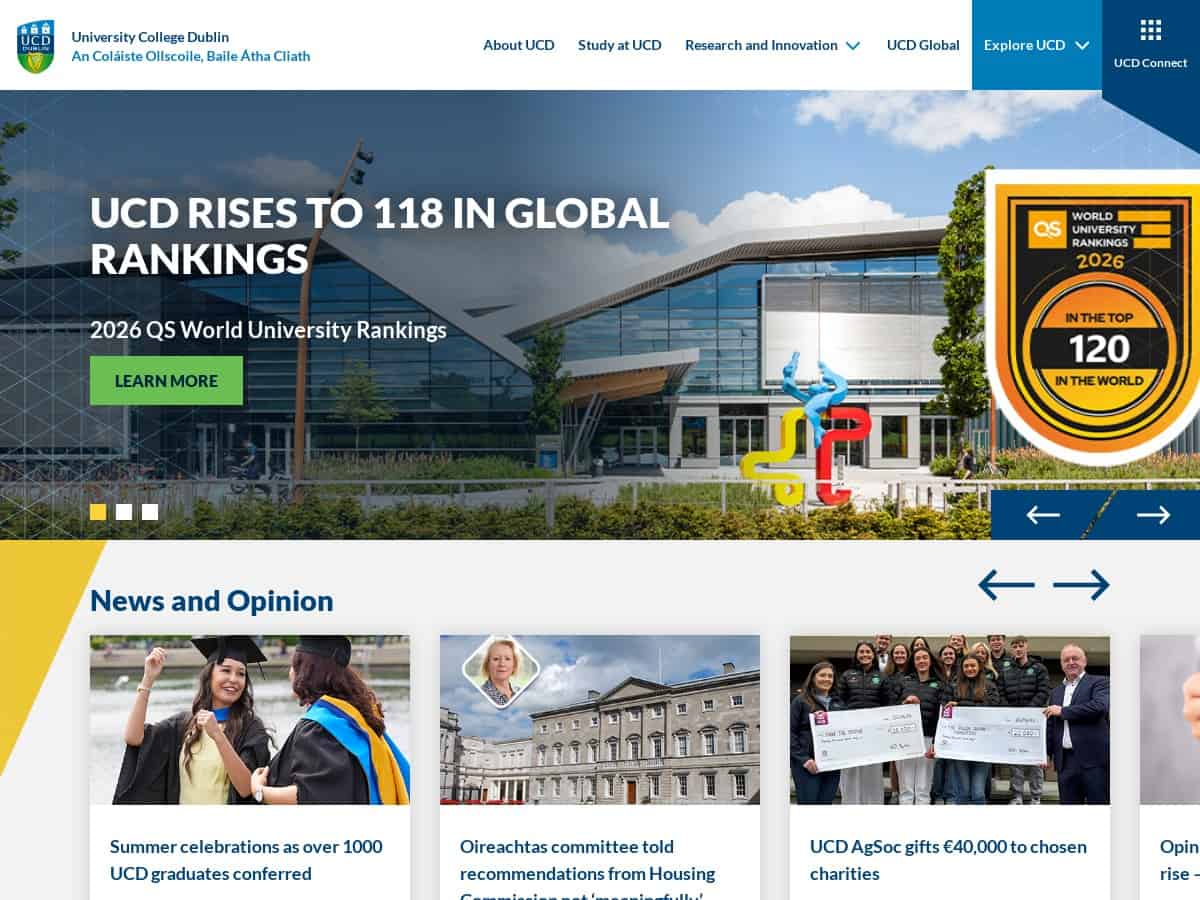
Founded in 1854, UCD is one of Ireland’s largest and most international universities. It is a research-intensive university located on a large, modern campus in south Dublin, offering a wide range of undergraduate and graduate programs.
University College Dublin, UCD, is the largest university in Ireland, with about 38,000 students and 3,300 staff, and roughly 30 percent of students from abroad. The main campus at Belfield covers about 133 hectares in the south of Dublin, around six kilometres from the city centre, with lakes, sport grounds and residences. It also has sites at Blackrock, where its graduate business school is based, and at Clonskeagh.
UCD began as the Catholic University of Ireland in 1854, with John Henry Newman as its first rector. His lectures on the idea of a university are still widely read. Its later history is tied to the National University of Ireland, and it took its present form as an independent university in 1997. James Joyce studied modern languages here at the end of the nineteenth century, and his student years appear in his fiction.
The university is organised in colleges covering arts and humanities, business, engineering and architecture, health and agricultural sciences, science, and social sciences and law. The Smurfit Business School and the Quinn School of Business are among the best-known business schools in the country. Research centres include the Conway Institute for biomolecular research, the Insight Centre for Data Analytics and the Earth Institute, and UCD works closely with Dublin’s pharmaceutical and technology industries.
Irish and other EU undergraduates generally pay no tuition under the Free Fees Initiative but pay a yearly student contribution, while students from outside the EU pay tuition that varies by programme. Check the current tariffs. Irish applicants use the CAO system, and international students and postgraduates have separate application routes.
Teaching is in English. UCD is a campus university, with a large student village on site, and a city bus line connects Belfield to Dublin centre. Rents in Dublin are among the highest in Europe, so early planning is advised.
Domains taught:
Agriculture, Bioengineering, Data Analytics, Engineering, Food Science, Life Sciences
Diplomas*:
Bachelor, Doctor, Master, MBA
Status:
Public
Partnerships:
UCD is a member of Universitas 21 and has strong partnerships with industry, particularly in the food, agriculture, and ICT sectors. It hosts NovaUCD, a centre for new ventures and entrepreneurs.
Research:
UCD is a leading research university in Ireland. Key research areas include agri-food, ICT, energy, and health. It is home to numerous research institutes and is a major participant in EU research programs.
Famous Alumnis:
James Joyce, V. V. Giri, Gabriel Byrne, Roddy Doyle
International recognition**:
Number of staff***:
3300
Current students***:
38000
Foreign students***:
30%
Cumulative former students***:
250000
Pros
Large, modern campus with excellent facilities, a wide range of courses, and a strong international community with extensive global partnerships.
Cons
The campus is located outside the city centre, and its large size can make it feel bureaucratic and less intimate than smaller universities.
Best For
Students looking for a comprehensive, internationally-focused university experience with strong research opportunities and a diverse student body.
Among national alternatives, Dublin City University stands out for its focus on bioengineering, data analytics and engineering, and it covers chemistry and telecommunications as well, and is smaller, enrolling about 17,500 students against roughly 38,000 here.
Where this institution leans on life sciences and engineering, Trinity College Dublin does the same, and it is also a public institution, and runs the same bachelor's, master's, doctoral and mba programmes.
University of Galway is the closest domestic counterpart for bioengineering, life sciences and data analytics; it does not run the mba programmes found here and covers marine science and civil engineering as well.
Technological University Dublin overlaps with this institution on food science, data analytics and engineering, so the two are easy to compare, and it covers civil engineering and automation as well, and is slightly smaller, at about 29,700 students against roughly 38,000 here.
University College Cork offers a comparable education in food science, life sciences and engineering: it does not run the mba programmes found here and covers microbiology and genetics and optics as well.
Most Similar Schools Abroad
The closest overseas parallel on agriculture, food science and life sciences is Stellenbosch University, located in South Africa; it has almost the same size, at about 36,125 students, and is also a public institution.
A foreign alternative with a similar emphasis on agriculture, food science and life sciences is University of Adelaide in Australia, and it covers chemistry and physics as well, and is slightly smaller, at about 30,279 students against roughly 38,000 here.
Laval University in Canada pursues a similar profile in agriculture, life sciences and data analytics, and it is also a public institution, and teaches at the same levels, namely bachelor's, master's, doctoral and mba.
University of Newcastle Australia, based in Australia, is built around life sciences, data analytics and engineering much like this university, and it runs the same bachelor's, master's, doctoral and mba programmes, and covers finance and civil engineering as well.
Beyond national borders, National Taiwan University stands out as a comparable school for agriculture, life sciences and data analytics; it teaches at the same levels, namely bachelor's, master's, doctoral and mba, and covers finance and chemistry as well.
*our own picks (our criteria: a mix between domains, diploma delivered, reputation and size), but obviously too many criteria for an apple-to-apple ranking.
FAQ
Where is UCD?
At Belfield in south Dublin, Ireland, about six kilometres from the city centre.
How large is UCD?
About 38,000 students and 3,300 staff, which makes it the largest university in Ireland.
When was it founded?
In 1854, as the Catholic University of Ireland, with John Henry Newman as its first rector.
Who studied at UCD?
James Joyce studied modern languages there.
What is UCD best known for?
Business, engineering, agriculture, law, health sciences and data analytics.
Which business schools belong to UCD?
The Smurfit Business School and the Quinn School of Business.
What is the Conway Institute?
A UCD research institute focused on biomolecular and biomedical research.
Does UCD charge tuition?
Irish and other EU undergraduates generally pay no tuition under the Free Fees Initiative but pay a student contribution. Students from outside the EU pay tuition that varies by programme. Check the current tariff.
How do you apply?
Irish undergraduates apply through the CAO system. International students and postgraduates have separate routes.
What is the language of teaching?
English.
Agriculture, Energy, Engineering, Food, Innovation, Research and Development, Sustainable Development
*: without any judgment of the quality, readers are strongly encouraged to check the official status of the exact diploma envisioned as many universities have a mix of recognized diplomas, not recognized, “co-delivered,” “equivalent to”, “some pathways” (…), can change over time, and can be named differently from one country to another.
**: international reputation: is based on some criteria that do not mean much in some domains or specialties (number of researchers, of scientific publications, on budget ….). Our approximate 1-4 scale:
known locally
known locally and internationally
is listed in some of the world university’s classifications
is listed among the 20 firsts in some of world university’s classifications
***: estimated numbers, based on online sources and/or feedbacks. The numbers can vary greatly depending on school organisation (ex.: school is part of a group, it employs internal staff or external consultants or has public staff without employing them …). Refer to all the links provided to have accurate and updated numbers.
Innovation.world is not affiliated with this school/university. We recommend to contact them directly on their website for any special request.
To complete or correct any information here or share your opinion, please comment below or > send us a direct message <.