MTT Assay for Measuring Cell Viability
Il test MTT è un test colorimetrico metodo per valutare l'attività metabolica cellulare, che serve come procuratore per la vitalità cellulare, la proliferazione e la citotossicità. Le cellule vitali con mitocondri attivi contengono enzimi reduttasi che convertono il sale giallo di tetrazolio MTT (3-(4,5-dimetiltiazol-2-il)-2,5-difeniltetrazolio bromuro) in un formazano viola insolubile. La quantità di formazano prodotta è proporzionale al numero di cellule viventi.
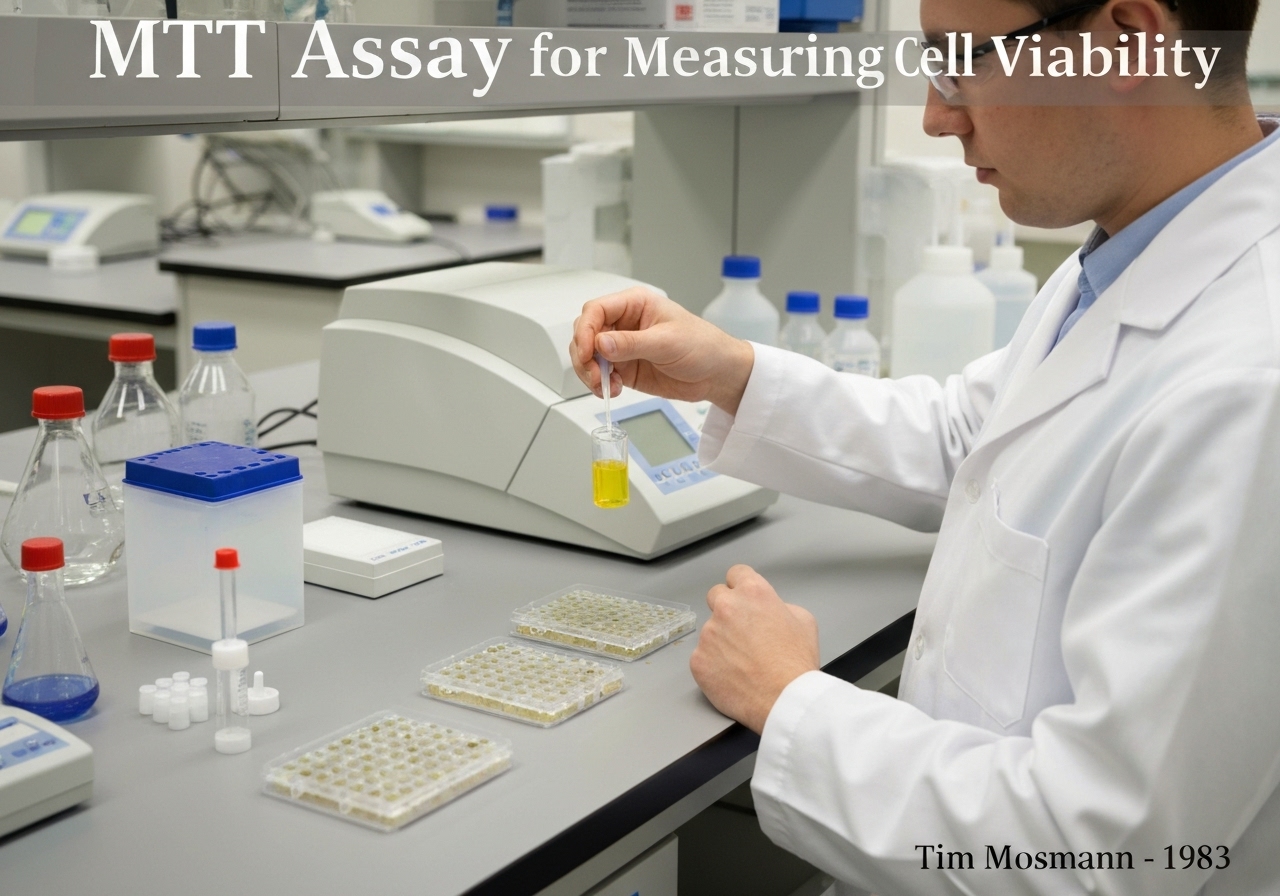
The MTT assay, first described by Tim Mosmann in 1983, revolutionized the way researchers quantify cellular responses in vitro. It provided a faster, more quantitative, and less radioactive alternative to previous methods like the chromium-release assay. The principle is based on the activity of mitochondrial dehydrogenases in living cells. These enzymes are part of the electron transport chain and are only active in metabolically functioning cells.
In the procedure, the water-soluble yellow MTT reagent is added to cells in a culture plate. It is taken up by the cells and reduced by mitochondrial enzymes into formazan, which is an insoluble, purple, crystalline product. The formazan crystals accumulate within the cells. After an incubation period, a solubilizing agent, such as dimethyl sulfoxide (DMSO) or an acidified alcohol solution, is added to dissolve these crystals, resulting in a colored solution. The absorbance of this purple solution is then measured using a spectrophotometer at a specific wavelength (typically between 500 and 600 nm). The intensity of the color is directly proportional to the number of metabolically active, and therefore viable, cells. By comparing the absorbance of treated cells to untreated control cells, one can calculate the percentage of cytotoxicity or inhibition of proliferation caused by the test compound.
UNESCO Nomenclature: 2406
- Biologia della cellula
Precursori
- development of cell culture techniques
- understanding of mitochondrial respiration and the electron transport chain
- invention of the spectrophotometer
- use of tetrazolium salts as redox indicators in histology
- need for a quantitative, non-radioactive cell viability assay
Applicazioni
- drug screening for cytotoxic effects in cancer research
- toxicology testing of chemicals
- assessing cell proliferation in response to growth factors
- high-throughput screening in drug discovery
- biocompatibility testing of materials
Idee e potenziali innovazioni
A causa dell'eliminazione del traffico generato dai bot, che attualmente supera i 40.000 al giorno, questo contenuto è riservato ai membri della community.
> Accedi O > Registrati L'accesso a questo contenuto, così come a tutti gli altri contenuti e strumenti riservati, è (100% gratuito).
Argomenti correlati: test MTT, test di citotossicità, vitalità cellulare, test colorimetrico, formazano, attività mitocondriale, tossicologia, screening farmacologico, screening ad alto rendimento, spettrofotometria.