Product Design, Manufacturing & Innovation Resources
Casa » Elettroforesi

Elettroforesi

1970
  • Arne Tiselius
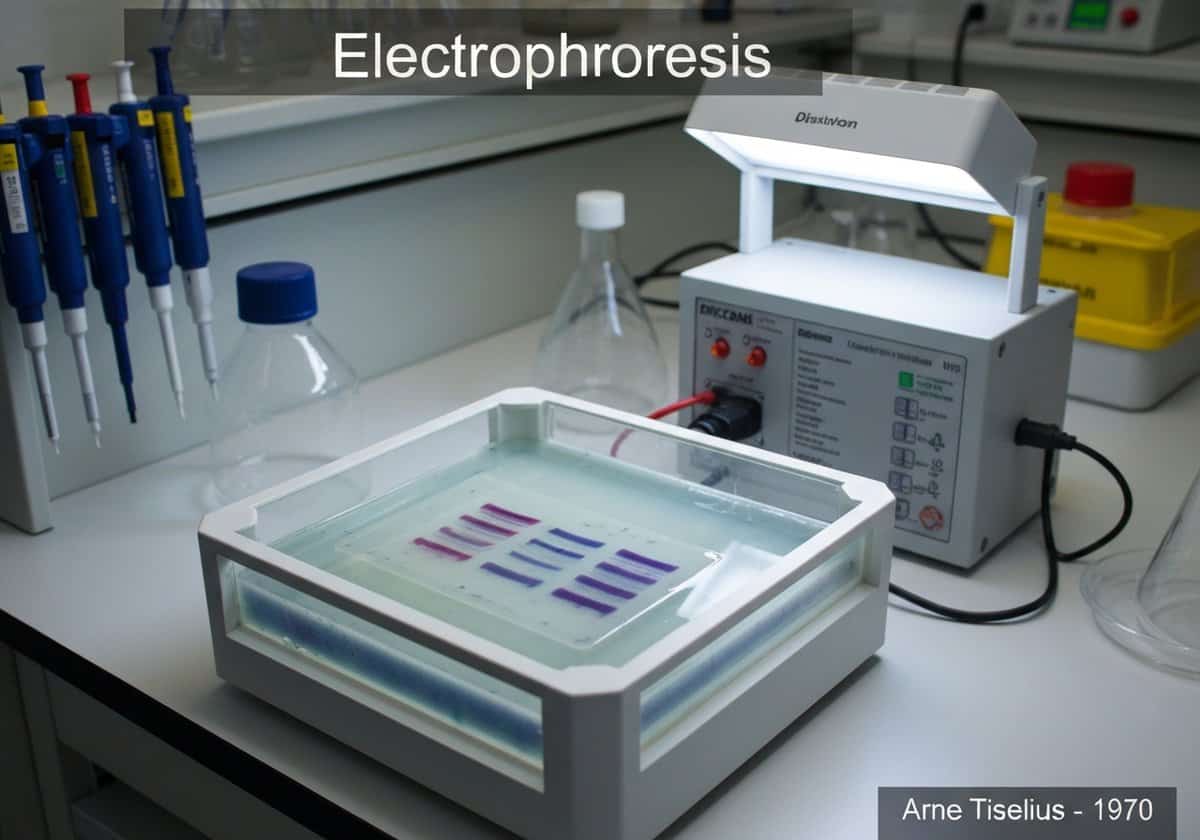
Apparecchiatura per l'elettroforesi su gel in laboratorio che separa i campioni di DNA in base alle dimensioni.

(Immagine generata a solo scopo illustrativo)

L'elettroforesi su gel è una tecnica utilizzata per separare macromolecole come DNA, RNA e proteine ​​in base alle loro dimensioni e carica. Un campo elettrico viene applicato a una matrice di gel, provocando il movimento delle molecole caricate negativamente (come il DNA) verso l'elettrodo positivo. Le molecole più piccole migrano più velocemente e più lontano attraverso i pori del gel rispetto alle molecole più grandi.
Gel electrophoresis is a cornerstone technique in molecular biology for the separation and analysis of macromolecules, primarily DNA, RNA, and proteins. The principle behind the technique is the migration of charged molecules through a porous gel matrix under the influence of an electric field. Since nucleic acids (DNA and RNA) have a consistently negative charge due to their phosphate backbone, they will naturally migrate towards the positive electrode (anode) when a current is applied. The gel itself, typically made of agarose for larger molecules like genomic DNA fragments or polyacrylamide for smaller fragments and proteins (in a technique called PAGE), acts as a molecular sieve. The matrix is composed of a network of pores through which the molecules must travel. Smaller molecules navigate this labirinto more easily and quickly than larger molecules, which are impeded more by the gel matrix. Consequently, the molecules are separated based on their size, with the smallest traveling the farthest from the starting point (the well) in a given amount of time. To perform DNA electrophoresis, a sample is first loaded into wells at one end of the gel. A ‘DNA ladder,’ a mixture of DNA fragments of known sizes, is run in a separate lane to serve as a reference for estimating the size of the unknown fragments. After the electric current is applied for a period, the separated fragments are visualized. Because DNA is invisible to the naked eye, a fluorescent dye that intercalates with the DNA, such as ethidium bromide or SYBR Green, is used. When placed under UV light, the dye fluoresces, revealing the DNA as distinct bands, each band representing a collection of fragments of the same size.

UNESCO Nomenclature: 2401
- Biochimica

Tipo

Processo fisico

Interruzione

Fondamento

Utilizzo

Uso diffuso

Precursori

  • Michael Faraday’s laws of elettrolisi
  • scoperta dell'elettricità
  • Lo sviluppo di Arne Tiselius dell'elettroforesi a limite mobile
  • sviluppo di supporti come carta, amido e infine gel di agarosio/poliacrilammide
  • scoperta del DNA e della sua carica negativa

Applicazioni

  • Impronta digitale del DNA
  • test di paternità
  • diagnosi di malattie genetiche
  • purificazione dei frammenti di DNA per la clonazione
  • analizzare PCR prodotti
  • analisi proteica (SDS-PAGE)

Brevetti:

NA

Idee e potenziali innovazioni

  • elettroforesi su gel a campo pulsato per la separazione di molecole di DNA molto grandi
  • elettroforesi capillare per analisi automatizzate ad alto rendimento
  • Elettroforesi su gel 2D per la separazione di miscele proteiche complesse
  • integrazione dell'elettroforesi con la spettrometria di massa per la proteomica
  • microfluidico chip-based electrophoresis for rapid analysis
  • software automatizzato di analisi e imaging del gel
  • sviluppo di coloranti del DNA più sicuri e non tossici
  • elettroforesi su gel a gradiente di temperatura (TGGE) per la rilevazione delle mutazioni
  • gel pre-colati per una migliore riproducibilità e praticità
  • tecniche di blotting (meridionale, settentrionale, occidentale) che trasferiscono le molecole separate su una membrana per ulteriori analisi
Correlato a: elettroforesi su gel, separazione del DNA, gel di agarosio, poliacrilammide, SDS-PAGE, DNA fingerprinting, peso molecolare, frammenti di restrizione, acidi nucleici, proteine.

Contesto storico

Elettroforesi

1954
1960
1967
1970
1975
1977
1983
1951
1958
1960
1970
1973
1975
1979
1983

(se la data è sconosciuta o non rilevante, ad esempio "meccanica dei fluidi", viene fornita una stima approssimativa della sua notevole comparsa)

decimo anno anniversario

Le immagini a grandezza naturale e i download sono disponibili, gratuitamente al 100%, solo per gli utenti registrati.

> Login <