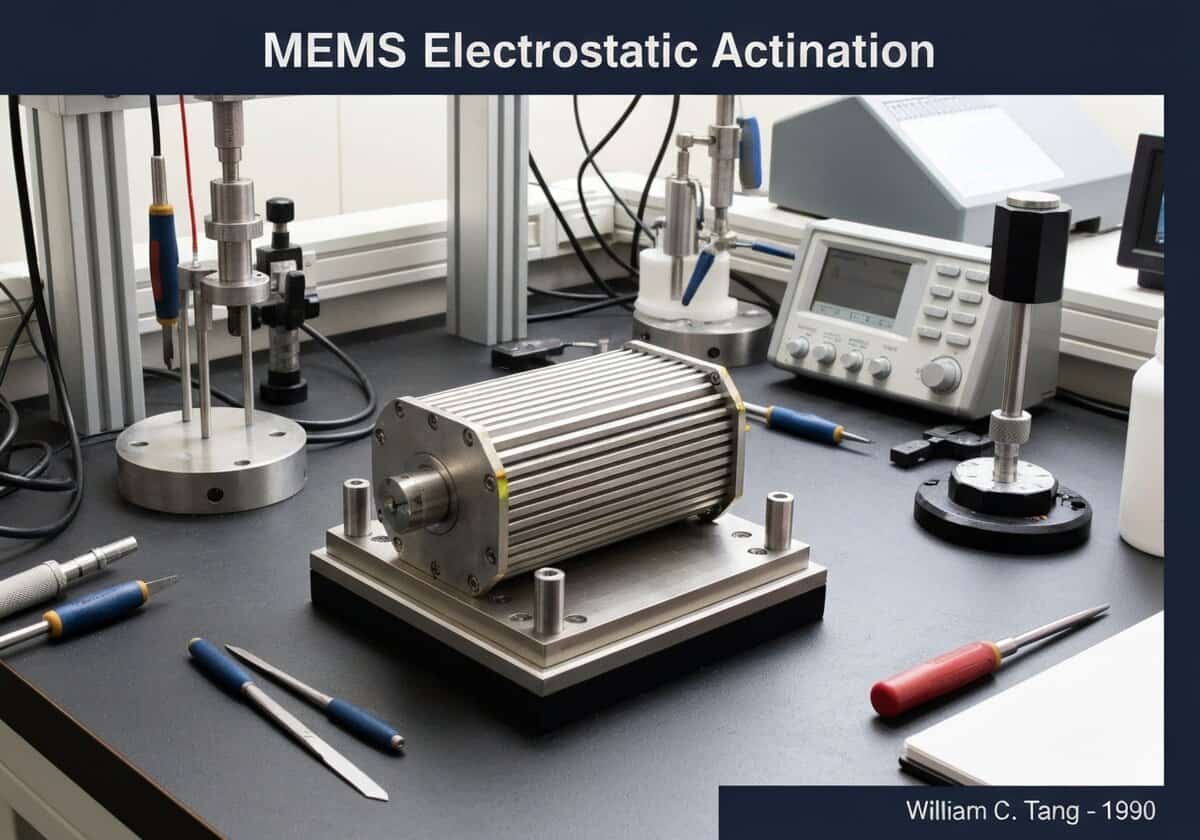
MEMS Electrostatic Actuation
Electrostatic actuation is a primary metodo for inducing motion in MEMSSfrutta la forza di attrazione tra due elettrodi separati da un intervallo dielettrico quando viene applicata una tensione. La forza è proporzionale al quadrato della tensione e al gradiente di capacità. I progetti più comuni includono condensatori a piastre parallele per il movimento fuori dal piano e azionamenti a pettine per grandi spostamenti nel piano.
Electrostatic actuation is favored in MEMS due to its low power consumption (ideally zero static power), high speed, and compatibility with standard microfabrication processes. The fundamental force [latex]F[/latex] in a parallel-plate actuator is given by [latex]F = \frac{1}{2} \frac{dC}{dx}V^2[/latex], where [latex]V[/latex] is the voltage and [latex]\frac{dC}{dx}[/latex] is the gradient of the capacitance [latex]C[/latex] with respect to displacement [latex]x[/latex]. For an ideal parallel-plate capacitor, this simplifies to [latex]F approx \frac{1}{2} \frac{\epsilon A V^2}{g^2}[/latex], where [latex]\epsilon[/latex] is the dielectric permittivity, [latex]A[/latex] is the plate area, and [latex]g[/latex] is the gap. This equation highlights a critical challenge: the force is highly non-linear with displacement. As the gap closes, the electrostatic force increases rapidly, while a typical mechanical restoring force (from a spring) increases linearly. At a certain point (typically one-third of the initial gap), the electrostatic force overwhelms the restoring force, causing the movable plate to snap unstably to the fixed plate. This phenomenon, known as ‘pull-in,’ limits the stable travel range of simple electrostatic actuators.
To overcome this limitation, the comb drive actuator was invented. It consists of two interdigitated comb-like structures of conductive fingers. When a voltage is applied, electrostatic fields form between the sides of the fingers. This generates a lateral force that moves one comb relative to the other, parallel to the substrate. The key advantage is that as the combs engage, the number of overlapping finger pairs increases, but the gap between them remains constant. This results in a capacitance that changes linearly with displacement, producing a force that is largely independent of the position of the movable comb. This stable, long-range actuation was a revolutionary development, enabling a wide range of devices, particularly high-performance resonant sensors like gyroscopes and accelerometers, where precise and stable force feedback is required.
UNESCO Nomenclature: 3308
- Ingegneria elettrica
Precursori
- Legge di Coulomb sulla forza elettrostatica
- the concept of the capacitor
- semiconductor fabrication for creating precise electrode gaps
- micromachining to create released, movable structures
Applicazioni
- comb drive resonators in gyroscopes
- digital micromirror devices (DMDs)
- RF MEMS switches and varactors
- tunable lasers and optical filters
- atomic force microscope (AFM) scanners
Idee e potenziali innovazioni
A causa dell'eliminazione del traffico generato dai bot, che attualmente supera i 40.000 al giorno, questo contenuto è riservato ai membri della community.
> Accedi O > Registrati L'accesso a questo contenuto, così come a tutti gli altri contenuti e strumenti riservati, è (100% gratuito).
Argomenti correlati: attuazione elettrostatica, MEMS, azionamento a pettine, attuatore, effetto pull-in, capacità, microattuatore, tensione, piastre parallele, microelettronica.