Product Design, Manufacturing & Innovation Resources
Home » Zeroth Law of Thermodynamics

Zeroth Law of Thermodynamics

1930
  • Ralph H. Fowler
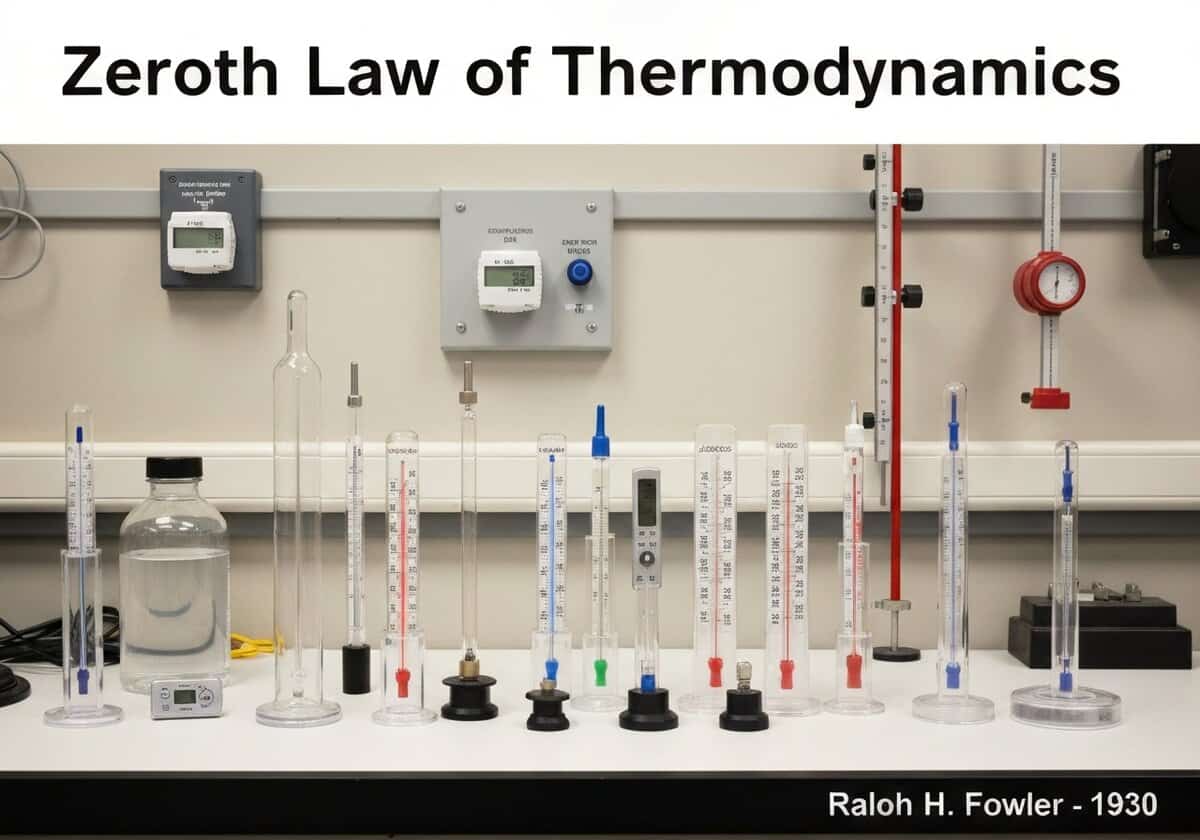
Thermodynamics laboratory with various thermometers and calibration equipment.

(generated image for illustration only)

This law establishes the concept of thermal equilibrium. If two systems are each in thermal equilibrium with a third, independent system, they are in thermal equilibrium with each other. This transitive property allows for the formal definition of temperature as a state function and provides a rational basis for constructing thermometers and universal temperature scales.


The Zeroth Law of Thermodynamics is fundamental, yet it was articulated long after the first and second laws were widely accepted, hence its unusual numbering. Before its formal statement, temperature was an intuitive concept, but the law provided a rigorous mathematical and physical foundation. It defines temperature as an intensive property that is equal when two systems are in thermal equilibrium. This means that if system A is in equilibrium with system C, and system B is also in equilibrium with system C, then A and B are in equilibrium with each other. System C can be thought of as a thermometer.

This law is crucial because it validates the use of a thermometer as a reliable tool for measuring the temperature of any other system. Without it, there would be no guarantee that two objects showing the same reading on a thermometer are actually at the same temperature. The novelty of the Zeroth Law was not in discovering a new physical phenomenon, but in recognizing and formalizing a principle that was already implicitly used. It elevated temperature from a mere comparative measure to a precisely defined state variable, paving the way for the mathematical formulations of the other laws of thermodynamics.

UNESCO Nomenclature: 2212
– Thermodynamics, statistical physics, and condensed matter

Type

Abstract System

Disruption

Foundational

Usage

Widespread Use

Precursors

  • invention of the thermoscope by Galileo Galilei
  • development of standardized temperature scales by Fahrenheit, Celsius, and Kelvin
  • early concepts of heat and calorimetry
  • theories on the nature of heat, including the caloric theory

Applications

  • thermometers (mercury, alcohol, digital)
  • thermostats for hvac systems
  • calibration of scientific and industrial temperature sensors
  • meteorology for consistent weather measurements
  • process control in chemical engineering

Patents:

NA

Potential Innovations Ideas

Due to scrapping bot traffic, currently more than 40k per day, this content is reserved to community members.
> Login < or > Register < (100% free) to access this, so as all other restricted content and tools.

Related to: zeroth law, thermal equilibrium, temperature, thermometer, thermodynamics, transitive property, state function, heat, system, empirical temperature.

Historical Context

Zeroth Law of Thermodynamics

1926
1927
1930
1930
1930
1931
1932
1926
1927
1927
1930
1930
1930
1931
1932

(if date is unknown or not relevant, e.g. "fluid mechanics", a rounded estimation of its notable emergence is provided)

Related Invention, Innovation & Technical Principles

Full size images and downloads are only available, 100% free, for registered members.

> Login <