Product Design, Manufacturing & Innovation Resources
Home » The Zeeman Effect

The Zeeman Effect

1896
  • Pieter Zeeman
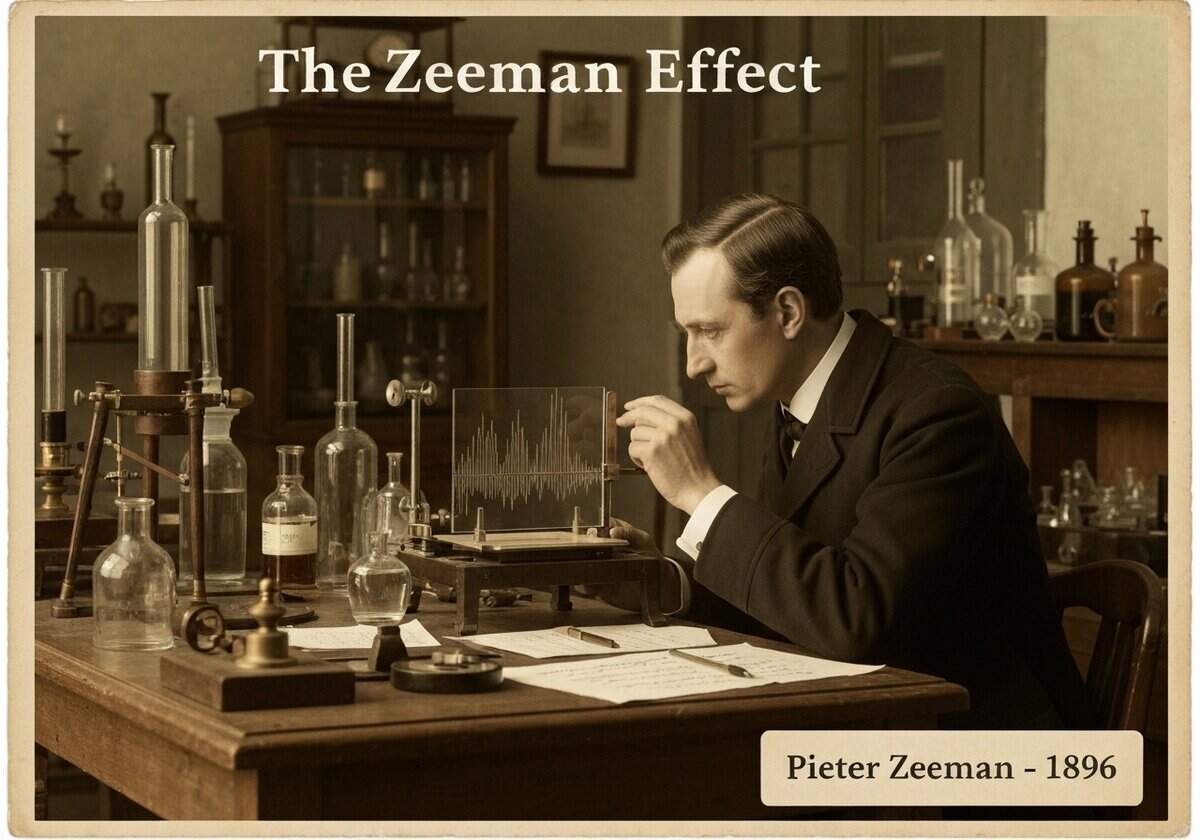
Spectroscopy experiment illustrating the Zeeman effect in atomic physics.

(generated image for illustration only)

The Zeeman effect is the splitting of an atomic spectral line into multiple components when an external static magnetic field is applied. This splitting occurs because the magnetic field interacts with the magnetic dipole moment associated with the atom’s orbital and spin angular momentum, shifting the energy levels of its electrons, a phenomenon crucial for probing atomic structure.

Discovered by Dutch physicist Pieter Zeeman in 1896, the Zeeman effect was a pivotal observation in the development of modern physics. When an atom is placed in a magnetic field, its energy levels, which are normally degenerate (having the same energy), are split. This is because the magnetic field interacts with the magnetic moment of the atom. This magnetic moment has two primary sources: the motion of electrons orbiting the nucleus (orbital angular momentum) and the intrinsic quantum property of electrons known as spin (spin angular momentum). The interaction lifts the degeneracy of states with different magnetic quantum numbers.

When an electron transitions between these split energy levels, it emits or absorbs a photon. Since there are now multiple possible final energy states, a single spectral line, corresponding to a transition in the absence of a field, splits into several distinct lines. The spacing and polarization of these lines provide detailed information about the atom’s electronic structure, including its angular momentum quantum numbers. Hendrik Lorentz provided an early classical explanation, but a complete understanding required the advent of quantum mechanics and the concept of electron spin. The effect is categorized into the ‘normal’ Zeeman effect (for atoms with zero total spin) and the more common ‘anomalous’ Zeeman effect (for atoms with non-zero spin).

UNESCO Nomenclature: 2202
– Atomic and molecular physics

Type

Physical Phenomenon

Disruption

Incremental

Usage

Widespread Use

Precursors

  • Michael Faraday’s work on electromagnetism and the Faraday effect
  • James Clerk Maxwell’s equations of electromagnetism
  • the development of high-resolution spectroscopy by Kirchhoff and Bunsen
  • Hendrik Lorentz’s classical electron theory
  • the discovery of the electron by J.J. Thomson

Applications

  • nuclear magnetic resonance (NMR) spectroscopy
  • magnetic resonance imaging (MRI)
  • electron spin resonance (esr) spectroscopy
  • atomic absorption spectroscopy (AAS) for elemental analysis
  • astrophysical measurements of stellar and solar magnetic fields
  • laser cooling and trapping of atoms

Patents:

NA

Potential Innovations Ideas

Due to scrapping bot traffic, currently more than 40k per day, this content is reserved to community members.
> Login < or > Register < (100% free) to access this, so as all other restricted content and tools.

Related to: Zeeman effect, spectral line splitting, magnetic field, atomic physics, spectroscopy, quantum mechanics, energy levels, angular momentum, Pieter Zeeman, Lorentz.

Historical Context

The Zeeman Effect

1890
1895
1895
1896
1900
1900
1900
1890
1890
1895
1895
1899
1900
1900
1900

(if date is unknown or not relevant, e.g. "fluid mechanics", a rounded estimation of its notable emergence is provided)

Related Invention, Innovation & Technical Principles

Full size images and downloads are only available, 100% free, for registered members.

> Login <