Product Design, Manufacturing & Innovation Resources
Home » Yield Strength

Yield Strength

1860
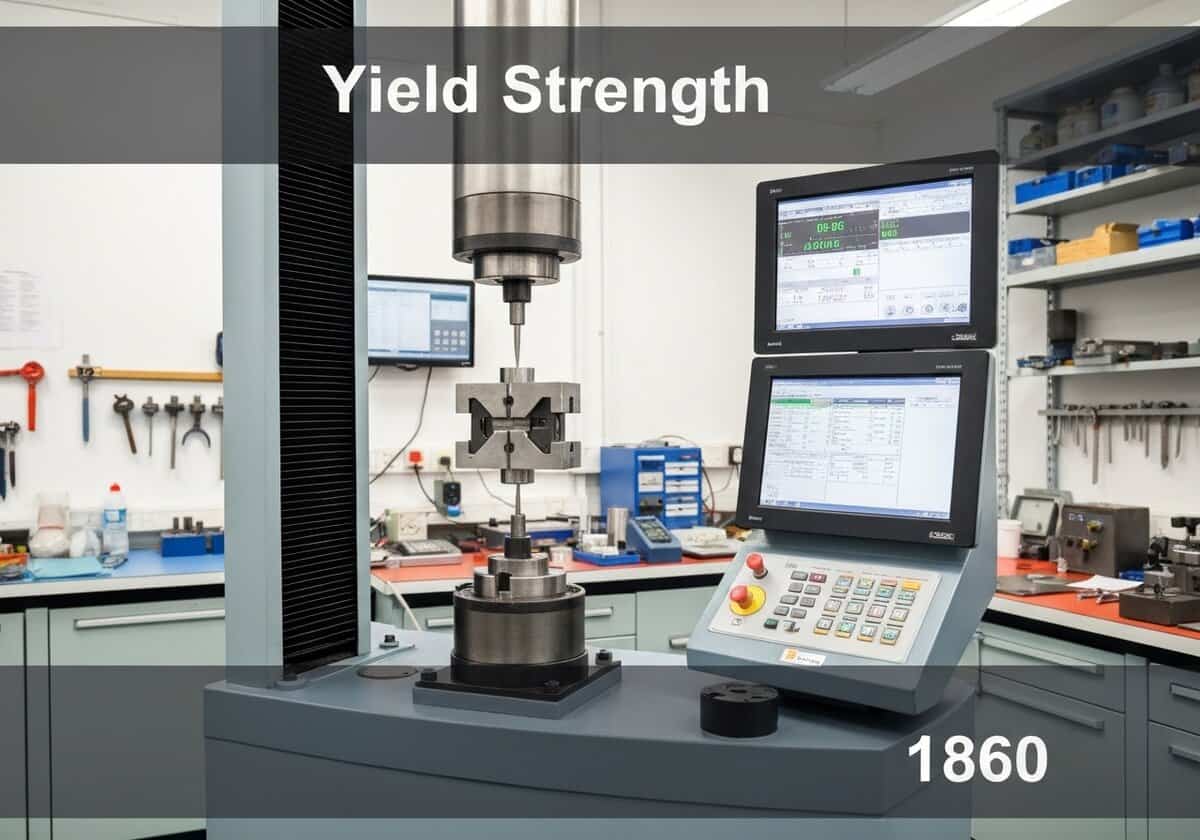
Tensile testing machine measuring yield strength in materials science.

(generated image for illustration only)

Yield strength, or the yield point, is the stress at which a material begins to deform plastically. Prior to the yield point, the material deforms elastically and will return to its original shape when the applied stress is removed. Once the yield point is passed, some fraction of the deformation will be permanent and non-reversible. It marks the limit of elastic behavior.


The transition from elastic to plastic behavior is a critical design consideration. For materials with a clear, sharp yield point (like low-carbon steel), it’s easily identified on the stress-strain curve as a distinct peak (upper yield point) followed by a drop to a lower, constant stress plateau (lower yield point). However, many materials, such as aluminum alloys, exhibit a gradual transition. For these, a proof stress or offset yield point is defined. This is commonly determined by the 0.2% offset method, where a line parallel to the initial elastic portion of the curve is drawn from a strain value of 0.002 (or 0.2%). The stress at which this line intersects the stress-strain curve is defined as the 0.2% proof yield strength. This value represents the stress that would cause a permanent, non-recoverable strain of 0.2% upon unloading. The yield strength is a fundamental parameter used to determine the maximum allowable load a mechanical component can bear before it is considered to have failed, as permanent deformation can render a part unusable even if it has not fractured.

UNESCO Nomenclature: 3313
– Materials science

Type

Physical Property

Disruption

Foundational

Usage

Widespread Use

Precursors

  • understanding of elastic vs. plastic behavior in metals
  • development of accurate extensometers to measure small deformations
  • industrial need for predictable material performance under load
  • theories of dislocation motion in crystalline solids

Applications

  • structural design of buildings and bridges to prevent permanent deformation
  • automotive crashworthiness design (energy absorption through plastic deformation)
  • design of fasteners and bolts
  • metal forming processes like rolling, forging, and extrusion
  • setting pressure limits for pipes and pressure vessels

Patents:

NA

Potential Innovations Ideas

Due to scrapping bot traffic, currently more than 40k per day, this content is reserved to community members.
> Login < or > Register < (100% free) to access this, so as all other restricted content and tools.

Related to: yield strength, yield point, plastic deformation, elastic limit, stress-strain curve, proof stress, 0.2% offset, material science, mechanical design, permanent set.

Historical Context

Yield Strength

1850
1850
1850
1860
1870
1876
1882-01-01
1850
1850
1850
1850
1867
1875-01-01
1881
1884

(if date is unknown or not relevant, e.g. "fluid mechanics", a rounded estimation of its notable emergence is provided)

Related Invention, Innovation & Technical Principles

Full size images and downloads are only available, 100% free, for registered members.

> Login <