Product Design, Manufacturing & Innovation Resources
Home » Polymers UV-Curing

Polymers UV-Curing

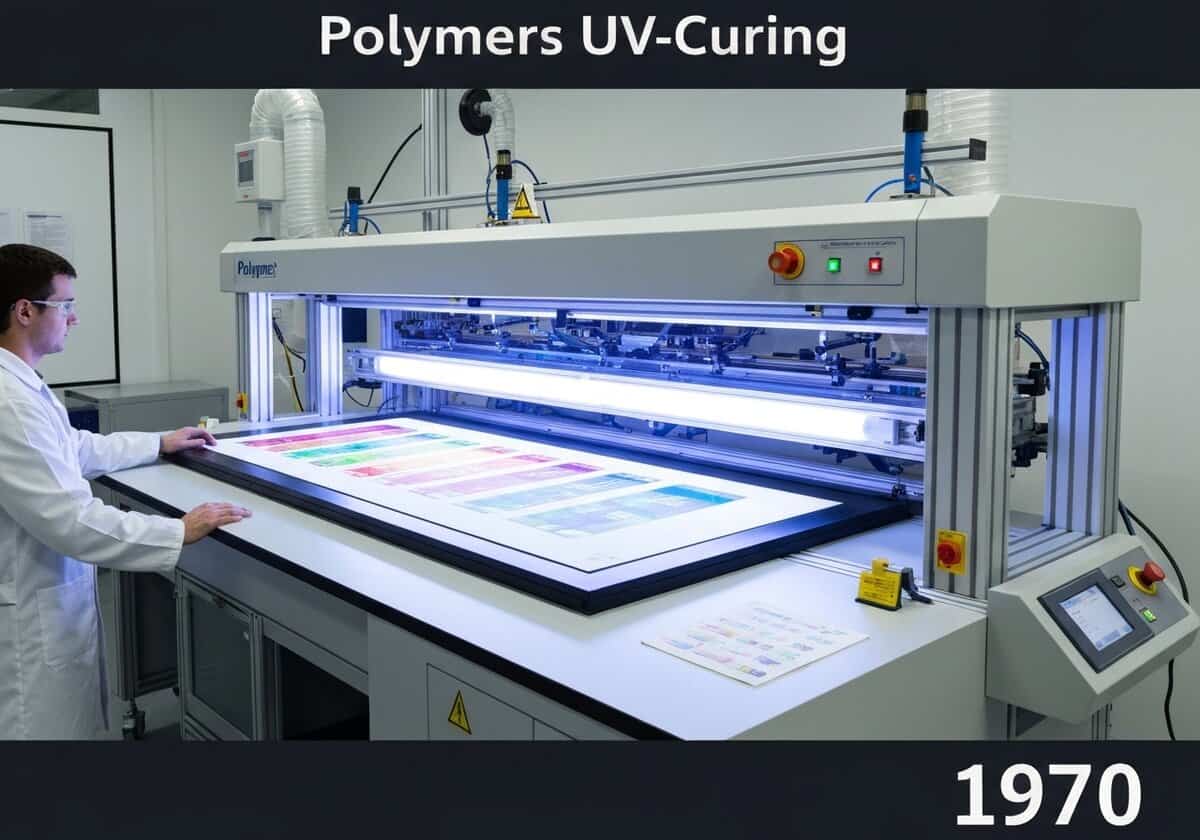
1970
UV-curing machine curing inks in a laboratory, polymer chemistry application.

(generated image for illustration only)

UV-curing is a rapid photochemical process where high-intensity ultraviolet light is used to instantly cure or dry inks, coatings, and adhesives. The UV energy triggers photoinitiators within the liquid formulation, which then start a polymerization reaction that cross-links the molecules, converting the liquid into a solid in a fraction of a second.

The UV-curing process relies on a specially formulated mixture containing monomers, oligomers, and photoinitiators. Monomers are small, simple molecules, while oligomers are short chains of these molecules. These components form the backbone of the final polymer. The key ingredient is the photoinitiator. When exposed to UV radiation of a specific wavelength and intensity, the photoinitiator molecule absorbs a photon and is promoted to an excited state. It then undergoes fragmentation, generating highly reactive species called free radicals. These free radicals immediately attack the carbon-carbon double bonds in the monomers and oligomers, initiating a chain reaction. This process, known as free-radical polymerization, rapidly creates a highly cross-linked, three-dimensional polymer network. The entire conversion from liquid to solid can occur in under a second. The main advantages of UV-curing over traditional thermal curing are speed, low energy consumption (as no large ovens are needed), and the absence of volatile organic compounds (VOCs) since the formulations are typically 100% solids. Different photoinitiators are sensitive to different UV wavelengths (UVA, UVB, or UVV – UV-Visible), allowing for precise control over the curing process, including the depth of cure in thicker coatings.

UNESCO Nomenclature: 2303
– Chemistry

Type

Chemical Process

Disruption

Substantial

Usage

Widespread Use

Precursors

  • Discovery of polymerization
  • Understanding of free-radical chemistry
  • Development of high-intensity UV lamps (e.g., mercury-vapor lamps)
  • Synthesis of photoinitiator molecules

Applications

  • printing industry (fast-drying inks)
  • automotive coatings (scratch-resistant clear coats)
  • dentistry (curing of dental fillings)
  • 3d printing (stereolithography)
  • electronics (conformal coatings for circuit boards)
  • nail polish (gel manicures)

Patents:

NA

Potential Innovations Ideas

Due to scrapping bot traffic, currently more than 40k per day, this content is reserved to community members.
> Login < or > Register < (100% free) to access this, so as all other restricted content and tools.

Related to: UV-curing, polymerization, photoinitiator, free radical, coatings, adhesives, inks, stereolithography, materials science, photochemistry.

Historical Context

1880
1897
1970
1890
1955
1980

(if date is unknown or not relevant, e.g. "fluid mechanics", a rounded estimation of its notable emergence is provided)

Related Invention, Innovation & Technical Principles

Full size images and downloads are only available, 100% free, for registered members.

> Login <