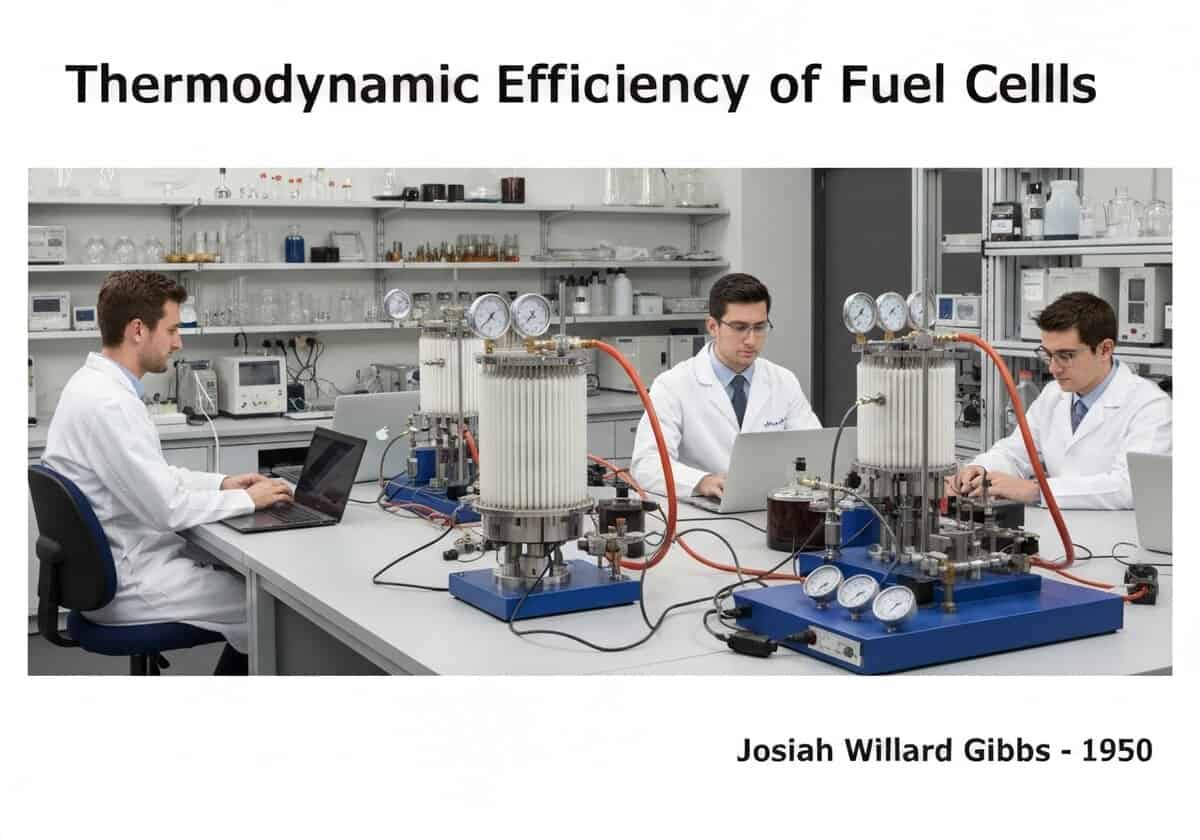
Thermodynamic Efficiency of Fuel Cells
The maximum theoretical efficiency of a fuel cell is governed by the ratio of the change in Gibbs free energy (\(\Delta G\)) to the change in enthalpy (\(\Delta H\)) of the electrochemical reaction. This is expressed as \(\eta_{thermo} = \frac{\Delta G}{\Delta H}\). Crucially, fuel cells are not heat engines and are therefore not constrained by the Carnot efficiency limit, allowing for significantly higher theoretical conversion efficiencies.
The Gibbs free energy, \(\Delta G\), represents the maximum amount of non-expansion work that can be extracted from a thermodynamically closed system at constant temperature and pressure. In a fuel cell, this work is the electrical work performed. The change in enthalpy, \(\Delta H\), represents the total heat content of the reaction, which is the energy released during combustion. The difference between these two values, \(T\Delta S\) (where T is temperature and \(\Delta S\) is the change in entropy), represents the unavoidable waste heat generated by the reaction even under ideal, reversible conditions.
In contrast, a heat engine’s maximum efficiency is dictated by the Carnot limit, \(\eta_C = 1 – \frac{T_{cold}}{T_{hot}}\), which depends on the temperature difference between its hot and cold reservoirs. For a typical hydrogen fuel cell operating at standard conditions, the thermodynamic efficiency is around 83%, whereas practical internal combustion engines struggle to exceed 40%. While the theoretical fuel cell efficiency is high, real-world devices suffer from several irreversible losses, or ‘polarizations’, that reduce their practical efficiency. These include activation losses (energy needed to initiate the reaction), ohmic losses (resistance to ion and electron flow), and mass transport losses (failure to supply reactants to reaction sites quickly enough).
UNESCO Nomenclature: 2212
– Thermodynamics
Precursors
- formulation of the first law of thermodynamics (c. 1850)
- formulation of the second law of thermodynamics and the concept of entropy by Rudolf Clausius (1850s)
- development of the concept of Gibbs free energy by Josiah Willard Gibbs (1870s)
Applications
- design of high-efficiency combined heat and power (CHP) systems
- optimization of fuel cell operating parameters (temperature, pressure)
- materials science research for reducing energy losses in electrodes and electrolytes
- theoretical modeling of next-generation fuel cell performance
- economic analysis of fuel cell viability versus combustion technologies
Potential Innovations Ideas
Due to scrapping bot traffic, currently more than 40k per day, this content is reserved to community members.
> Login < or > Register < (100% free) to access this, so as all other restricted content and tools.
Related to: Gibbs free energy, enthalpy, entropy, fuel cell efficiency, thermodynamics, Carnot cycle, polarization, voltage loss, electrochemistry, energy conversion.