Product Design, Manufacturing & Innovation Resources
Home » The R Programming Language

The R Programming Language

1993
  • Ross Ihaka
  • Robert Gentleman
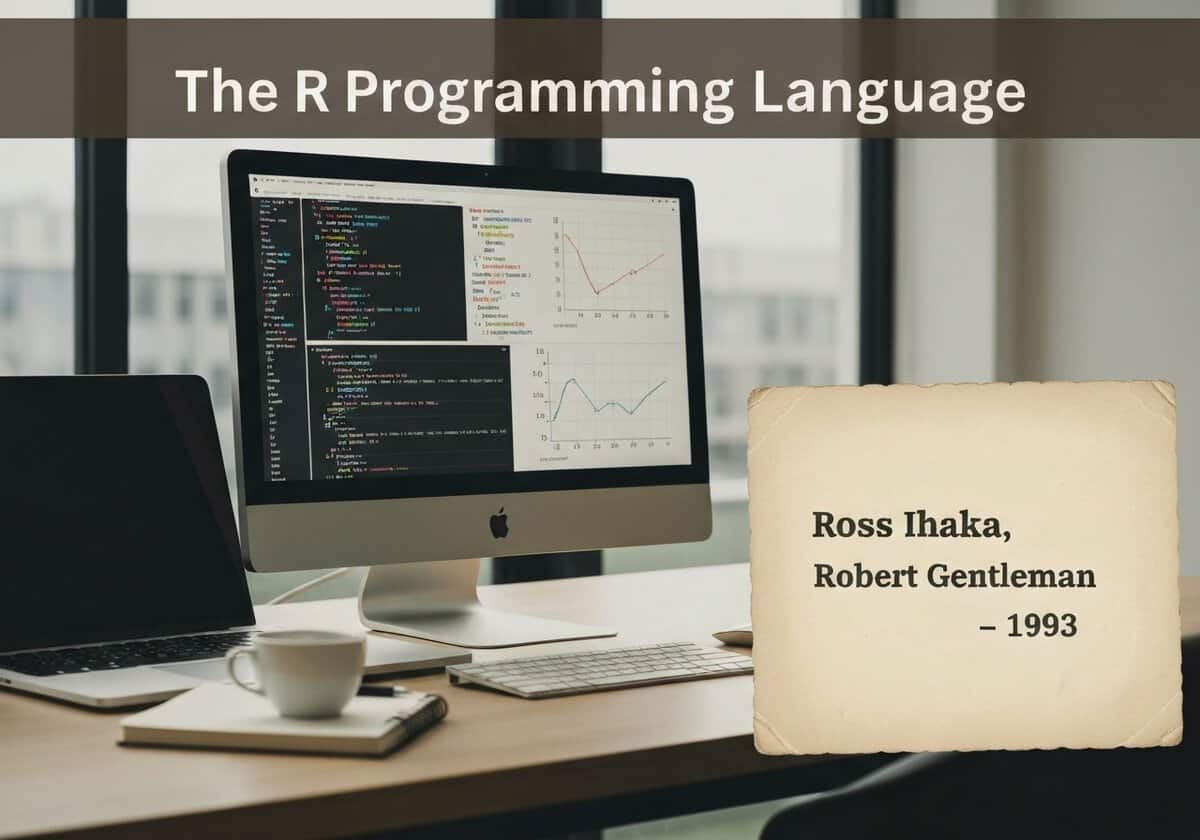
R programming environment with statistical analysis tools and coding interface.

(generated image for illustration only)

R is a free software environment for statistical computing and graphics, and a dialect of the S programming language. It was created by Ross Ihaka and Robert Gentleman at the University of Auckland, New Zealand. R is considered an alternative implementation of S, with semantics derived from Scheme, which introduced powerful features like lexical scoping not present in early S.

R’s lineage traces directly back to the S language, developed at Bell Labs by John Chambers and colleagues. While S was primarily a commercial product (S-PLUS), R was conceived as a free, open-source alternative. Ross Ihaka and Robert Gentleman, academics at the University of Auckland, began the project in 1992 to create a language for their teaching needs that was syntactically similar to S but with different underlying mechanics. They incorporated ideas from functional programming languages like Scheme, most notably lexical scoping. This design choice distinguishes R from the earlier S versions and has profound implications for how functions handle variables, making code more predictable and easier to reason about.

The name “R” was chosen partly as a play on the names of its authors (Ross and Robert) and partly as a nod to its predecessor, S. The project was announced to the public on the S-news mailing list in 1993, and the R Core Team was formed in 1997 to manage the language’s development after it gained significant traction. R’s core is written in C and Fortran, allowing it to interface with high-performance numerical libraries, while users interact with it through its own high-level interpreted language. This combination of statistical heritage, open-source accessibility, and modern programming features fueled its rise to become a lingua franca for statistics and data science.

UNESCO Nomenclature: 1203
– Computer science

Type

Software/Algorithm

Disruption

Substantial

Usage

Widespread Use

Precursors

  • The S programming language developed at Bell Labs
  • The Scheme programming language and its concept of lexical scoping
  • The AWK language which influenced S’s data handling
  • The C programming language in which R’s interpreter is written
  • The Fortran language used for many of R’s numerical libraries

Applications

  • development of the RStudio IDE
  • creation of the Tidyverse ecosystem
  • widespread use in academic research for statistical analysis
  • data science and machine learning applications in industry
  • bioinformatics analysis through the Bioconductor project

Patents:

    Potential Innovations Ideas

    Due to scrapping bot traffic, currently more than 40k per day, this content is reserved to community members.
    > Login < or > Register < (100% free) to access this, so as all other restricted content and tools.

    Related to: R, S language, statistical computing, Ross Ihaka, Robert Gentleman, open source, Bell Labs, programming language, history, Scheme.

    Historical Context

    The R Programming Language

    1982-07-01
    1988-06-01
    1990
    1993
    1997-04-23
    2001
    2010
    1980
    1986-01-01
    1990
    1990
    1993
    1998
    2010
    2016

    (if date is unknown or not relevant, e.g. "fluid mechanics", a rounded estimation of its notable emergence is provided)

    Related Invention, Innovation & Technical Principles

    Full size images and downloads are only available, 100% free, for registered members.

    > Login <