Product Design, Manufacturing & Innovation Resources
Home » Quantization of Energy

Quantization of Energy

1900-12-14
  • Max Planck
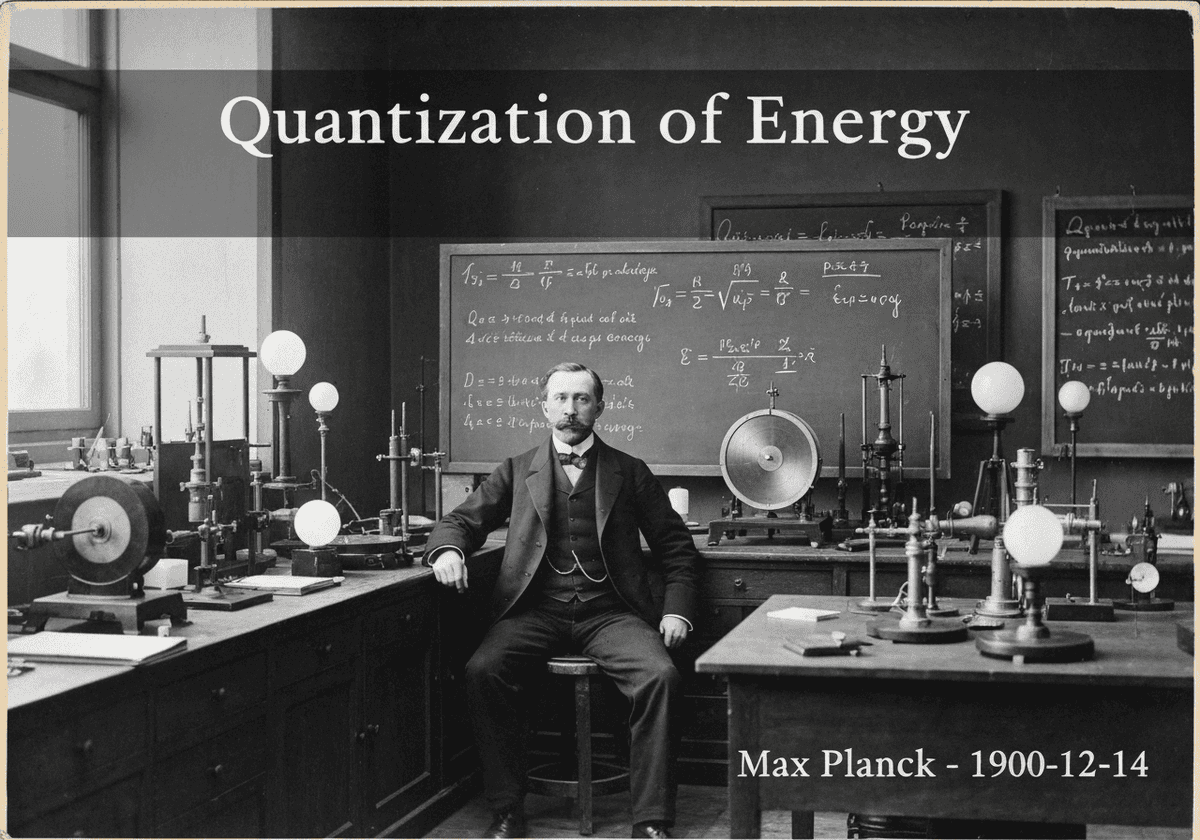
Max Planck in a laboratory exploring quantum physics and energy quantization.

(generated image for illustration only)

Energy is not continuous but comes in discrete packets called quanta. The energy \(E\) of a single quantum of electromagnetic radiation (a photon) is directly proportional to its frequency \(\nu\). This relationship is defined by the Planck-Einstein relation, \(E = h\nu\), where \(h\) is the Planck constant. This concept fundamentally challenged classical physics.

The concept of quantization originated from Max Planck’s work on black-body radiation. Classical physics, specifically the Rayleigh-Jeans law, failed to accurately predict the spectral distribution of thermal radiation emitted by a black body, leading to the ‘ultraviolet catastrophe’. To resolve this, Planck postulated in 1900 that the energy of the oscillators in the walls of the black body could only take on discrete values, proportional to an integer multiple of a fundamental unit of energy, \(h\nu\). This meant energy was emitted and absorbed in discrete packets, or ‘quanta’.

This was a radical departure from the classical view where energy was considered a continuous quantity. Albert Einstein later extended this idea in 1905 to explain the photoelectric effect, proposing that light itself is composed of these discrete energy packets, which were later named photons. The energy of a photon is given by \(E = h\nu\), where \(h \approx 6.626 \times 10^{-34} \text{ J} \cdot \text{s}\). This relation connects the particle-like property of light (energy packets) with its wave-like property (frequency), laying the groundwork for wave-particle duality. The quantization of energy is not limited to light; it is a fundamental principle of quantum mechanics, applying to the energy levels of electrons in atoms, vibrational modes of molecules, and other quantum systems.

UNESCO Nomenclature: 2210
– Quantum Physics

Type

Abstract System

Disruption

Revolutionary

Usage

Widespread Use

Precursors

  • Kirchhoff’s law of thermal radiation (1859)
  • Stefan-Boltzmann law (1879)
  • Wien’s displacement law (1893)
  • Rayleigh-Jeans law (c. 1900)
  • Studies on black-body radiation

Applications

  • lasers
  • photoelectric effect explanation
  • led lighting
  • quantum computing
  • atomic clocks

Patents:

NA

Potential Innovations Ideas

Due to scrapping bot traffic, currently more than 40k per day, this content is reserved to community members.
> Login < or > Register < (100% free) to access this, so as all other restricted content and tools.

Related to: quantization, Planck’s constant, black-body radiation, photon, energy levels, quantum, frequency, Max Planck.

Historical Context

Quantization of Energy

1900
1900
1900
1900-12-14
1902
1904
1907
1900
1900
1900
1900
1902
1902
1907
1909

(if date is unknown or not relevant, e.g. "fluid mechanics", a rounded estimation of its notable emergence is provided)

Related Invention, Innovation & Technical Principles

Full size images and downloads are only available, 100% free, for registered members.

> Login <