Product Design, Manufacturing & Innovation Resources
Home » Planckian Locus

Planckian Locus

1931
  • International Commission on Illumination (CIE)
Colorimeter measuring light sources in a laboratory for colorimetry applications.

(generated image for illustration only)

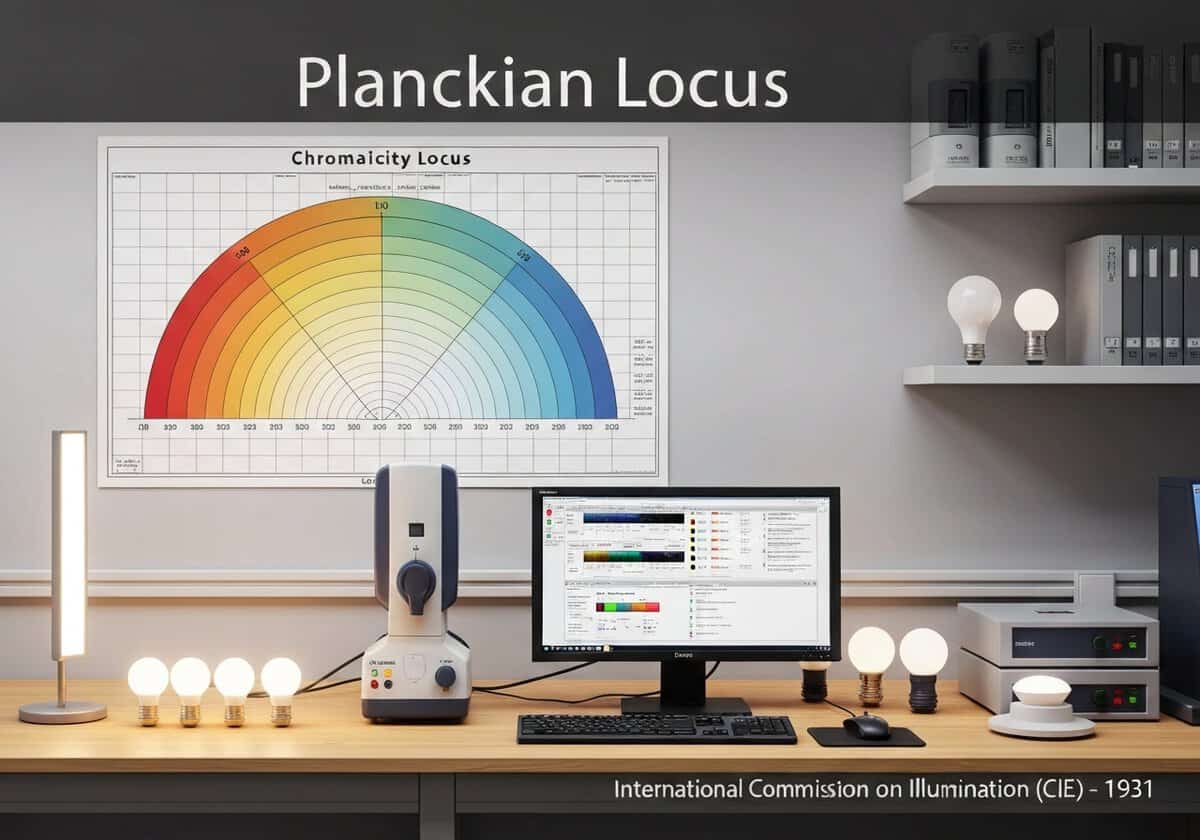
The Planckian locus is the path that the color of an incandescent black-body radiator follows in a chromaticity space as its temperature changes. It is typically plotted on the CIE 1931 xy chromaticity diagram, appearing as an arc from the reddish-orange region to the bluish-white region. It serves as the fundamental reference for defining color temperature.


The Planckian locus is a direct graphical representation of Planck’s law within the framework of human color perception. After the International Commission on Illumination (CIE) standardized the 1931 color space, it became possible to plot the color of any light source as a coordinate pair (x, y). By calculating the (x, y) coordinates for a perfect black-body radiator at every temperature from about 1000 K to over 10,000 K and connecting these points, the Planckian locus is formed.

This curve is not a straight line. It starts in the deep red part of the diagram at low temperatures, curves up through orange, yellow, and white near the center, and ends in the blue region at very high temperatures. Its significance lies in being the absolute reference for ‘white’ light produced by thermal radiation. Any light source whose chromaticity coordinates fall exactly on this locus has a color temperature equal to the black-body temperature at that point. For sources not on the locus, it serves as the reference for finding the closest point, which defines the correlated color temperature (CCT).

UNESCO Nomenclature: 2209
– Optics

Type

Abstract System

Disruption

Substantial

Usage

Widespread Use

Precursors

  • Planck’s law of black-body radiation (1900)
  • Development of trichromatic color theory by Young and Helmholtz
  • The work of the International Commission on Illumination (CIE) in standardizing color measurement

Applications

  • colorimetry and spectrophotometry
  • manufacturing of lighting and displays to specify white points
  • calibration of color measurement instruments
  • computer graphics rendering engines for realistic lighting
  • digital image processing for white balance algorithms

Patents:

NA

Potential Innovations Ideas

Due to scrapping bot traffic, currently more than 40k per day, this content is reserved to community members.
> Login < or > Register < (100% free) to access this, so as all other restricted content and tools.

Related to: Planckian locus, CIE 1931, chromaticity diagram, black-body radiator, color space, colorimetry, xy chromaticity, CCT, light source, standard illuminant.

Historical Context

Planckian Locus

1930
1930
1930
1931
1932
1933
1937
1927
1930
1930
1930
1931
1932
1936-01-01
1938

(if date is unknown or not relevant, e.g. "fluid mechanics", a rounded estimation of its notable emergence is provided)

Related Invention, Innovation & Technical Principles

Full size images and downloads are only available, 100% free, for registered members.

> Login <