Product Design, Manufacturing & Innovation Resources
Home » The Photovoltaic Effect

The Photovoltaic Effect

1839-01-01
  • Alexandre-Edmond Becquerel
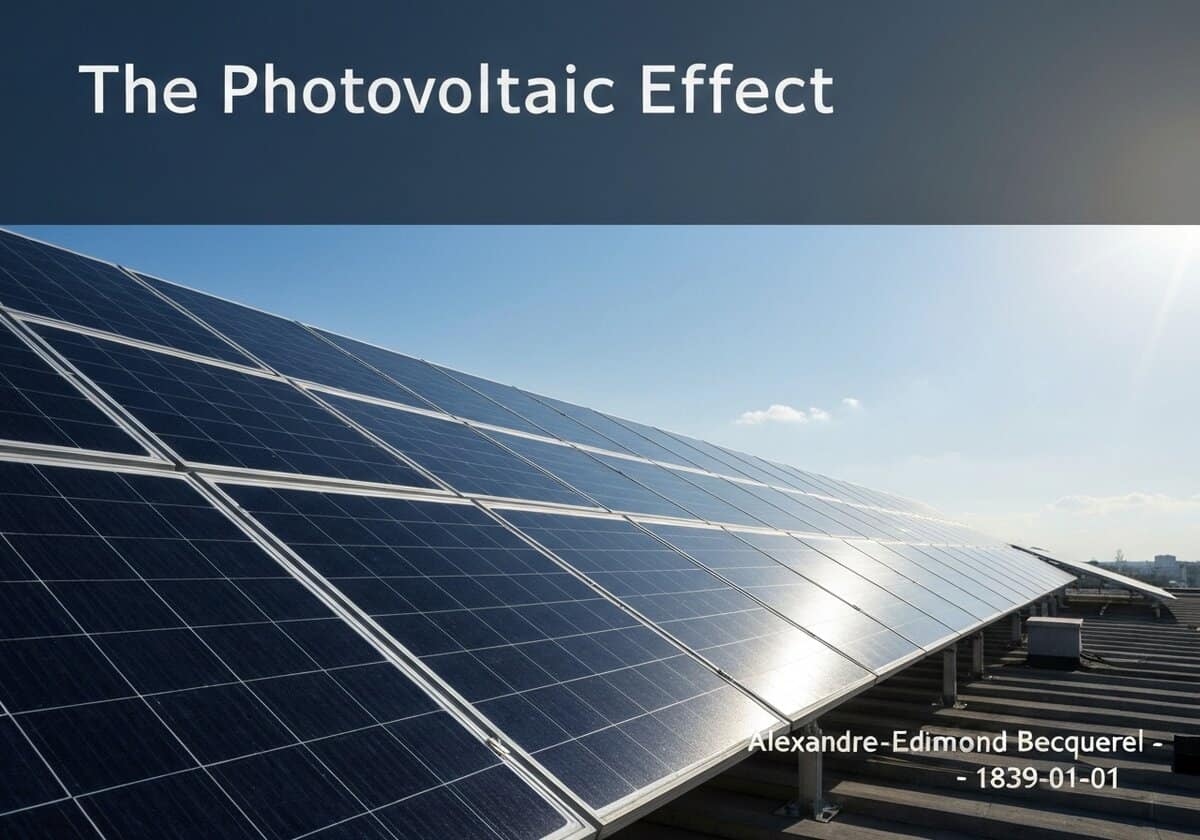
Solar panel installation demonstrating the photovoltaic effect in solid state physics.

(generated image for illustration only)

The photovoltaic effect is the generation of voltage and electric current in a material upon exposure to light. It is a physical and chemical phenomenon. A common application is the solar cell, which uses this effect to convert sunlight directly into electricity. The effect is based on photons of light exciting electrons into a higher state of energy.


The photovoltaic effect was first observed by French physicist Alexandre-Edmond Becquerel in 1839. He discovered that a voltage developed when a silver chloride electrode in an acidic solution was illuminated. The effect remained a scientific curiosity for decades. The modern understanding is rooted in semiconductor physics. When a photon with sufficient energy strikes a semiconductor material, it can excite an electron, moving it from the valence band to the conduction band. This creates an electron-hole pair. In a photovoltaic device, an internal electric field, typically created by a p-n junction, separates these charge carriers. The electrons are swept to the n-side and the holes to the p-side. This separation of charge creates a voltage across the junction. If an external circuit is connected, the free electrons will flow through the circuit, creating a direct current (DC). The energy of the photon must be greater than the band gap of the semiconductor material for this process to occur. Photons with energy less than the band gap pass through the material without being absorbed, while photons with energy much greater than the band gap will have their excess energy converted into heat, reducing the overall efficiency of the cell.

The first solid-state photovoltaic cell was created by Charles Fritts in 1883, who coated selenium with a thin layer of gold. However, its efficiency was less than 1%. The breakthrough came in 1954 at Bell Labs, where Daryl Chapin, Calvin Fuller, and Gerald Pearson developed the first practical silicon solar cell, achieving an efficiency of around 6%. This invention marked the beginning of the modern era of solar power technology and was initially used for niche applications like powering satellites in space.

UNESCO Nomenclature: 2211
– Solid state physics

Type

Physical Phenomenon

Disruption

Foundational

Usage

Widespread Use

Precursors

  • later confirmed by the discovery of the electron by J.J. Thomson (1897)
  • later Einstein’s explanation of the photoelectric effect (1905)
  • development of semiconductor physics and the p-n junction theory (1940s)
  • discovery of selenium’s photoconductivity by Willoughby Smith (1873)

Applications

  • solar panels for residential and utility-scale power generation
  • photovoltaic power stations
  • solar-powered calculators and watches
  • spacecraft power systems
  • remote sensing and telecommunications

Patents:

NA

Potential Innovations Ideas

Due to scrapping bot traffic, currently more than 40k per day, this content is reserved to community members.
> Login < or > Register < (100% free) to access this, so as all other restricted content and tools.

Related to: photovoltaic effect, solar cell, semiconductor, p-n junction, electron-hole pair, photons, direct current, band gap, Becquerel, renewable energy.

Historical Context

The Photovoltaic Effect

1833
1834
1836
1839-01-01
1842
1847
1850
1832
1834
1835
1838
1841
1845
1850
1850

(if date is unknown or not relevant, e.g. "fluid mechanics", a rounded estimation of its notable emergence is provided)

Related Invention, Innovation & Technical Principles

Full size images and downloads are only available, 100% free, for registered members.

> Login <