Product Design, Manufacturing & Innovation Resources
Home » Light-Dependent Reactions (Photophosphorylation)

Light-Dependent Reactions (Photophosphorylation)

1954
  • Daniel I. Arnon
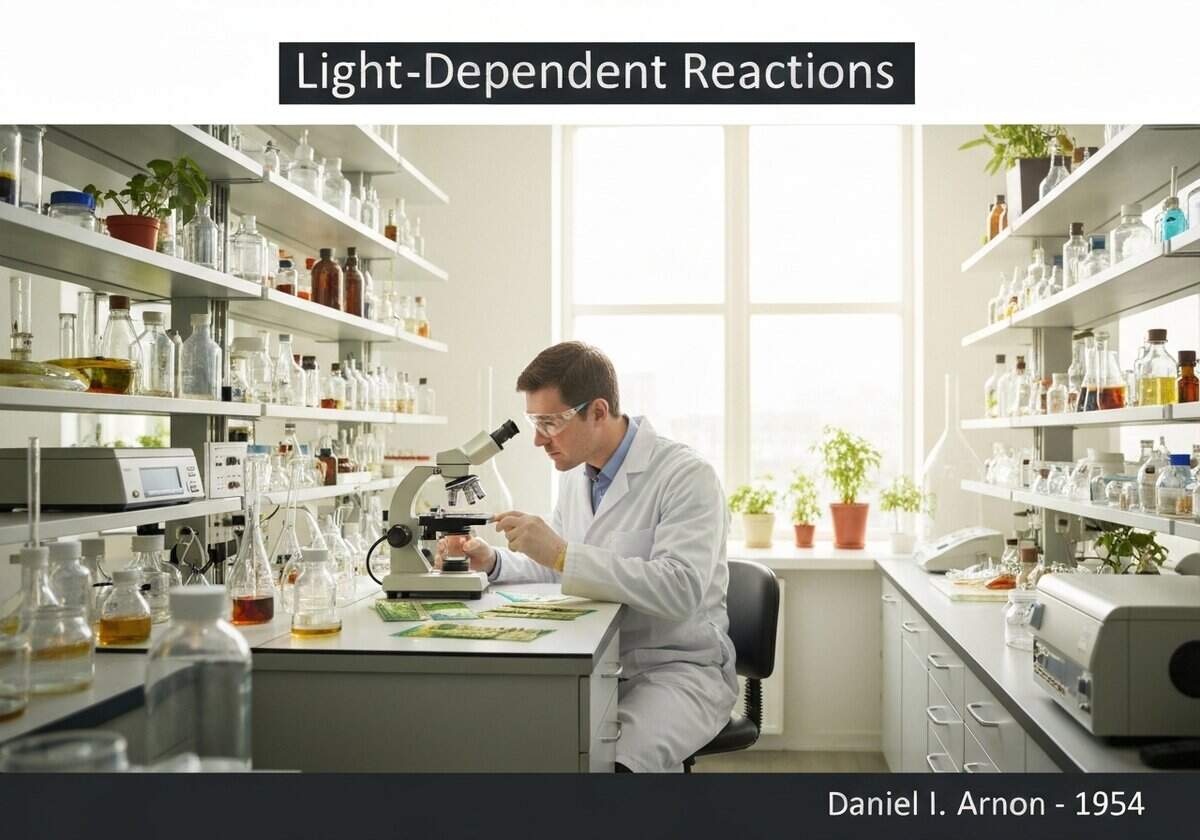
Chloroplasts in a laboratory setting highlighting light-dependent reactions in plant physiology.

(generated image for illustration only)

The first stage of photosynthesis, the light-dependent reactions, occurs in the thylakoid membranes of chloroplasts. Light energy is captured by chlorophyll to split water (photolysis), releasing oxygen, protons (\(H^+\)), and electrons (\(e^-\)). This energy is used to create two energy-carrying molecules: adenosine triphosphate (ATP) and nicotinamide adenine dinucleotide phosphate (NADPH), which power the subsequent Calvin cycle.
The light-dependent reactions are initiated when photons strike pigment molecules in Photosystem II (PSII). This excites electrons, which are then passed along an electron transport chain. To replace these electrons, PSII splits water molecules at the oxygen-evolving complex, a process called photolysis, which releases O2 as a byproduct. As electrons move down the transport chain to Photosystem I (PSI), their energy is used to pump protons from the stroma into the thylakoid lumen, creating a proton motive force.

At PSI, electrons are re-energized by another photon and are used to reduce NADP+ to NADPH. The proton gradient established across the thylakoid membrane drives an enzyme called ATP synthase, which synthesizes ATP from ADP and inorganic phosphate as protons flow back into the stroma. This process is known as photophosphorylation. In some cases, a cyclic pathway involving only PSI can occur, which generates ATP but not NADPH, helping to balance the cell’s energy needs.

UNESCO Nomenclature: 2417
– Plant Physiology

Type

Biochemical Process

Disruption

Foundational

Usage

Widespread Use

Precursors

  • discovery of chloroplasts by Hugo Von Mohl
  • isolation of chlorophyll by Pierre Joseph Pelletier and Joseph Bienaimé Caventou
  • Robert Hill’s demonstration that isolated chloroplasts produce oxygen in the presence of light and an artificial electron acceptor (the Hill reaction)
  • discovery of ATP as the main energy currency of the cell

Applications

  • research into artificial photosynthesis
  • development of herbicides that target electron transport chains
  • understanding of solar energy conversion
  • bio-hydrogen production from algae

Patents:

NA

Potential Innovations Ideas

Due to scrapping bot traffic, currently more than 40k per day, this content is reserved to community members.
> Login < or > Register < (100% free) to access this, so as all other restricted content and tools.

Related to: light-dependent reactions, photophosphorylation, thylakoid, chlorophyll, photosystem II, photosystem I, electron transport chain, ATP, NADPH, photolysis.

Historical Context

Light-Dependent Reactions (Photophosphorylation)

1940
1950
1950
1954
1960
1967
1970
1930
1940
1950
1951
1958
1960
1970
1973

(if date is unknown or not relevant, e.g. "fluid mechanics", a rounded estimation of its notable emergence is provided)

Related Invention, Innovation & Technical Principles

Full size images and downloads are only available, 100% free, for registered members.

> Login <