Product Design, Manufacturing & Innovation Resources
Home » Paschen-Back Effect

Paschen-Back Effect

1912
  • Friedrich Paschen
  • Ernst Back
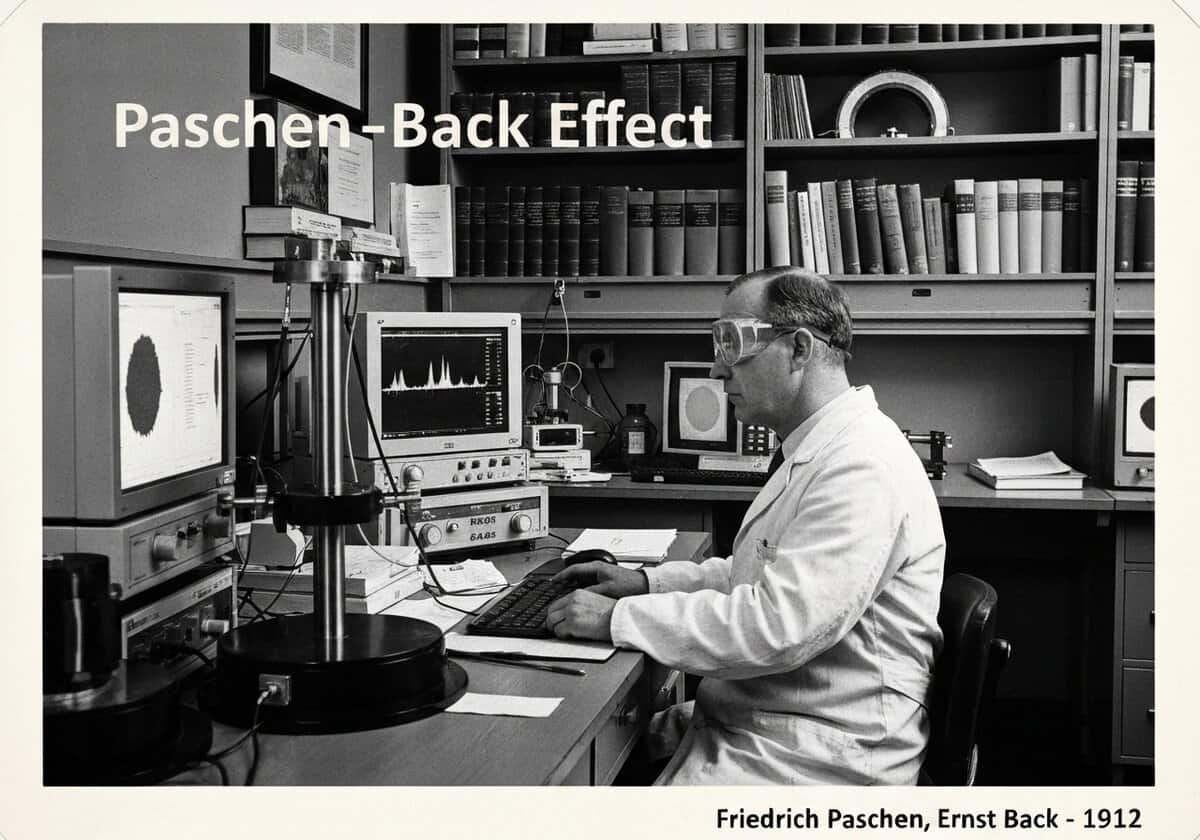
Physicist conducting spectroscopy experiments in a strong magnetic field.

(generated image for illustration only)

The Paschen-Back effect occurs in the presence of a very strong magnetic field, where the Zeeman splitting energy becomes much larger than the fine-structure (spin-orbit) interaction energy. In this regime, the coupling between orbital (\(\vec{L}\)) and spin (\(\vec{S}\)) angular momentum is broken. They precess independently around the strong external magnetic field, simplifying the spectral pattern.


The Paschen-Back effect represents the high-field limit of the Zeeman effect. While the anomalous Zeeman effect describes the case where the external field is a small perturbation compared to the internal spin-orbit coupling, the Paschen-Back effect describes the opposite scenario. When the magnetic field is sufficiently strong, the interaction energy of the magnetic moments with the external field, \(\hat{H}_Z\), dominates over the spin-orbit interaction Hamiltonian, \(\hat{H}_{SO}\).

As a result, \(\vec{L}\) and \(\vec{S}\) are effectively decoupled. The ‘good’ quantum numbers are no longer J and \(m_J\), but rather \(m_L\) and \(m_S\), which describe the independent projections of orbital and spin angular momentum along the magnetic field axis. The first-order energy shift is then given by the sum of the independent interactions: \(\Delta E = (m_L + g_s m_S)\mu_B B\). With \(g_s \approx 2\), this leads to a splitting pattern that closely resembles the normal Zeeman triplet, although the fine-structure interaction, now treated as a small perturbation, causes each of these lines to have a small residual substructure. The transition from the anomalous Zeeman regime to the Paschen-Back regime is continuous and can be calculated using intermediate-field theories.

UNESCO Nomenclature: 2202
– Atomic and molecular physics

Type

Physical Phenomenon

Disruption

Incremental

Usage

Niche/Specialized

Precursors

  • the Zeeman effect in weak fields
  • the theory of fine structure and spin-orbit coupling
  • the availability of techniques to generate strong magnetic fields, such as the Weiss electromagnet
  • advances in high-resolution spectroscopy

Applications

  • spectroscopy of astrophysical objects with immense magnetic fields (e.g., neutron stars, white dwarfs)
  • research in high-field physics laboratories using superconducting magnets
  • understanding atomic structure in extreme physical conditions
  • testing quantum electrodynamics (qed) in the strong-field limit
  • diagnostics for high-density plasmas

Patents:

NA

Potential Innovations Ideas

Due to scrapping bot traffic, currently more than 40k per day, this content is reserved to community members.
> Login < or > Register < (100% free) to access this, so as all other restricted content and tools.

Related to: Paschen-Back effect, strong magnetic field, fine structure, spin-orbit decoupling, spectroscopy, atomic physics, high-field limit, quantum mechanics, energy levels, decoupling.

Historical Context

Paschen-Back Effect

1907
1909
1910
1912
1915
1915-11
1916
1907
1909
1910
1911-04-08
1913
1915
1916
1917

(if date is unknown or not relevant, e.g. "fluid mechanics", a rounded estimation of its notable emergence is provided)

Related Invention, Innovation & Technical Principles

Full size images and downloads are only available, 100% free, for registered members.

> Login <