Product Design, Manufacturing & Innovation Resources
Home » The Oxidation State Concept (oxidation number)

The Oxidation State Concept (oxidation number)

1938
  • Wendell Mitchell Latimer
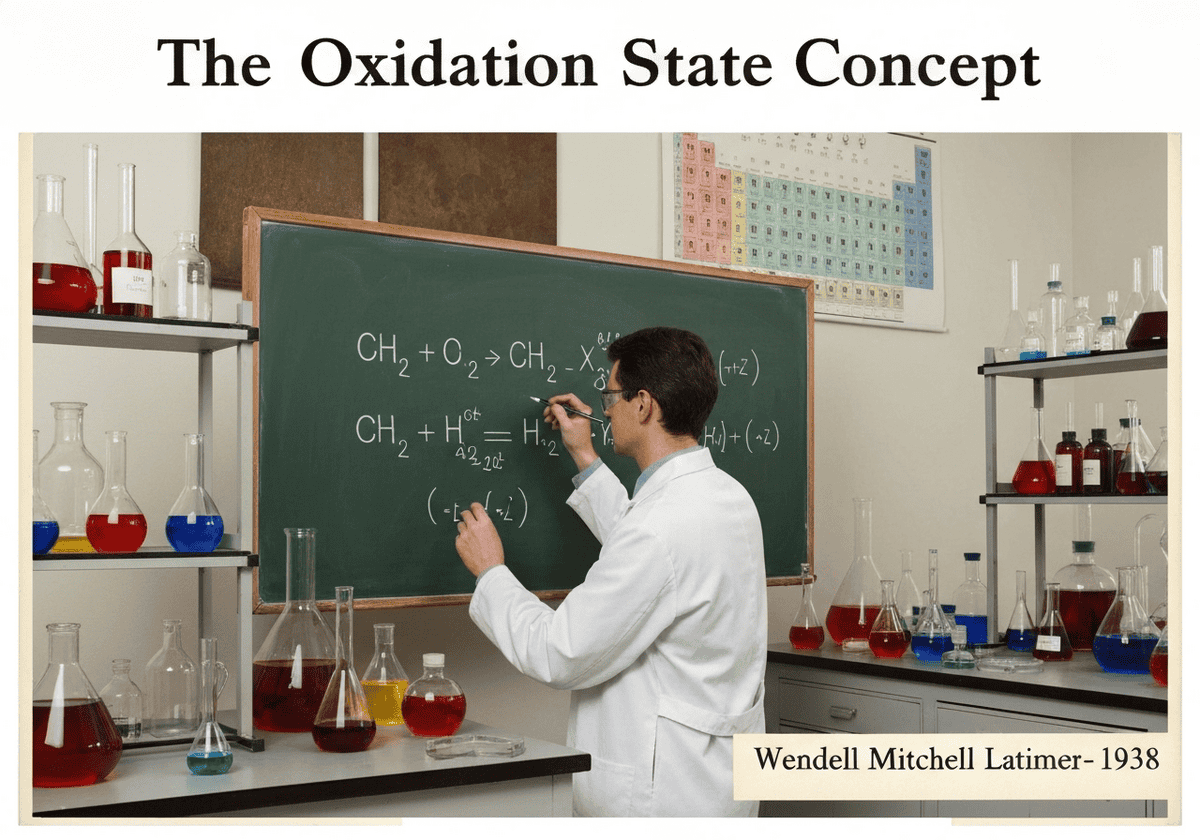
Chemist balancing redox equations in a laboratory, showcasing oxidation state in inorganic chemistry.

(generated image for illustration only)

The oxidation state, or oxidation number, is a hypothetical charge that an atom would have if all its bonds to different atoms were 100% ionic. It provides a way to track electron transfer in redox reactions. An increase in oxidation state signifies oxidation, while a decrease signifies reduction. This formalism simplifies the analysis of complex chemical reactions.

The oxidation state is a formal tool, not a representation of the actual charge on an atom, especially in covalent compounds where electrons are shared, not fully transferred. A set of rules is used to assign oxidation states. For example, the oxidation state of an atom in its elemental form is 0. For a monatomic ion, it equals the ion’s charge. In compounds, fluorine is always -1, and oxygen is usually -2 (except in peroxides). The sum of oxidation states in a neutral compound is zero, while in a polyatomic ion, it equals the ion’s charge.

Consider potassium permanganate, \(KMnO_4\). We know K is +1 and each O is -2. For the compound to be neutral, the sum of oxidation states must be zero. Let the oxidation state of Mn be x. Then, \((+1) + x + 4(-2) = 0\). Solving this gives \(x = +7\). So, the oxidation state of manganese in permanganate is +7. If this ion participates in a reaction where it is converted to \(Mn^{2+}\), the oxidation state of manganese has decreased from +7 to +2, signifying a reduction. This bookkeeping method is indispensable for identifying which species are oxidized and reduced and for balancing the complex equations that describe these reactions.

UNESCO Nomenclature: 2203
– Inorganic chemistry

Type

Abstract System

Disruption

Substantial

Usage

Widespread Use

Precursors

  • concept of valence
  • lewis structures and electron dot diagrams
  • electronegativity concept by linus pauling

Applications

  • balancing redox equations
  • naming inorganic compounds (e.g., iron(iii) oxide)
  • predicting reaction products
  • electrochemistry analysis

Patents:

NA

Potential Innovations Ideas

Due to scrapping bot traffic, currently more than 40k per day, this content is reserved to community members.
> Login < or > Register < (100% free) to access this, so as all other restricted content and tools.

Related to: oxidation state, oxidation number, electron counting, formal charge, redox balancing, inorganic nomenclature, covalent bonds, ionic bonds.

Historical Context

The Oxidation State Concept (oxidation number)

1931
1932
1936-01-01
1938
1940
1950
1950
1931
1932
1933
1937
1940
1947
1950
1950

(if date is unknown or not relevant, e.g. "fluid mechanics", a rounded estimation of its notable emergence is provided)

Related Invention, Innovation & Technical Principles

Full size images and downloads are only available, 100% free, for registered members.

> Login <