Product Design, Manufacturing & Innovation Resources
Home » Non-Newtonian Fluid Definition

Non-Newtonian Fluid Definition

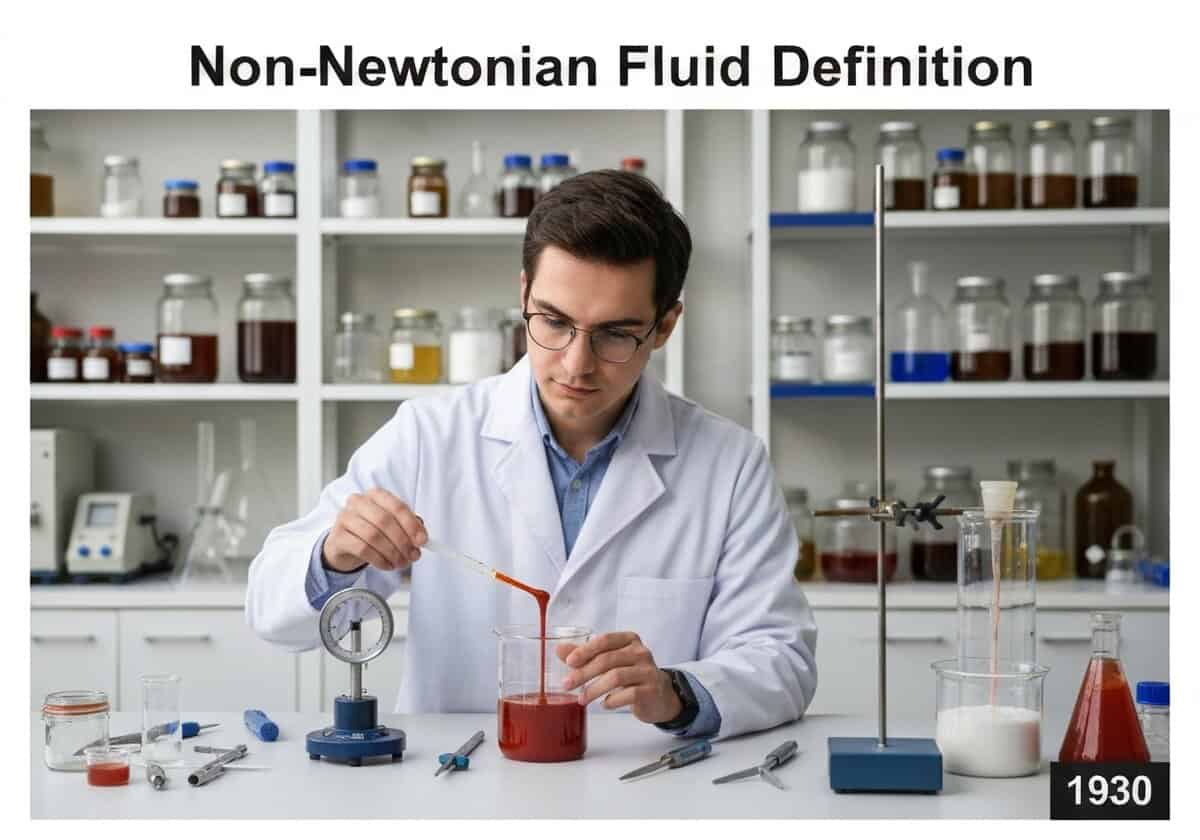
1930
Scientist experimenting with non-Newtonian fluid viscosity in a laboratory setting.

(generated image for illustration only)

A non-Newtonian fluid is one whose viscosity changes under an applied shear stress. Unlike a Newtonian fluid where viscosity is constant, its flow properties are not described by a linear relationship between shear stress (\(\tau\)) and shear rate (\(\dot{\gamma}\)). This dependency can manifest as shear-thinning (viscosity decreases with stress) or shear-thickening (viscosity increases with stress).

The fundamental difference between Newtonian and non-Newtonian fluids lies in their response to shear. For a Newtonian fluid, the relationship is linear, defined by Newton’s law of viscosity: \(\tau = \mu \dot{\gamma}\), where \(\mu\) is the constant coefficient of viscosity. For non-Newtonian fluids, this relationship is non-linear and can be time-dependent. The apparent viscosity, defined as \(\eta = \tau / \dot{\gamma}\), is not a constant but a function of the shear rate itself, \(\eta(\dot{\gamma})\).

This behavior arises from the fluid’s internal microstructure, such as long polymer chains, suspended particles, or emulsions. When a shear force is applied, these microstructures can align, deform, or rearrange, altering the fluid’s resistance to flow. For example, in a polymer solution (a shear-thinning fluid), the randomly coiled polymer chains untangle and align with the flow direction under high shear, reducing internal friction and thus viscosity. Conversely, in a concentrated suspension like cornstarch in water (a shear-thickening fluid), the particles may jam together under high shear, drastically increasing viscosity.

The study of these complex flow behaviors is called rheology. Understanding a fluid’s non-Newtonian properties is critical in many industrial processes, from pumping and mixing to coating and molding, as the processing conditions directly influence the material’s behavior.

UNESCO Nomenclature: 2210
– Mechanics

Type

Abstract System

Disruption

Foundational

Usage

Widespread Use

Precursors

  • Isaac Newton’s law of viscosity (1687)
  • Studies on colloids and suspensions by Thomas Graham (1860s)
  • Development of viscometry techniques
  • Early observations of anomalous flow in materials like clay slurries and paints

Applications

  • food processing (e.g., ketchup, mayonnaise)
  • cosmetics (e.g., creams, nail polish)
  • drilling muds in the oil industry
  • liquid body armor
  • paint manufacturing

Patents:

NA

Potential Innovations Ideas

Due to scrapping bot traffic, currently more than 40k per day, this content is reserved to community members.
> Login < or > Register < (100% free) to access this, so as all other restricted content and tools.

Related to: non-newtonian fluid, viscosity, shear stress, shear rate, rheology, fluid dynamics, shear-thinning, shear-thickening.

Historical Context

Non-Newtonian Fluid Definition

1926
1926
1927
1930
1930
1930
1931
1925
1926
1927
1927
1930
1930
1930
1931

(if date is unknown or not relevant, e.g. "fluid mechanics", a rounded estimation of its notable emergence is provided)

Related Invention, Innovation & Technical Principles

Full size images and downloads are only available, 100% free, for registered members.

> Login <