Product Design, Manufacturing & Innovation Resources
Home » Neodymium Magnets

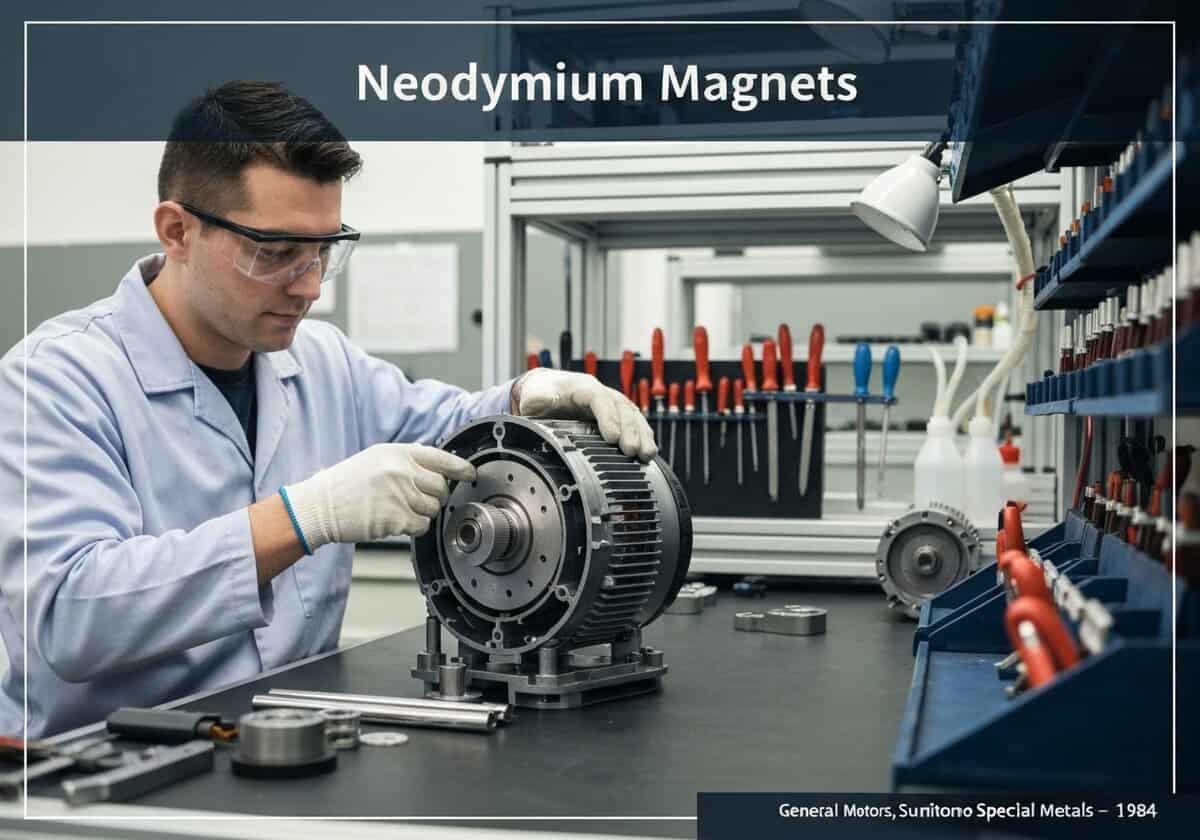
Neodymium Magnets

1984
  • General Motors
  • Sumitomo Special Metals
Neodymium magnets used in electric motor assembly in solid state physics.

(generated image for illustration only)

Neodymium magnets are the strongest type of permanent magnet commercially available. They are a ternary alloy of neodymium, iron, and boron, with the stoichiometric formula Nd2Fe14B. Their immense magnetic strength results from the material’s high magnetic anisotropy and saturation magnetization, derived from its tetragonal crystal structure. However, they are brittle, susceptible to corrosion, and have a low curie temperature.
The exceptional performance of neodymium magnets stems from the specific roles played by each constituent element within its unique crystal structure. The compound forms a tetragonal crystal lattice with the formula \(Nd_2Fe_{14}B\). In this structure, iron (Fe) atoms provide a very high saturation magnetization, meaning the material can hold a strong magnetic field. Neodymium (Nd), a rare-earth element, is crucial for providing an extremely high magnetocrystalline anisotropy. This means that the crystal has a preferred axis of magnetization, making it very difficult to demagnetize. The boron (B) atoms do not contribute directly to the magnetism but are essential for stabilizing this specific tetragonal phase, preventing the formation of other, less magnetically favorable iron-neodymium compounds.

There are two primary manufacturing methods. Sintered NdFeB magnets are produced by powder metallurgy. The raw alloy is milled into a fine powder, which is then aligned in a strong magnetic field, pressed, and heated (sintered) to fuse the particles together. This process creates the strongest, highest-grade magnets but results in a hard, brittle product. Bonded NdFeB magnets are made by mixing the magnetic powder with a polymer binder, which can then be injection-molded or compression-molded into complex shapes. Bonded magnets are weaker than their sintered counterparts but offer greater design flexibility and corrosion resistance. To improve performance at higher temperatures, small amounts of other rare earths like dysprosium (Dy) or terbium (Tb) are often added to increase the material’s coercivity.

UNESCO Nomenclature: 2211
– Solid state physics

Type

Physical Device

Disruption

Revolutionary

Usage

Widespread Use

Precursors

  • discovery of ferromagnetism
  • development of earlier permanent magnets like alnico and samarium-cobalt magnets
  • understanding of crystal structures and their relation to magnetic properties
  • advances in powder metallurgy and sintering techniques

Applications

  • electric motors in cordless tools, hybrid and electric vehicles
  • hard disk drives for voice coil motors
  • wind turbine generators
  • audio equipment like headphones and speakers
  • magnetic resonance imaging (mri) scanners
  • magnetic levitation systems

Patents:

  • US Patent 4,496,395
  • US Patent 4,770,723

Potential Innovations Ideas

Due to scrapping bot traffic, currently more than 40k per day, this content is reserved to community members.
> Login < or > Register < (100% free) to access this, so as all other restricted content and tools.

Related to: neodymium magnet, NdFeB, permanent magnet, magnetic anisotropy, saturation magnetization, general motors, Sumitomo, sintering, hard disk drive, electric motor.

Historical Context

Neodymium Magnets

1980
1980
1980
1984
1986
1986
1991
1980
1980
1980
1984
1985
1986
1990
1994

(if date is unknown or not relevant, e.g. "fluid mechanics", a rounded estimation of its notable emergence is provided)

Related Invention, Innovation & Technical Principles

Full size images and downloads are only available, 100% free, for registered members.

> Login <