Metropolis-Hastings Algorithm
1970
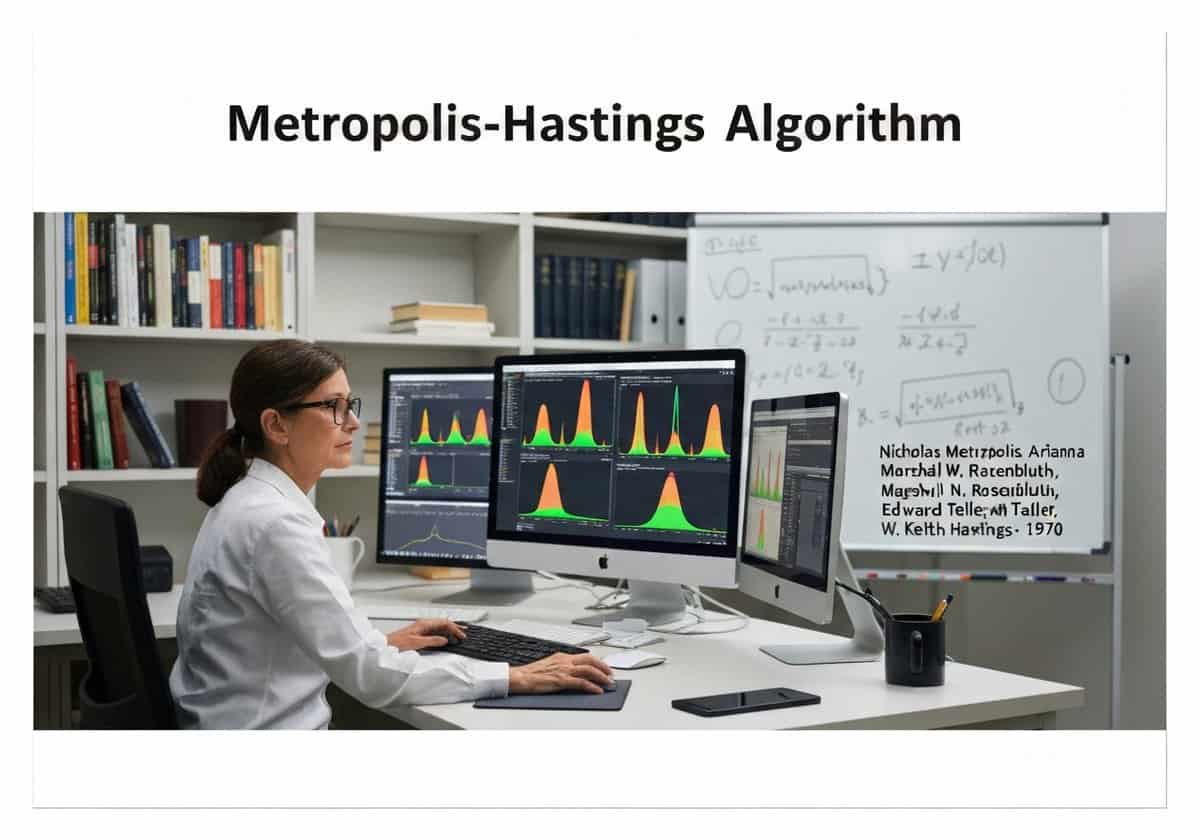
- Nicholas Metropolis
- Arianna W. Rosenbluth
- Marshall N. Rosenbluth
- Augusta H. Teller
- Edward Teller
- W. Keith Hastings
The Metropolis-Hastings algorithm is a prominent MCMC method for obtaining a sequence of random samples from a probability distribution for which direct sampling is difficult. At each iteration, it generates a candidate for the next sample based on the current sample. This candidate is then accepted or rejected with a certain probability, ensuring the resulting chain converges to the desired distribution.
The algorithm works by constructing a Markov chain whose stationary distribution is the target distribution \(P(x)\). Let the current state be \(x_t\). First, a candidate state \(x’\) is generated from a proposal distribution \(Q(x’|x_t)\), which can be any distribution that is easy to sample from (e.g., a Gaussian centered at \(x_t\)). Second, an acceptance probability \(\alpha(x’, x_t)\) is calculated: \(\alpha(x’, x_t) = \min\left(1, \frac{P(x’)Q(x_t|x’)}{P(x_t)Q(x’|x_t)}\right)\). A random number \(u\) is drawn from a uniform distribution on \([0, 1]\). If \(u \le \alpha\), the candidate is accepted, and the next state is set to \(x_{t+1} = x’\). Otherwise, the candidate is rejected, and the chain remains at the current state, \(x_{t+1} = x_t\).
The brilliance of this acceptance ratio is that it only requires knowing \(P(x)\) up to a constant of proportionality, since any normalization constant cancels out in the fraction \(\frac{P(x’)}{P(x_t)}\). This is crucial in Bayesian statistics, where the posterior distribution is often known only up to the intractable marginal likelihood. The original Metropolis algorithm (1953) is a special case where the proposal distribution \(Q\) is symmetric, i.e., \(Q(x’|x_t) = Q(x_t|x’)\), simplifying the acceptance probability to \(\min\left(1, \frac{P(x’)}{P(x_t)}\right)\). Hastings’ 1970 generalization allowed for asymmetric proposal distributions, significantly broadening the algorithm’s applicability and efficiency.
UNESCO Nomenclature: 1209
– Statistics
Precursors
- Metropolis algorithm (1953)
- theory of detailed balance in Markov chains
- Monte Carlo integration
- Bayesian probability theory
Applications
- simulating the boltzmann distribution in statistical mechanics
- bayesian inference in machine learning
- solving complex optimization problems via simulated annealing
- computational finance for risk modeling
- signal processing and image reconstruction
Potential Innovations Ideas
Due to scrapping bot traffic, currently more than 40k per day, this content is reserved to community members.
> Login < or > Register < (100% free) to access this, so as all other restricted content and tools.
Related to: Metropolis-Hastings, MCMC, Bayesian statistics, acceptance-rejection, proposal distribution, stationary distribution, Markov chain, sampling, statistical mechanics, simulated annealing.