Laser Coherence
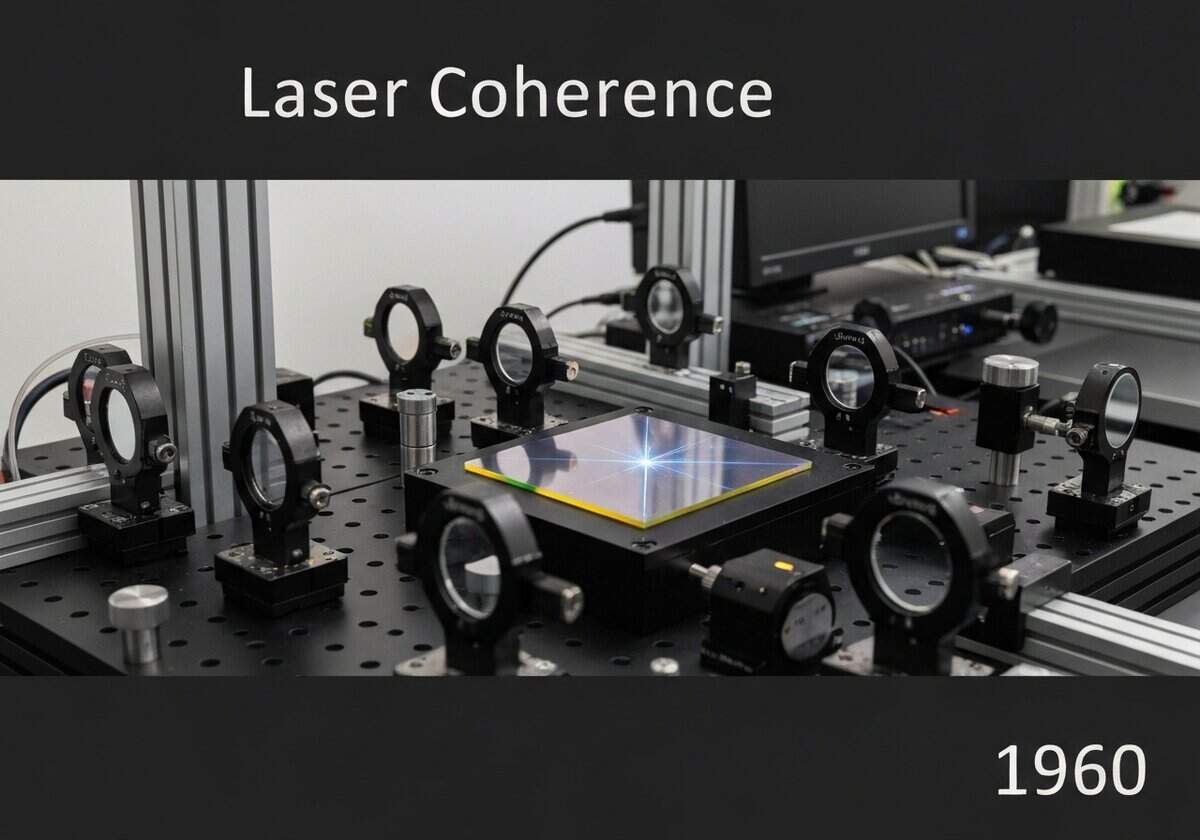
Coherence is a key property of laser light, describing the correlation of the electromagnetic field at different points in space or time. Temporal coherence relates to the light’s monochromaticity (narrow spectral width), while spatial coherence relates to its directionality and ability to be focused to a tight spot. This high degree of order distinguishes lasers from conventional light sources.
The coherence of laser light arises directly from the process of stimulated emission. Since each stimulated photon is an exact replica of the incident photon in phase, frequency, and direction, a cascade of such events produces a large number of photons that are all in phase with one another. This phase relationship is maintained as the light oscillates within the optical resonator, which further filters and reinforces a single coherent mode.
Temporal coherence is a measure of the phase correlation of a wave with itself at different points in time. It is quantified by the coherence time, \(tau_c\), the time over which the phase remains predictable. This is inversely related to the spectral bandwidth, \(Deltau\), of the light (\(tau_c approx 1/Deltau\)). Lasers have very narrow bandwidths, leading to long coherence times and coherence lengths (\(L_c = ctau_c\)), which can be many meters. This allows for interference effects over large path differences, crucial for holography and interferometry.
Spatial coherence describes the phase correlation between different points across the wavefront at the same instant. A laser beam with high spatial coherence has a uniform wavefront phase, allowing it to travel long distances with minimal divergence (high directionality) and to be focused to a diffraction-limited spot. This property is essential for applications like laser cutting, welding, and long-distance communication.
UNESCO Nomenclature: 2210
– Optics
Precursors
- Thomas Young’s double-slit experiment demonstrating interference
- Michelson interferometer
- Van Cittert–Zernike theorem for classical coherence
- development of the laser itself
Applications
- holography
- interferometry
- fiber-optic communication
- lidar
- laser cooling of atoms
- coherent optical tomography
Potential Innovations Ideas
Due to scrapping bot traffic, currently more than 40k per day, this content is reserved to community members.
> Login < or > Register < (100% free) to access this, so as all other restricted content and tools.
Related to: coherence, laser, spatial coherence, temporal coherence, monochromatic, directionality, holography, interferometry, phase, wavefront.