Product Design, Manufacturing & Innovation Resources
Home » Joule Heating and Electric Power

Joule Heating and Electric Power

1841
  • James Prescott Joule
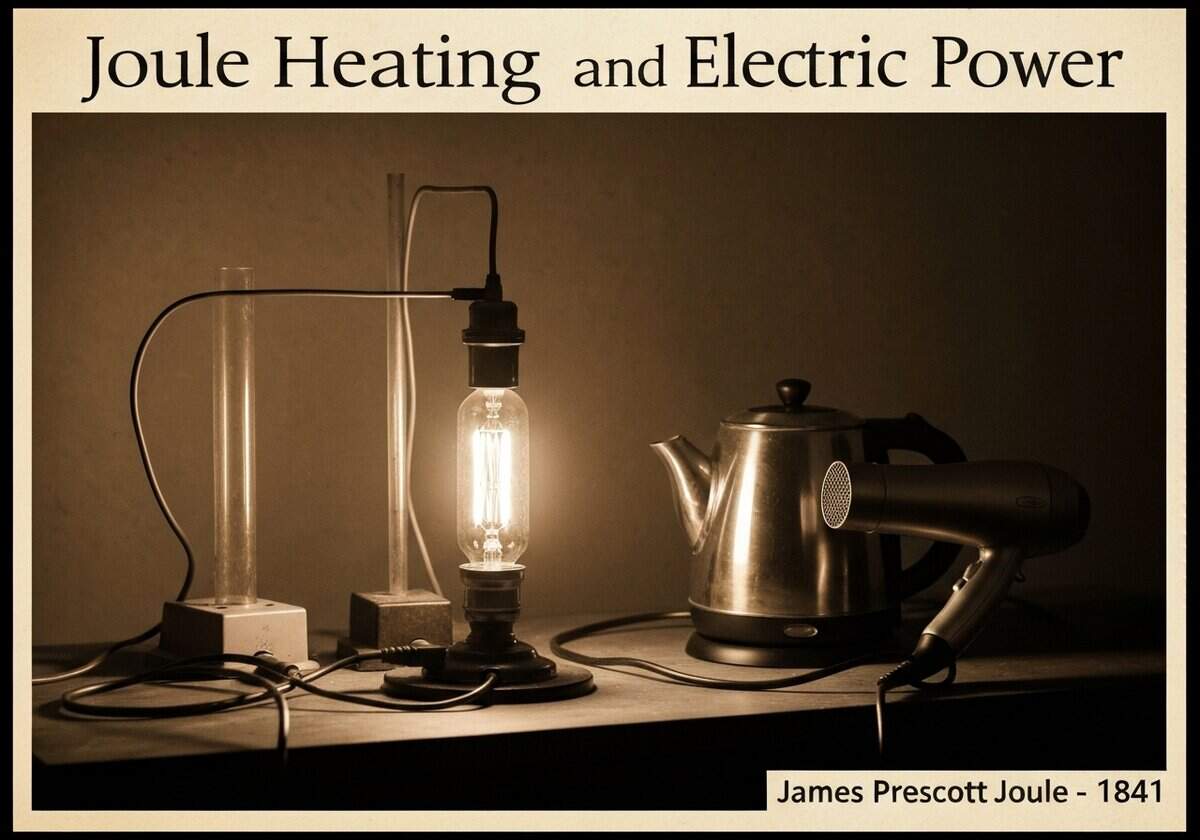
Demonstration of Joule heating in a vintage laboratory with electric appliances.

(generated image for illustration only)

Joule heating, or ohmic heating, is the phenomenon where heat is produced by an electric current passing through a conductor. The rate of heat generation, or power dissipated (\(P\)), is given by Joule’s first law, \(P = VI\). By combining this with Ohm’s law, the power can be expressed as \(P = I^2 R\) or \(P = \frac{V^2}{R}\).
The physical basis for Joule heating is the interaction between moving charge carriers (electrons) and the ions of the conductor. As electrons are accelerated by the electric field, they collide with the ions in the material’s lattice structure. Each collision transfers kinetic energy from the electron to the ion, increasing the ion’s vibrational energy. This increased atomic vibration manifests as a rise in the conductor’s temperature.

While this effect is harnessed for heating applications, it is often an undesirable source of energy loss. In power transmission, for example, the \(P = I^2 R\) relationship shows that power loss is proportional to the square of the current. This is why electricity is transmitted over long distances at very high voltages and low currents, to minimize these ‘I-squared-R’ losses. Understanding Joule heating is crucial for thermal management in electronics, preventing components like microprocessors from overheating and failing.

UNESCO Nomenclature: 2205
– Electromagnetism

Type

Abstract System

Disruption

Substantial

Usage

Widespread Use

Precursors

  • Ohm’s law, which defines the relationship between voltage, current, and resistance
  • The law of conservation of energy, establishing that energy cannot be created or destroyed
  • Early experiments on electricity and heat by scientists like Benjamin Franklin and Humphry Davy

Applications

  • electric space heaters and stoves
  • incandescent light bulbs (heating a filament until it glows)
  • fuses, which melt and break a circuit when current is too high
  • electric kettles, toasters, and hair dryers
  • de-icing systems on aircraft wings and windshields

Patents:

NA

Potential Innovations Ideas

Due to scrapping bot traffic, currently more than 40k per day, this content is reserved to community members.
> Login < or > Register < (100% free) to access this, so as all other restricted content and tools.

Related to: Joule heating, ohmic heating, electric power, power dissipation, resistance, I^2R loss, energy conversion, thermodynamics, electric heater, james prescott joule.

Historical Context

Joule Heating and Electric Power

1834
1835
1838
1841
1845
1850
1850
1833
1834
1836
1839-01-01
1842
1847
1850
1850

(if date is unknown or not relevant, e.g. "fluid mechanics", a rounded estimation of its notable emergence is provided)

Related Invention, Innovation & Technical Principles

Full size images and downloads are only available, 100% free, for registered members.

> Login <