Product Design, Manufacturing & Innovation Resources
Home » The Iterative Product Design Process

The Iterative Product Design Process

1960
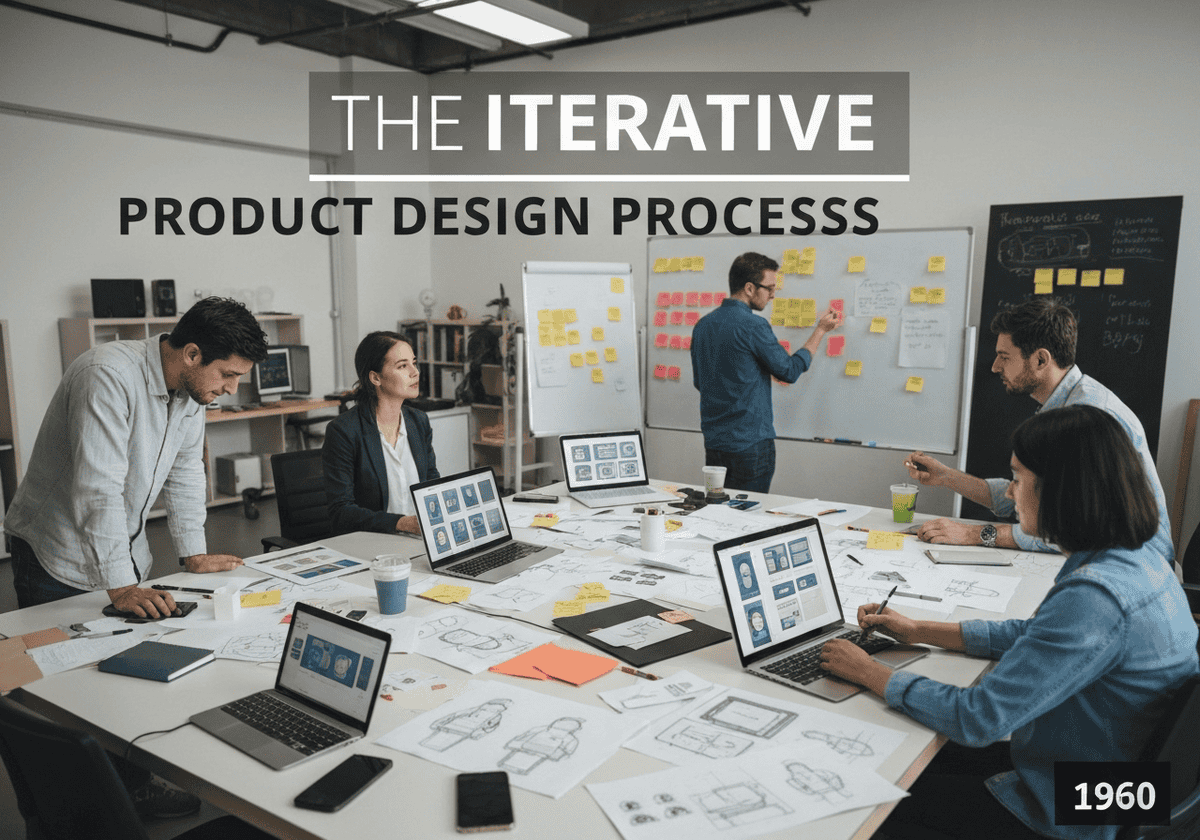
Modern design studio with industrial designers collaborating on product development.

(generated image for illustration only)

A structured methodology for creating new products, typically involving analysis, concept development, and synthesis. It is an iterative cycle where designers research user needs, brainstorm ideas, create prototypes, and test them to refine the final product. This process ensures that the end product is both functional and meets market demands effectively before full-scale production.

The product design process is a framework that guides designers and engineers from an initial idea to a market-ready product. It begins with the ‘Analysis’ phase, which involves deep market research, competitive analysis, and understanding user needs through methods like interviews and surveys. This phase defines the problem and sets the design constraints and goals. The subsequent ‘Concept’ phase is a creative exploration where designers brainstorm a wide range of potential solutions. Techniques like sketching, mind-mapping, and storyboarding are common. Multiple ideas are generated without initial judgment to foster innovation. Following this, the ‘Synthesis’ phase involves refining and combining the most promising concepts into a tangible design. This is where detailed specifications are created, and early prototypes, such as mockups or 3D models, are built. The process is inherently iterative; feedback from testing these prototypes is used to circle back to earlier stages for refinement. For example, a usability test might reveal a flaw that requires a return to the concept phase to explore alternative solutions. This cyclical nature ensures continuous improvement and reduces the risk of market failure by validating the design against real-world user feedback and technical feasibility before committing to mass production.

UNESCO Nomenclature: 3305
– Industrial Technology

Type

Abstract System

Disruption

Foundational

Usage

Widespread Use

Precursors

  • the scientific method
  • craftsmanship traditions and apprenticeship models
  • early engineering drawing and drafting techniques
  • the industrial revolution’s focus on mass production processes

Applications

  • development of smartphones
  • creation of ergonomic office furniture
  • design of modern automobiles
  • software application development (ui/ux)

Patents:

NA

Potential Innovations Ideas

Due to scrapping bot traffic, currently more than 40k per day, this content is reserved to community members.
> Login < or > Register < (100% free) to access this, so as all other restricted content and tools.

Related to: product design process, iterative design, analysis, concept, synthesis, prototyping, user research, product development.

Historical Context

The Iterative Product Design Process

1950
1955
1956
1960
1960
1960
1960
1950
1950
1955
1958
1960
1960
1960
1960

(if date is unknown or not relevant, e.g. "fluid mechanics", a rounded estimation of its notable emergence is provided)

Related Invention, Innovation & Technical Principles

Full size images and downloads are only available, 100% free, for registered members.

> Login <