Product Design, Manufacturing & Innovation Resources
Home » Internal Energy and Enthalpy of a Perfect Gas

Internal Energy and Enthalpy of a Perfect Gas

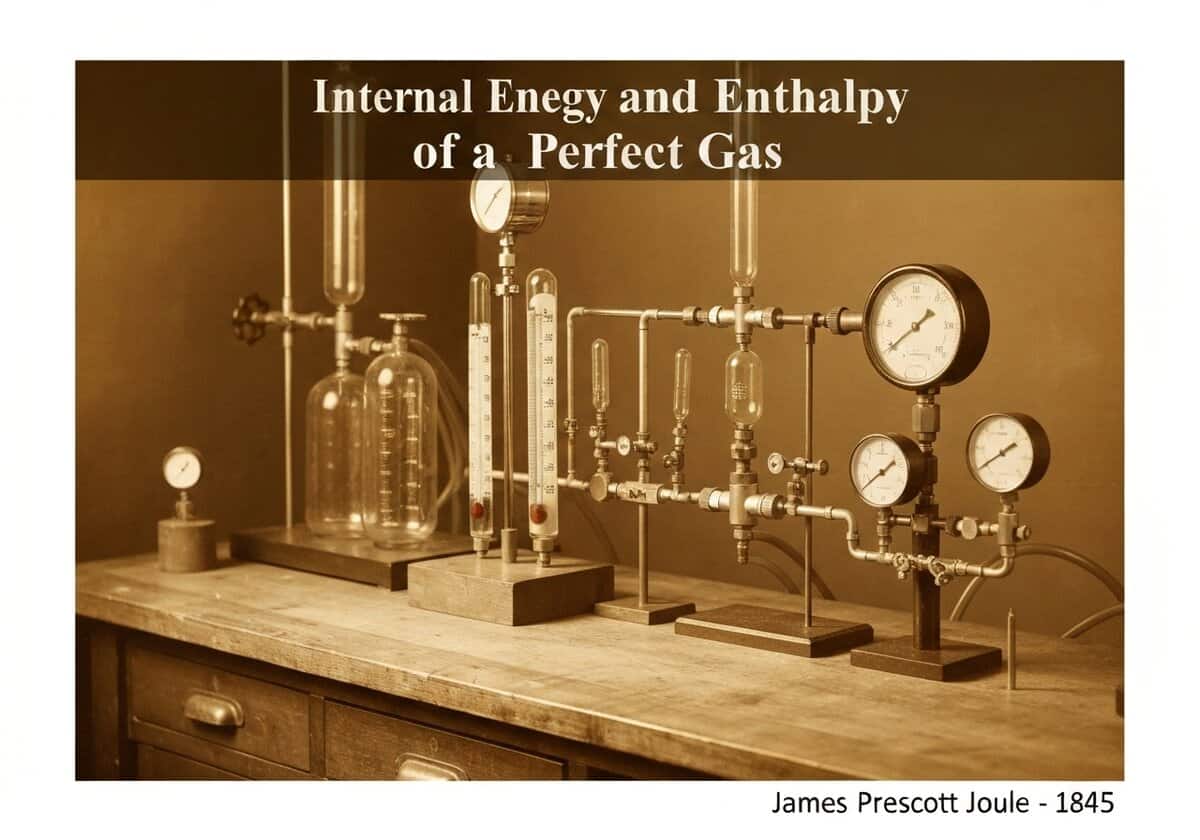
1845
  • James Prescott Joule
Laboratory apparatus for measuring internal energy and enthalpy of a perfect gas in thermodynamics.

(generated image for illustration only)

For a perfect gas, the internal energy (\(U\)) and enthalpy (\(H\)) are functions of temperature only. Their changes are given by \(\Delta U = m c_v \Delta T\) and \(\Delta H = m c_p \Delta T\), where \(c_v\) and \(c_p\) are the specific heats at constant volume and pressure, respectively, and are assumed to be constant.

A cornerstone of the perfect gas model is the principle that its internal energy depends solely on its temperature. This was experimentally demonstrated by James Prescott Joule in his expansion experiments. For an ideal gas, internal energy is the sum of the kinetic energies of its constituent molecules. Since temperature is a measure of the average kinetic energy, internal energy is a function of temperature. The perfect gas model simplifies this further by assuming a linear relationship through a constant specific heat at constant volume, \(c_v\). Thus, the change in specific internal energy is \(\Delta u = c_v \Delta T\).

Enthalpy (\(H\)) is a thermodynamic potential defined as \(H = U + PV\). For a perfect gas, using the ideal gas law (\(PV = nRT\)), enthalpy becomes \(H = U(T) + nRT\), which is also a function of temperature only. The change in specific enthalpy is similarly given by \(\Delta h = c_p \Delta T\), where \(c_p\) is the constant specific heat at constant pressure. This simplification is immensely powerful in engineering, as it allows for straightforward calculation of energy changes in processes like compression, expansion, and heating without needing complex tables or equations of state, forming the basis for analyzing engines, refrigerators, and power plants.

UNESCO Nomenclature: 2212
– Thermodynamics

Type

Theoretical Model

Disruption

Foundational

Usage

Widespread Use

Precursors

  • first law of thermodynamics
  • joule’s expansion experiment
  • concept of internal energy
  • ideal gas law
  • definition of enthalpy

Applications

  • analysis of thermodynamic cycles (e.g., Brayton, Otto)
  • calculation of heat transfer in gas systems
  • design of heat exchangers
  • modeling of gas turbines and jet engines
  • chemical process engineering for energy balance calculations

Patents:

NA

Potential Innovations Ideas

Due to scrapping bot traffic, currently more than 40k per day, this content is reserved to community members.
> Login < or > Register < (100% free) to access this, so as all other restricted content and tools.

Related to: internal energy, enthalpy, perfect gas, Joule’s first law, specific heat, temperature, thermodynamics, energy balance, heat transfer, thermodynamic cycles.

Historical Context

Internal Energy and Enthalpy of a Perfect Gas

1835
1838
1841
1845
1850
1850
1850
1834
1836
1839-01-01
1842
1847
1850
1850
1850

(if date is unknown or not relevant, e.g. "fluid mechanics", a rounded estimation of its notable emergence is provided)

Related Invention, Innovation & Technical Principles

Full size images and downloads are only available, 100% free, for registered members.

> Login <