Product Design, Manufacturing & Innovation Resources
Home » Hydrostatic Pressure

Hydrostatic Pressure

1600
  • Simon Stevin
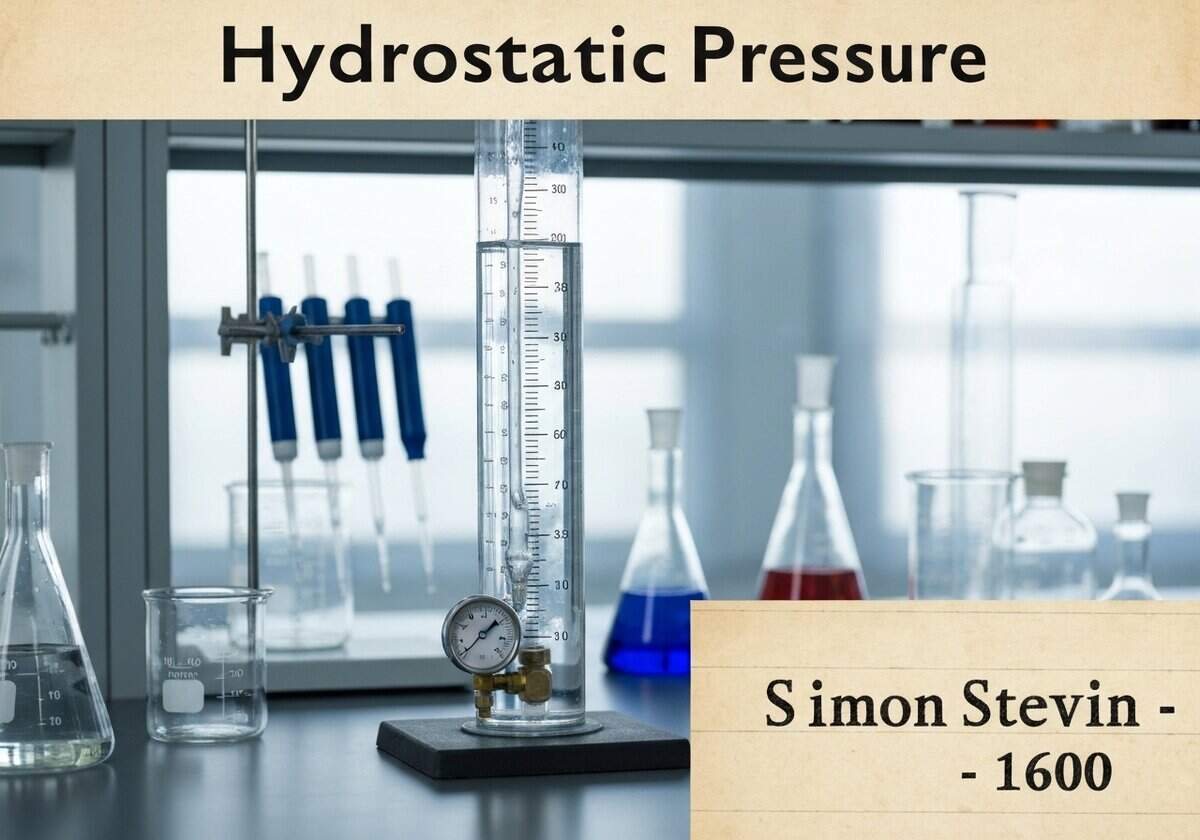
Fluid mechanics experiment demonstrating hydrostatic pressure in a laboratory setting.

(generated image for illustration only)

Hydrostatic pressure is the pressure exerted by a fluid at equilibrium at a given point within the fluid, due to the force of gravity. It increases in proportion to depth measured from the surface because of the increasing weight of fluid exerting downward force from above. The formula is \(p = \rho g h\), where \(\rho\) is the fluid density.


The principles of hydrostatic pressure were explored by Simon Stevin in the late 16th century, who demonstrated the hydrostatic paradox—that the pressure at the bottom of a container depends only on the height of the fluid, not the shape of the container or the total weight of the fluid. This concept was a significant advance from Archimedes’ earlier work on buoyancy. The formula \(p = \rho g h\) quantifies this relationship, where \(p\) is the hydrostatic pressure (gauge pressure, not including atmospheric pressure at the surface), \(\rho\) is the fluid density, \(g\) is the acceleration due to gravity, and \(h\) is the height of the fluid column above the point of measurement. This linear relationship means that for every 10 meters of depth in water, the pressure increases by approximately one atmosphere. This has profound implications for deep-sea exploration, where submersibles must be engineered to withstand crushing forces. The same principle governs atmospheric pressure, although the calculation is more complex because air is a compressible gas, and its density (\(\rho\)) is not constant with altitude. Hydrostatic equilibrium is a key concept in astrophysics, describing the balance between gravity pulling inward and a pressure gradient pushing outward that keeps stars and planets stable.

UNESCO Nomenclature: 2209
– Mechanics

Type

Abstract System

Disruption

Foundational

Usage

Widespread Use

Precursors

  • Archimedes’ principle of buoyancy
  • Euclidean geometry for calculating volumes and areas
  • Early observations of fluid behavior in aqueducts and irrigation systems

Applications

  • design of dams and levees
  • submarine and submersible engineering
  • atmospheric pressure modeling
  • manometers and barometers for pressure measurement
  • water tower design for municipal water supply

Patents:

NA

Potential Innovations Ideas

Due to scrapping bot traffic, currently more than 40k per day, this content is reserved to community members.
> Login < or > Register < (100% free) to access this, so as all other restricted content and tools.

Related to: hydrostatic pressure, fluid mechanics, gravity, density, depth, simon stevin, hydrostatic paradox, dam design, submarine, barometer.

Historical Context

Hydrostatic Pressure

1600
1650
1650
1678
1687
1687
1738
1750
1650
1650
1672
1687
1687
1738
1750

(if date is unknown or not relevant, e.g. "fluid mechanics", a rounded estimation of its notable emergence is provided)

Related Invention, Innovation & Technical Principles

Full size images and downloads are only available, 100% free, for registered members.

> Login <