Product Design, Manufacturing & Innovation Resources
Home » High-Temperature Superconductivity

High-Temperature Superconductivity

1986
  • Johannes Georg Bednorz
  • Karl Alexander Müller
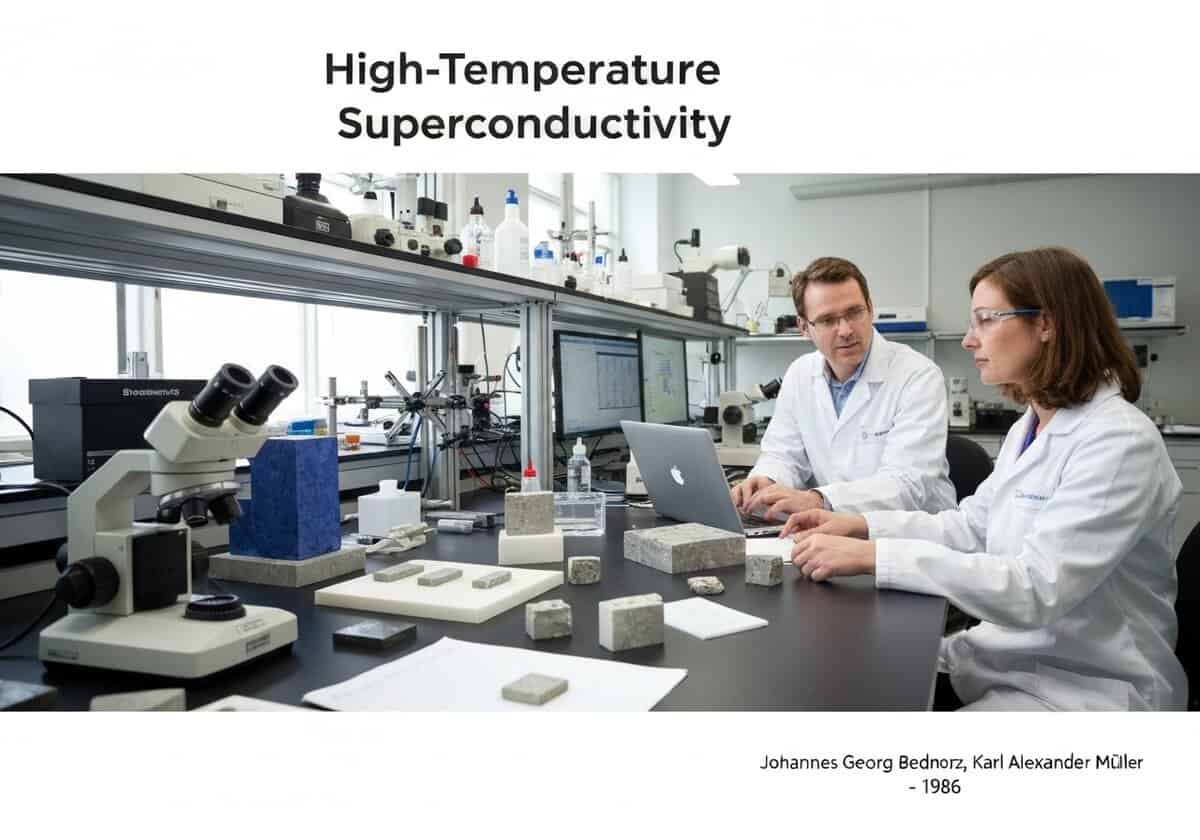
Laboratory scene with researchers studying high-temperature superconducting ceramic materials.

(generated image for illustration only)

In 1986, Georg Bednorz and K. Alex Müller discovered superconductivity in a ceramic material, a lanthanum-based cuprate perovskite, at a critical temperature of ~35 K. This was significantly higher than the ~23 K record for conventional superconductors at the time and shattered the belief that superconductivity was restricted to much lower temperatures, opening the field of high-temperature superconductivity.
The discovery by Bednorz and Müller at the IBM Zurich Research Laboratory was a major breakthrough. For decades, the progress in raising the critical temperature (\(T_c\)) had been slow and incremental, with most physicists believing that the electron-phonon mechanism described by BCS theory had a theoretical upper limit of around 30-40 K. Bednorz and Müller decided to investigate metallic oxides, a class of materials generally considered unsuitable for superconductivity. Their discovery in lanthanum barium copper oxide (LBCO) with a \(T_c\) of 35 K was quickly confirmed and followed by a rapid succession of discoveries of related materials with even higher critical temperatures. In 1987, Paul Chu’s group discovered yttrium barium copper oxide (YBCO) with a \(T_c\) of 92 K. This was a particularly significant milestone because 92 K is above the boiling point of liquid nitrogen (77 K), a coolant that is far cheaper and easier to handle than the liquid helium required for all previous superconductors. This made many applications economically and practically feasible for the first time. These materials, known as cuprates, are Type II superconductors with a layered, perovskite-like crystal structure. Despite intense research for over three decades, a complete, universally accepted microscopic theory for high-temperature superconductivity in cuprates remains elusive, though it is widely believed to involve a different pairing mechanism than the conventional phonon-mediated attraction of BCS theory.

UNESCO Nomenclature: 2211
– Solid state physics

Type

Physical Property

Disruption

Incremental

Usage

Widespread Use

Precursors

  • BCS theory (providing a baseline for comparison)
  • research into metallic oxides and ceramics
  • advanced materials synthesis techniques
  • development of reliable low-temperature measurement systems

Applications

  • superconducting power transmission cables
  • high-field electromagnets for research and mri
  • fault current limiters for power grids
  • cellular communication filters
  • high-performance electric motors and generators

Patents:

NA

Potential Innovations Ideas

Due to scrapping bot traffic, currently more than 40k per day, this content is reserved to community members.
> Login < or > Register < (100% free) to access this, so as all other restricted content and tools.

Related to: high-temperature superconductivity, cuprates, YBCO, critical temperature, liquid nitrogen, Bednorz and Müller, unconventional superconductivity, condensed matter physics, perovskite, ceramic superconductor.

Historical Context

High-Temperature Superconductivity

1980
1984
1986
1986
1991
1995
2000
1980
1984
1985
1986
1990
1994
1997
2002

(if date is unknown or not relevant, e.g. "fluid mechanics", a rounded estimation of its notable emergence is provided)

Related Invention, Innovation & Technical Principles

Full size images and downloads are only available, 100% free, for registered members.

> Login <