Product Design, Manufacturing & Innovation Resources
Home » The Hannover Principles

The Hannover Principles

1992
  • William McDonough
  • Michael Braungart
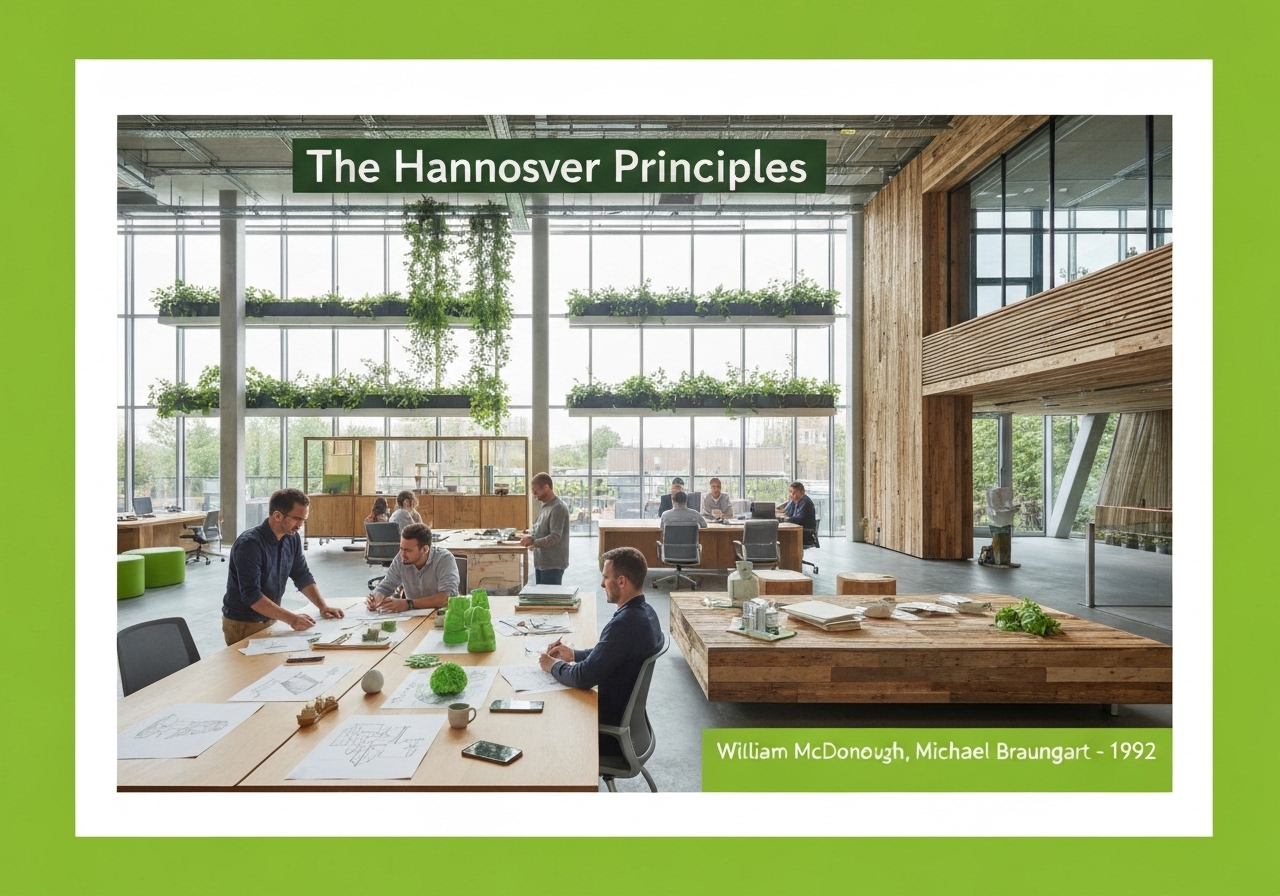
Architectural office demonstrating sustainable design principles from the Hannover Principles.

(generated image for illustration only)

A set of nine foundational principles for sustainable design, developed by William McDonough and Michael Braungart. They advocate for the rights of humanity and nature to coexist, recognize interdependence, respect relationships between spirit and matter, accept responsibility for design consequences, create safe objects of long-term value, eliminate waste, rely on natural energy flows, and understand the limitations of design.


The Hannover Principles were commissioned in 1992 by the City of Hannover, Germany, as a guiding framework for the design of the World’s Fair, Expo 2000. Architect William McDonough and chemist Michael Braungart collaborated to create this declaration of design interdependence. The principles move beyond simply minimizing harm (“eco-efficiency”) to a philosophy of creating positive, regenerative impacts (“eco-effectiveness”). They are not a prescriptive checklist but a set of values intended to inspire designers across all disciplines.

The nine principles are: 1. Insist on the rights of humanity and nature to co-exist. 2. Recognize interdependence. 3. Respect relationships between spirit and matter. 4. Accept responsibility for the consequences of design. 5. Create safe objects of long-term value. 6. Eliminate the concept of waste. 7. Rely on natural energy flows. 8. Understand the limitations of design. 9. Seek constant improvement by sharing knowledge. These principles laid the intellectual groundwork for later concepts like Cradle-to-Cradle design, fundamentally shifting the conversation from doing “less bad” to actively doing “more good” through design.
UNESCO Nomenclature: 3301
– Architecture

Type

Abstract System

Disruption

Substantial

Usage

Widespread Use

Precursors

  • Rachel Carson’s “silent spring” (1962)
  • the limits to growth report (1972)
  • Brundtland report “our common future” (1987)
  • principles of industrial ecology
  • early environmental movements of the 1960s and 1970s

Applications

  • expo 2000 in Hannover, Germany
  • ford river rouge complex revitalization
  • Herman Miller “mirra” chair design
  • cradle to cradle certification program

Patents:

NA

Potential Innovations Ideas

Due to scrapping bot traffic, currently more than 40k per day, this content is reserved to community members.
> Login < or > Register < (100% free) to access this, so as all other restricted content and tools.

Related to: Hannover principles, sustainable design, William McDonough, Michael Braungart, eco-effectiveness, green building, design philosophy, expo 2000, environmental ethics, circular economy.

Historical Context

The Hannover Principles

1990
1990
1991
1992
1993
1994
1997
1990
1990
1990
1992
1992
1993-07-22
1996
1998

(if date is unknown or not relevant, e.g. "fluid mechanics", a rounded estimation of its notable emergence is provided)

Related Invention, Innovation & Technical Principles

Full size images and downloads are only available, 100% free, for registered members.

> Login <