Product Design, Manufacturing & Innovation Resources
Home » Gravitational Waves

Gravitational Waves

2015-09-14
  • Albert Einstein
  • Rainer Weiss
  • Kip Thorne
  • Barry Barish
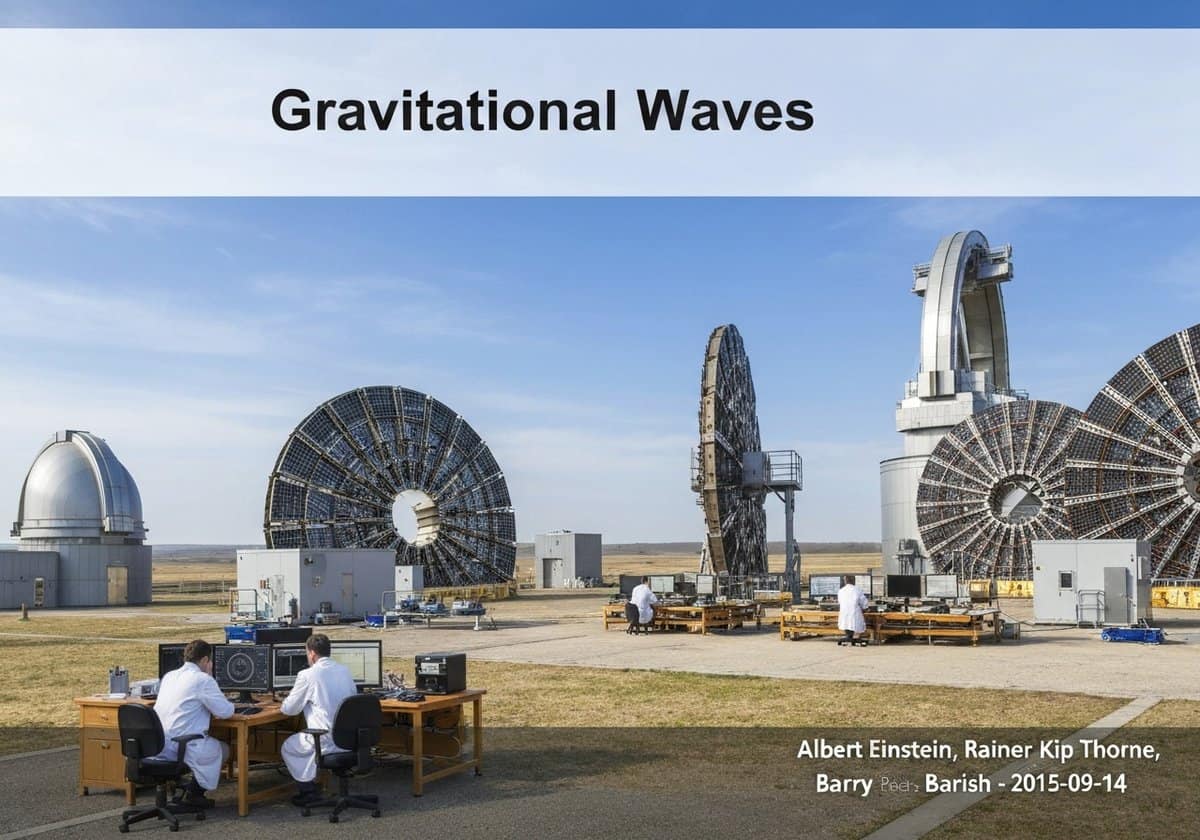
Gravitational wave observatory with advanced detectors and scientists analyzing data.

(generated image for illustration only)

General relativity predicts that accelerating masses generate ripples in the fabric of spacetime called gravitational waves. These waves propagate outwards at the speed of light, carrying energy as gravitational radiation. They are created by cataclysmic cosmic events like the merger of black holes or neutron stars, causing spacetime to stretch and squeeze as they pass.

Gravitational waves are disturbances in spacetime’s curvature, generated by accelerated masses, that propagate as waves from their source at light speed. Predicted by Einstein in 1916, they differ from electromagnetic waves, which are oscillations of fields *through* spacetime; gravitational waves are oscillations *of* spacetime itself. As a wave passes, it stretches and compresses space, and any objects within it, perpendicular to its direction of travel. This effect is incredibly small. For even the most violent cosmic events, the change in distance over a kilometer is less than a proton’s width, making detection extraordinarily difficult.

For decades, their existence was only inferred indirectly from the Hulse-Taylor binary pulsar, whose orbital decay matched predictions of energy loss via gravitational radiation. The first direct detection occurred on September 14, 2015, by the Laser Interferometer Gravitational-Wave Observatory (LIGO). The signal, GW150914, originated from two merging stellar-mass black holes over a billion light-years away. This landmark discovery, earning the 2017 Nobel Prize in Physics, opened a new window onto the universe. Gravitational-wave astronomy allows scientists to observe phenomena invisible to traditional telescopes, like black hole mergers, and to test general relativity in extreme gravity regimes.

UNESCO Nomenclature: 2211
– Relativity

Type

Abstract System

Disruption

Foundational

Usage

Widespread Use

Precursors

  • Einstein’s theory of general relativity
  • Maxwell’s equations for electromagnetic waves (as an analogy)
  • Michelson-Morley interferometer (as a technological basis for detectors)

Applications

  • gravitational-wave astronomy, a new way to observe the universe
  • studying the merger of black holes and neutron stars
  • testing general relativity in extreme conditions
  • probing the early universe
  • measuring the hubble constant independently

Patents:

NA

Potential Innovations Ideas

Due to scrapping bot traffic, currently more than 40k per day, this content is reserved to community members.
> Login < or > Register < (100% free) to access this, so as all other restricted content and tools.

Related to: gravitational waves, general relativity, LIGO, spacetime, black hole merger, neutron star, astronomy, interferometer.

Historical Context

1994
1997
2002
2015-09-14
1991
1995
2000
2004

(if date is unknown or not relevant, e.g. "fluid mechanics", a rounded estimation of its notable emergence is provided)

Related Invention, Innovation & Technical Principles

Full size images and downloads are only available, 100% free, for registered members.

> Login <