Gödel Numbers
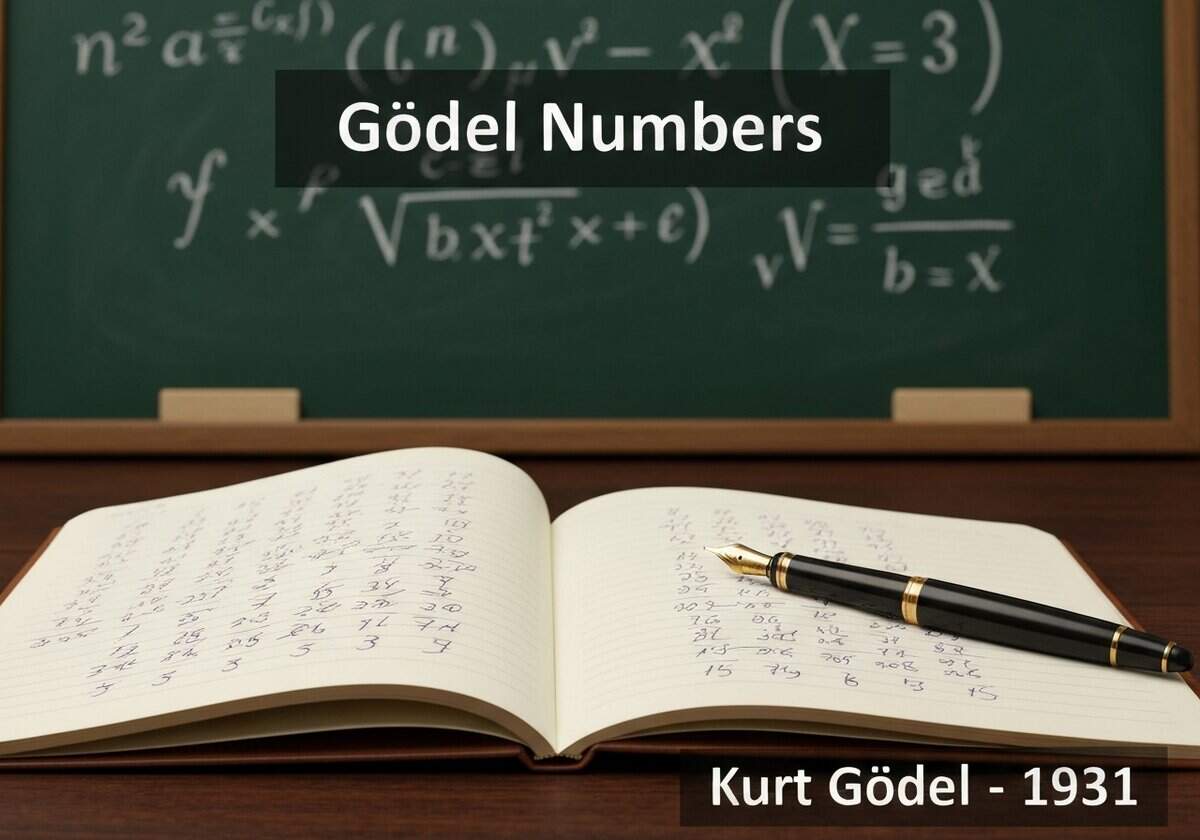
The Gödel Numbering is a foundational technique that assigns a unique natural number (a Gödel number) to every symbol, formula, and proof in a formal language. This arithmetization of syntax allows metamathematical statements about a formal system (e.g., ‘this formula is provable’) to be encoded as arithmetical statements about numbers, which can then be reasoned about within the system itself.
Gödel numbering is the ingenious mechanism that bridges the gap between syntax (the symbolic structure of a formal language) and number theory (the properties of integers). The process allows statements about logic to be translated into statements about numbers. The method works by first assigning a unique integer to each basic symbol of the formal language (e.g., ‘¬’ → 1, ‘∨’ → 2, ‘∀’ → 3, ‘x’ → 4, etc.).
A formula, which is a sequence of these symbols, can then be assigned its own unique number. Gödel’s original method used prime factorization. For a sequence of symbols with numbers \(s_1, s_2, …, s_k\), the formula’s Gödel number would be \(2^{s_1} \cdot 3^{s_2} \cdot 5^{s_3} \cdot \dots \cdot p_k^{s_k}\), where \(p_k\) is the k-th prime number. Due to the fundamental theorem of arithmetic (unique prime factorization), this mapping is injective; every formula gets a unique number, and from any such number, the original formula can be uniquely recovered.
Finally, a proof, which is a sequence of formulas, can be encoded in the same way, by taking the Gödel numbers of its constituent formulas and applying the prime-power encoding again. This complete arithmetization means that complex metamathematical properties, such as ‘sequence F is a valid proof of formula P’, become purely arithmetical predicates involving the Gödel numbers of F and P. This allowed Gödel to construct a formula that refers to its own provability, the key step in his incompleteness proof.
UNESCO Nomenclature: 1201
– Pure mathematics
Usage
Conceptual/Theoretical
Precursors
- analytic geometry (Descartes’ mapping of geometry to algebra)
- Leibniz’s concept of a ‘characteristica universalis’
- the fundamental theorem of arithmetic (unique prime factorization)
- formalization of languages in logic by Frege and Russell
- Cantor’s work on mappings between sets
Applications
- computability theory (representing turing machines and programs as numbers)
- computer science (the principle that code is data)
- information theory
- cryptography
- formal language theory
- proofs of undecidability, such as the halting problem
Potential Innovations Ideas
Due to scrapping bot traffic, currently more than 40k per day, this content is reserved to community members.
> Login < or > Register < (100% free) to access this, so as all other restricted content and tools.
Related to: Gödel number, arithmetization, syntax, metamathematics, encoding, formal language, proof theory, computability, self-reference, prime factorization.