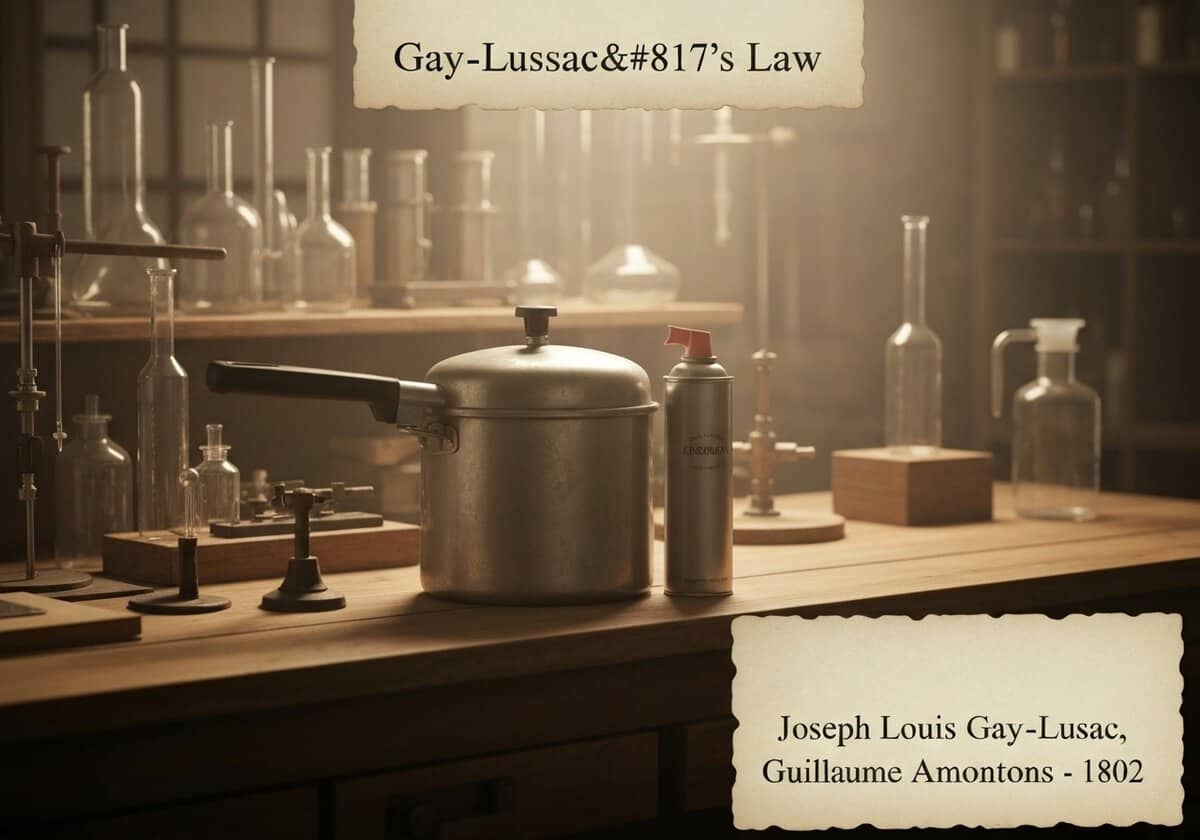
Gay-Lussac’s Law (Pressure-Temperature Law)
1802
- Joseph Louis Gay-Lussac
- Guillaume Amontons
Also known as Amontons’s law, this principle states that for a fixed mass of an ideal gas at a constant volume, its pressure is directly proportional to its absolute temperature. The relationship is expressed mathematically as \(P \propto T\) or as a comparison between two states, \(\frac{P_1}{T_1} = \frac{P_2}{T_2}\). This describes gas behavior under isochoric (constant volume) conditions.
Gay-Lussac’s Pressure-Temperature Law is a cornerstone of the ideal gas laws, describing the direct relationship between pressure and temperature for a gas confined to a constant volume. While Joseph Louis Gay-Lussac published his findings in 1802, the groundwork was laid nearly a century earlier by Guillaume Amontons, who built an ‘air thermometer’ based on this principle. However, Gay-Lussac’s more precise experiments with improved equipment provided the definitive evidence that solidified the law.
The law’s novelty was its precise, linear formulation of a relationship that was previously only qualitatively understood. A critical aspect of the law is the use of an absolute temperature scale, such as Kelvin. When temperature is measured in Celsius or Fahrenheit, the relationship is linear but not directly proportional (i.e., doubling the Celsius temperature does not double the pressure). The realization that all pressure-temperature graphs for gases extrapolate to zero pressure at the same temperature, -273.15°C, led to the concept of absolute zero and the Kelvin scale, which makes the proportionality direct and simple.
From a molecular perspective, the law is explained by the kinetic theory of gases. Heating a gas in a rigid container increases the average kinetic energy of its molecules. This means the molecules move faster and collide more frequently and more forcefully with the container’s walls. Since pressure is defined as force per unit area, these more energetic collisions result in a higher overall pressure. This law, combined with Boyle’s Law (pressure-volume) and Charles’s Law (volume-temperature), was instrumental in the formulation of the combined gas law and, ultimately, the ideal gas law (\(PV=nRT\)), which unifies the behavior of ideal gases into a single equation.
UNESCO Nomenclature: 2212
– Thermodynamics
Precursors
- Guillaume Amontons’s early work on the relationship between pressure and temperature in air thermometers
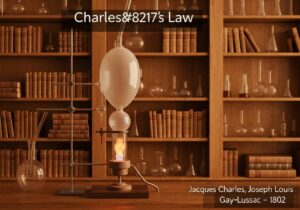
- Jacques Charles’s work on the relationship between volume and temperature (Charles’s Law)
- Robert Boyle’s work on the relationship between pressure and volume (Boyle’s Law)
- Development of accurate thermometers and manometers for pressure measurement
Applications
- pressure cookers
- aerosol spray cans
- automobile tires pressure variation with temperature
- autoclaves for sterilization
- internal combustion engines
- heating, ventilation, and air conditioning (hvac) systems
Potential Innovations Ideas
Due to scrapping bot traffic, currently more than 40k per day, this content is reserved to community members.
> Login < or > Register < (100% free) to access this, so as all other restricted content and tools.
Related to: Gay-Lussac’s law, pressure law, Amontons’ law, ideal gas, thermodynamics, constant volume, isochoric process, absolute temperature, gas laws, pressure-temperature relationship.